Datiscaceae
Datisca Family / False Hemp
Datiscaceae is a small family of flowering plants containing the single genus Datisca, with only two species. These are large, perennial, dioecious herbs resembling hemp (Cannabis), characterized by alternate, pinnately compound leaves and small, apetalous flowers borne in axillary clusters. They are notable for forming root nodules capable of nitrogen fixation with actinobacteria (Frankia) and belong to the order Cucurbitales.
Overview
The Datiscaceae family includes just one genus, Datisca, and two species with a remarkably disjunct distribution: D. cannabina occurs from the Mediterranean region eastwards to Central Asia and the Himalayas, while D. glomerata is found in California and northern Mexico. These robust perennial herbs typically grow in moist environments like riverbanks, canyon bottoms, and seepage areas.
Key features include their large size (up to 2 meters tall), hemp-like pinnately compound leaves with serrated leaflets, dioecious reproductive system (separate male and female plants) with wind-pollinated, apetalous flowers, and an inferior ovary developing into a capsule that opens at the apex. A significant biological feature is their ability to form nitrogen-fixing root nodules in symbiosis with the actinobacterium Frankia, an ability shared with only a few other lineages outside the main nitrogen-fixing clade (Fabids), including others in the Cucurbitales and Fagales orders. Phylogenetically, Datiscaceae belongs to the order Cucurbitales.
Datisca species have been used locally for dyes (yielding a yellow color) and in traditional medicine.
Quick Facts
- Scientific Name: Datiscaceae Dumort.
- Common Name: Datisca Family, False Hemp
- Number of Genera: 1 (Datisca)
- Number of Species: 2
- Distribution: Disjunct: Mediterranean to C Asia/Himalayas; California & N Mexico.
- Evolutionary Group: Angiosperms - Eudicots - Rosids - Fabids - Cucurbitales
- Habit: Large perennial herbs, dioecious, nitrogen-fixing root nodules.
Key Characteristics
Growth Form and Habit
Plants are robust, erect, perennial herbs growing up to 2 meters tall from a rhizomatous base. Stems are somewhat woody, especially near the base, and die back seasonally in temperate regions.
Leaves
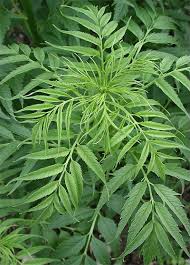
Leaves are arranged alternately along the stem. They are large and pinnately compound (odd-pinnate, sometimes appearing trifoliate near the top), strongly resembling the leaves of hemp (Cannabis sativa). Leaflets are lanceolate with coarsely serrated margins. Leaves lack stipules.
Inflorescence
Flowers are borne in dense, drooping or erect, spike-like or panicle-like clusters arising from the axils of the upper leaves and associated bracts.
Flowers
Flowers are small, inconspicuous, unisexual (plants are dioecious), and radially symmetrical (actinomorphic). They are notably apetalous (lacking petals) and adapted for wind pollination.
- Male flowers: Possess a calyx reduced to 4-9 irregular lobes or teeth. Stamens are numerous (typically 8-25, often around 12) with short filaments and relatively large anthers releasing abundant pollen. A reduced pistil (pistillode) is absent.
- Female flowers: Have a calyx tube that is fused (adnate) to the inferior ovary, topped by 3-8 small calyx lobes. The ovary is inferior, composed of 3-5 fused carpels forming a single chamber (unilocular) which is characteristically open at the apex between the styles. Ovules are numerous, borne on intrusive parietal placentas (partitions extending inwards from the ovary wall). There are 3-5 short styles, each deeply forked (bifid). Sterile stamens (staminodes) are absent.
Fruits and Seeds
The fruit is a membranous, ribbed capsule that opens distinctively at the apex, between the persistent styles. It contains numerous, very small seeds.
Roots
Roots form characteristic nodules that house nitrogen-fixing actinobacteria of the genus Frankia. This symbiosis allows the plants to thrive in nutrient-poor soils.
Chemical Characteristics
Plants contain tannins and various flavonoids, including datiscin, which yields a yellow dye.
Field Identification
Identifying Datiscaceae species relies on recognizing their distinctive vegetative habit, floral features, and habitat:
Primary Identification Features
- Large herbaceous habit resembling hemp: Tall, erect perennial herbs.
- Alternate, pinnately compound leaves: Leaves divided into leaflets arranged along a central axis.
- Serrated leaflet margins: Leaflet edges are distinctly toothed.
- Dioecious plants: Male and female flowers occur on separate individuals.
- Small, apetalous flowers in axillary clusters: Look for dense clusters of inconspicuous flowers lacking petals.
- Inferior ovary (female flowers): Ovary located below the attachment of calyx lobes.
- Capsule opening at apex: The fruit is a capsule that splits open between the styles at the top.
Secondary Identification Features
- Moist habitats: Typically found along riverbanks, streamsides, canyon bottoms, or other moist, often disturbed areas.
- Disjunct distribution: Found either in Mediterranean/Asia or California/Mexico, not overlapping.
- Nitrogen-fixing nodules: Root nodules may be present (requires careful excavation).
Seasonal Identification Tips
Identification is easiest during the growing season:
- Growing Season (Spring/Summer): The large, hemp-like compound leaves are very characteristic.
- Flowering/Fruiting Season (Summer/Fall): Dense axillary clusters of small, apetalous flowers (check for stamens vs. inferior ovary/styles) or the distinctive apically opening capsules confirm identification.
- Dormant Season: Dried, persistent stems and open capsules might remain visible.
Common Confusion Points
Distinguishing Datiscaceae from similar-looking plants:
- Cannabis sativa (Hemp/Marijuana): Also a large herb with compound leaves, but leaves are palmately compound (leaflets radiate from one point), lower leaves are often opposite, flowers are different (petal-less but structured differently), fruit is an achene, and lacks nitrogen-fixing nodules. Belongs to Cannabaceae (Rosales).
- Other large herbs with compound leaves: Families like Apiaceae or some Asteraceae might have large compound leaves, but differ significantly in flower structure (usually have petals, different ovary position), fruit type, and leaf arrangement.
- Focus on the combination: Large Herb + Alternate Pinnately Compound Leaves + Serrated Leaflets + Dioecious + Apetalous + Inferior Ovary + Apically Opening Capsule + Moist Habitat = Datiscaceae.
Field Guide Quick Reference
Look For:
- Large perennial herb (hemp-like)
- Leaves: Alternate, Pinnately Compound, Serrated
- No stipules
- Dioecious (separate male/female plants)
- Flowers: Small, Apetalous, in axillary clusters
- Male: Numerous stamens
- Female: Inferior ovary, 3-5 bifid styles
- Fruit: Capsule opening at apex
- Moist habitats
- Nitrogen-fixing root nodules
Key Variations:
- Number of leaflets varies
- Number of floral parts (calyx lobes, stamens, styles) varies slightly
- Two distinct geographic ranges
Notable Examples
The family contains only two species in the genus Datisca:

Datisca cannabina
False Hemp
The Old World species, found from the eastern Mediterranean (Crete, Turkey) eastward through the Caucasus, Iran, Central Asia to the Himalayas. A large perennial herb resembling hemp, growing in moist valleys and along streams. Source of a yellow dye.

Datisca glomerata
Durango Root
The New World species, native to California and northern Mexico. Very similar in appearance to D. cannabina, found in canyons, stream banks, and moist slopes. Also known to form nitrogen-fixing nodules.
Phylogeny and Classification
Datiscaceae is classified within the order Cucurbitales, which belongs to the Fabid clade (nitrogen-fixing clade) of the Rosids within the Eudicots. This placement is well-supported by molecular data.
Within Cucurbitales, Datiscaceae represents a small, distinct lineage. Its exact sister relationship is sometimes debated, but it is often placed near Begoniaceae or a larger clade including Begoniaceae, Cucurbitaceae, and Anisophylleaceae. The order Cucurbitales is notable for including several families capable of forming nitrogen-fixing root nodule symbioses with Frankia (Datiscaceae, Coriariaceae) or rhizobia (not present in Datiscaceae), an ability otherwise concentrated in the related orders Fagales and Rosales.
Position in Plant Phylogeny
- Kingdom: Plantae
- Clade: Angiosperms (Flowering plants)
- Clade: Eudicots
- Clade: Rosids
- Clade: Fabids
- Order: Cucurbitales
- Family: Datiscaceae
Evolutionary Significance
Datiscaceae, despite its small size, holds evolutionary interest:
- Disjunct Distribution: The wide geographic separation between the two species (Mediterranean/Asia vs. N America) points to an ancient origin and subsequent extinction or range contraction, making it a classic example for biogeographic studies.
- Nitrogen Fixation: Its ability to form root nodules with Frankia is significant as this capability is rare outside the core nitrogen-fixing clade (Fabales, Fagales, Rosales, Cucurbitales) and provides insights into the evolution of this symbiosis.
- Phylogenetic Link: Helps connect relationships within the diverse Cucurbitales order.
- Morphological Simplicity: Its reduced, apetalous flowers offer insights into floral evolution and adaptation to wind pollination.