Cunoniaceae
Cunonia Family
Cunoniaceae is a family of trees and shrubs primarily found in the Southern Hemisphere, playing a significant ecological role in temperate rainforests, montane forests, and shrublands of Australasia, South America, and Southern Africa. The family is characterized by often opposite, compound leaves with prominent stipules.
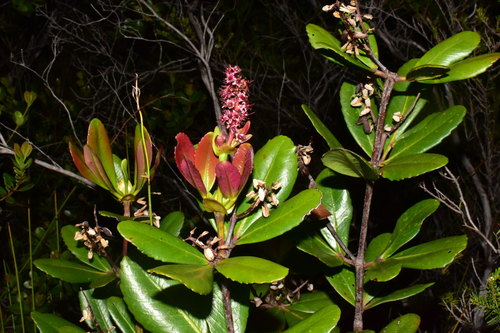
Overview
The Cunoniaceae family comprises around 27-30 genera and 300-350 species of woody plants. Its distribution pattern strongly reflects Gondwanan origins, with centers of diversity in Australia, New Caledonia, New Guinea, New Zealand, southern South America, Madagascar, and Southern Africa. Members range from small shrubs to large forest trees.
Key distinguishing features include the typically opposite, compound leaves with toothed margins and often large, conspicuous stipules (especially interpetiolar ones). The flowers are usually small and clustered, and the fruit is most commonly a capsule. The family belongs to the order Oxalidales.
Ecologically, Cunoniaceae are important components of many Southern Hemisphere ecosystems, particularly in wet forests and montane environments. Some species are valued for timber (e.g., Weinmannia, Caldcluvia), while others have horticultural significance (e.g., Ceratopetalum, Eucryphia).
Quick Facts
- Scientific Name: Cunoniaceae R.Br.
- Common Name: Cunonia Family (not widely used)
- Number of Genera: Approximately 27-30
- Number of Species: Approximately 300-350
- Distribution: Predominantly Southern Hemisphere (Australasia, South America, Southern Africa, Madagascar), few extending north.
- Evolutionary Group: Eudicots - Rosids - Fabids - Oxalidales
Key Characteristics
Growth Form and Habit
Members are predominantly trees or shrubs, ranging from small shrubs to large canopy trees. Some species can be lianas or scrambling shrubs. Most are evergreen.
Leaves
Leaves are usually arranged oppositely, though sometimes whorled or alternate. They are typically compound (pinnate, trifoliate, or sometimes reduced to a single leaflet - unifoliate), rarely simple. Leaflet margins are commonly serrated or toothed. A hallmark of the family is the presence of stipules, which are often conspicuous, frequently interpetiolar (located between the petioles of opposite leaves), sometimes fused into a single structure, occasionally large and leaf-like (e.g., Ackama), or sometimes small and falling early but leaving distinct scars.
Inflorescence
Flowers are borne in various types of inflorescences, often forming dense clusters. Common types include panicles, racemes, heads, or cymes, usually located terminally or in the upper leaf axils.
Flowers
Flowers are generally small, numerous, and radially symmetrical (actinomorphic). They are typically bisexual, although some species have unisexual flowers (plants may be dioecious or polygamous). Flowers are usually 4- or 5-merous (parts in fours or fives), but variation exists (3-10 parts).
- Calyx: 4 or 5 sepals, usually free or slightly fused at the base, typically persistent in fruit.
- Corolla: 4 or 5 petals, free, often small and inconspicuous, sometimes absent (apetalous, e.g., some Weinmannia).
- Androecium: Stamens usually number twice the sepals or petals (8 or 10), sometimes more numerous. Filaments are free, arising from a nectar disc or the rim of a hypanthium.
- Gynoecium: The ovary is usually superior (sometimes half-inferior), typically composed of 2 carpels (ranging from 2 to 5, rarely more), which can be fused or sometimes free. Each carpel usually has two or more ovules. Styles are typically free and often persist on the fruit. A nectar-producing disc is commonly present around the base of the ovary.
Fruits and Seeds
The most common fruit type is a capsule, typically small, woody or leathery, splitting open along the septa (septicidal) or locules (loculicidal). Less commonly, the fruit may be a follicle, nut, drupe, or berry. Seeds are generally small and numerous, sometimes equipped with wings or hairs to aid in wind dispersal.
Chemical Characteristics
Many species are known to be rich in tannins, contributing to their use in traditional medicine or tanning. They are also often aluminum accumulators. Saponins and iridoid compounds have been reported in some genera.
Field Identification
Identifying Cunoniaceae in the field often relies on recognizing a combination of vegetative features, especially leaf and stipule characteristics:
Primary Identification Features
- Opposite, compound leaves: Look for leaves arranged in pairs, typically divided into leaflets (pinnate or trifoliate common).
- Serrated leaflet margins: The edges of the leaflets are usually toothed.
- Conspicuous stipules or stipule scars: Check the node between the petioles for stipules (often interpetiolar, sometimes large or fused) or the scars they leave behind if they have fallen.
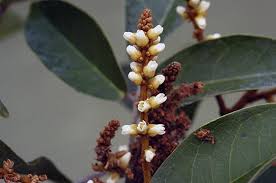
- Small flowers in dense clusters: Inflorescences are typically composed of many small, often whitish or cream-colored flowers.
- Capsular fruit (common): Look for small, often 2-parted capsules, frequently with persistent styles.
Secondary Identification Features
- Tree or shrub habit: Most members are woody plants.
- Southern Hemisphere distribution: Primarily found in specific regions of the Southern Hemisphere, often in moist forest or montane habitats.
- Tannin presence: Broken leaves or bark might have an astringent quality.
Seasonal Identification Tips
Vegetative features are useful year-round for these mostly evergreen plants:
- Year-round: Opposite leaves, compound structure, serrated margins, and especially the presence/scars of stipules are key vegetative clues.
- Flowering/Fruiting Season: Provides definitive characteristics but flowers are small. Look for dense clusters. Persistent capsules or remnants might be found outside the main fruiting season.
Common Confusion Points
Distinguishing Cunoniaceae from other families with opposite, compound leaves requires careful attention to detail:
- Sapindaceae (some genera): Some maples (Acer) have opposite, compound leaves but typically lack stipules and have distinct winged samara fruits.
- Bignoniaceae (some genera): May have opposite, compound leaves, but often have large, showy, tubular flowers and long capsule fruits with winged seeds, and usually lack stipules (or have pseudostipules).
- Oleaceae (e.g., Fraxinus - Ash): Have opposite, pinnately compound leaves but lack stipules and have distinct samara fruits. Flowers differ significantly (often reduced).
- Staphyleaceae (Bladdernut family): Opposite, trifoliate/pinnate leaves, often serrated, stipules present but small/falling early. Distinctive inflated capsule fruit.
- Focus on the combination: Opposite + Compound + Serrated + Conspicuous Stipules (especially Interpetiolar) + Small Flowers/Capsule Fruit points strongly towards Cunoniaceae.
Field Guide Quick Reference
Look For:
- Trees or shrubs
- Opposite, compound leaves (pinnate/trifoliate)
- Serrated leaflet margins
- Conspicuous interpetiolar stipules (or scars)
- Small flowers in dense clusters
- Capsular fruit (often small, 2-parted)
Key Variations:
- Leaves sometimes simple or whorled
- Stipules vary in size and fusion
- Petals present or absent
- Fruit types other than capsules occur
- Predominantly Southern Hemisphere
Notable Examples
The Cunoniaceae family includes several ecologically important and some horticulturally recognized genera:

Weinmannia
(Various common names, e.g., Kamahi)
The largest genus in the family (~150 species), widespread across the family's range (Latin America, Mascarenes, Malesia, Pacific). Trees or shrubs with often pinnate leaves, small apetalous flowers in racemes, and small capsules with hairy seeds.

Cunonia capensis
Red Alder / Butterspoon Tree
A tree native to Southern Africa, known for its pinnate leaves with large, fused, spoon-shaped interpetiolar stipules ("butterspoons") enclosing the buds. Bears dense spikes of small, cream-colored flowers.

Ceratopetalum gummiferum
NSW Christmas Bush
An iconic Australian shrub or small tree famous for its display around Christmas time. The small white flowers are followed by enlarging, persistent sepals that turn bright red, creating the main display.

Eucryphia
Leatherwood / Ulmo
A small genus with species in Tasmania (Australia) and Chile/Argentina (South America), a classic example of Gondwanan disjunction. Known for simple or pinnate leaves and relatively large, showy white flowers. E. lucida (Leatherwood) is the source of prized Tasmanian honey.
Phylogeny and Classification
Cunoniaceae is firmly placed within the order Oxalidales, part of the Fabid clade of rosid eudicots. The order Oxalidales itself contains a somewhat morphologically diverse group of families, united primarily by molecular data.
Within Oxalidales, Cunoniaceae represents a significant lineage, particularly notable for its woody habit and extensive radiation in the Southern Hemisphere. Its sister group relationships are still debated but likely involve families such as Oxalidaceae, Connaraceae, Elaeocarpaceae, Brunelliaceae, and Cephalotaceae. The family's distribution and diversity are strongly linked to the breakup of the supercontinent Gondwana.
Position in Plant Phylogeny
- Kingdom: Plantae
- Clade: Angiosperms (Flowering plants)
- Clade: Eudicots
- Clade: Rosids
- Clade: Fabids
- Order: Oxalidales
- Family: Cunoniaceae
Evolutionary Significance
Cunoniaceae holds considerable evolutionary significance:
- Gondwanan Distribution: Its predominantly Southern Hemisphere range provides compelling evidence for diversification linked to the ancient supercontinent Gondwana and subsequent continental drift.
- Ecological Dominance: Members are often key components or even dominant species in certain Southern Hemisphere forest ecosystems (e.g., Weinmannia in Andean cloud forests, Nothofagus-Cunoniaceae forests).
- Morphological Diversity: Despite core unifying features, the family shows considerable variation in leaf structure, stipule form, flower presence/absence (petals), and fruit type, offering insights into trait evolution.
- Biogeographic Studies: The family is frequently used in studies reconstructing historical biogeography and understanding diversification patterns across southern landmasses.