Cistaceae
Rock-rose Family
Cistaceae, the Rock-rose family, is a family primarily of shrubs and herbs belonging to the order Malvales. It is most diverse in the Mediterranean Basin but also occurs elsewhere in Europe, western Asia, North Africa, and North and South America. Members typically have simple, often opposite leaves, and produce showy but ephemeral flowers usually with 5 petals crumpled in bud, a distinctive calyx often of 3 large plus 2 small sepals, numerous stamens, and a superior ovary developing into a capsule. Many species are adapted to dry, sunny habitats and form ectomycorrhizal associations.
Overview
The Rock-rose family, Cistaceae, is placed within the large order Malvales, part of the Malvid clade of Rosids. It is a relatively small family comprising about 8 genera and around 200 species. The family's center of diversity is overwhelmingly the Mediterranean region, where genera like Cistus, Helianthemum, and Halimium are characteristic elements of garrigue, maquis, and other dry, sunny habitats. The family also extends into other parts of Europe, North Africa, and Western Asia, and notably has representatives in North America (genera Helianthemum, Lechea, Hudsonia) and South America.
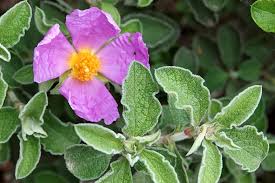
Cistaceae consists mostly of low-growing evergreen or semi-evergreen shrubs, subshrubs, and perennial herbs. They are often aromatic due to resins and volatile oils, and frequently possess specialized hairs (stellate or glandular). Key identifying features include usually opposite, simple leaves (though sometimes alternate or stipulate/exstipulate depending on genus), and especially the flowers. Flowers are typically showy, radially symmetrical, with 5 large, delicate petals that are distinctly crumpled in bud and last only a few hours. The calyx often has a characteristic structure of 3 large inner sepals and 2 smaller outer sepals. Flowers also feature numerous stamens and a superior ovary that develops into a dry capsule containing small seeds.
Many Cistaceae species are adapted to dry, nutrient-poor soils and fire-prone environments, often thriving after disturbances. They frequently form symbiotic ectomycorrhizal associations with fungi, aiding nutrient uptake. While not native to Oklahoma, some Helianthemum species occur in eastern North America, and Mediterranean Cistus species are sometimes cultivated in warmer regions for their attractive flowers.
Quick Facts
- Scientific Name: Cistaceae Juss.
- Common Name: Rock-rose family
- Number of Genera: Approximately 8
- Number of Species: Approximately 200
- Distribution: Mediterranean Basin primarily; also Europe, W Asia, N Africa, N America, S America.
- Evolutionary Group: Eudicots - Rosids (Malvids / Eurosids II) - Order Malvales
Key Characteristics
Growth Form and Habit
Mostly perennial shrubs, subshrubs (woody only at the base), or herbs. Often low-growing and branching. Stems and leaves frequently covered in simple, stellate (star-shaped), or glandular hairs, sometimes resinous and aromatic. Many species form beneficial ectomycorrhizal relationships with soil fungi.
Leaves
Leaves are typically arranged oppositely along the stem, but can be alternate (especially upper leaves) or sometimes whorled (Hudsonia). They are almost always simple with entire (smooth) margins. Leaves are often sessile or have short petioles. Stipules are present in some genera (e.g., Helianthemum) but absent in others (e.g., Cistus, Halimium).
Inflorescence
Flowers are borne solitary or, more commonly, in determinate inflorescences such as simple or compound cymes, which are sometimes raceme-like or panicle-like. Inflorescences are typically terminal or axillary.
Flowers
Flowers are usually showy, actinomorphic (radially symmetrical), and bisexual (perfect). They are typically 5-merous regarding the corolla, but the calyx structure is often distinctive.
- Calyx: Consists of usually 5 sepals (sometimes 3) which are free or slightly fused at the base and persistent in fruit. A characteristic arrangement in many genera (Cistus, Helianthemum) is having 3 large inner sepals and 2 smaller, narrower outer sepals. Sometimes the outer 2 sepals are absent (Halimium).
- Corolla: Typically composed of 5 large, free petals (sometimes 3 or absent). Petals are delicate, often brightly colored (white, yellow, pink, orange, purplish), and characteristically crumpled or wrinkled in the bud, unfolding like crepe paper. They are very ephemeral, often lasting only a few hours or a single day before falling.
- Androecium: Stamens are numerous (indefinite, >10 to many), arising from the base of the ovary, possibly associated with nectariferous tissue but without a distinct, separate nectar disk. Filaments are slender and distinct. Anthers are small, typically yellow or orange, dehiscing via longitudinal slits. In some species (Helianthemum), stamens are sensitive to touch and move outwards briefly when disturbed.
- Gynoecium: The ovary is superior, composed of 3, 5, or sometimes up to 10(-12) fused carpels. It is typically 1-locular with 3, 5, or 10 intrusive parietal placentas (where ovules attach to the ovary wall), or sometimes incompletely divided into locules corresponding to the number of carpels. Ovules are usually numerous (sometimes few per placenta), orthotropous or anatropous. There is usually a single style, which can be short or long, topped by a capitate or lobed stigma (often 3- or 5-lobed).
Fruits and Seeds
The fruit is typically a loculicidal capsule, meaning it splits open along the midribs of the carpels. The capsule opens by 3, 5, or 10 valves corresponding to the carpel number. It contains few to numerous small seeds. Seeds usually possess hard seed coats, contain starchy or oily endosperm, and have a curved or folded embryo.
Chemical Characteristics
Plants often contain resins, essential oils, tannins (including ellagitannins), and flavonoids. These contribute to their aroma, potential flammability in dry conditions, and traditional uses. Ectomycorrhizal symbiosis is ecologically significant for nutrient uptake on poor soils.
Field Identification
Cistaceae members are often recognizable by their showy but short-lived flowers combined with their typical habit and leaf arrangement, especially in their main distribution centers like the Mediterranean.
Primary Identification Features
- Habit: Shrub, subshrub, or herb, often low-growing.
- Leaves Usually Opposite and Simple: Check arrangement and leaf complexity.
- Showy Flowers with 5 Crumpled Petals: Petals look wrinkled in bud, open wide, but fall quickly. Usually white, yellow, pink/purple.
- Calyx Often 3 Large + 2 Small Sepals: Observe the relative sizes of the 5 sepals (or check if only 3 are present).
- Numerous Stamens: Many stamens surrounding the superior ovary.
- Fruit a Capsule: Dry fruit splitting open by valves.
- Habitat/Distribution: Often found in dry, sunny, open habitats. Most diverse in the Mediterranean region; specific genera in N America.
Secondary Identification Features
- Presence of stellate or glandular hairs.
- Aromatic foliage (in some Cistus).
- Stipules present or absent (varies by genus).
- Touch-sensitive stamens (in some Helianthemum).
Seasonal Identification Tips (relevant to N America / potential cultivation)
- Spring/Summer: Main flowering period. Look for the characteristic ephemeral flowers. Vegetative features (opposite leaves, habit) are also visible.
- Summer/Fall: Developing or mature capsules are present.
- Year-Round: Habit (shrub/herb) and leaf arrangement (opposite) persistent in shrubs/perennials. Check habitat preferences (dry, sunny). Lechea and Hudsonia in N America have distinct small-leaved appearances.
Common Confusion Points
- Rosaceae (e.g., Potentilla, some roses): May have 5 petals and numerous stamens, but petals are not typically crumpled in bud, a hypanthium is often present, stipules are usually prominent and persistent, calyx structure differs (often with epicalyx lobes), and fruit is usually an aggregate of achenes, drupelets, or a hip, rarely a simple capsule. Leaves often compound.
- Hypericaceae (Hypericum - St. John's Worts): Often have opposite leaves and numerous stamens, but flowers are typically yellow with 5 non-crumpled petals, often with translucent or black dots on petals/leaves, and fruit is usually a capsule or berry with different structure.
- Malvaceae (Mallows, Hibiscus): Can have showy 5-petaled flowers, but stamens are characteristically fused into a tube around the style (monadelphous), leaves are usually alternate and often palmately lobed or veined, stipules usually present, fruit typically a schizocarp or capsule.
- The combination of 5 crumpled petals, often 3+2 sepals, numerous distinct stamens, superior ovary, and capsule fruit is highly indicative of Cistaceae.
Field Guide Quick Reference
Look For:
- Shrub, subshrub, or herb habit
- Leaves simple, usually opposite
- Showy flowers, 5 crumpled petals (ephemeral)
- Calyx often 3 large + 2 small sepals
- Numerous stamens
- Ovary superior
- Fruit a capsule
- Often dry, sunny habitats
Key Variations:
- Petal color (White, Yellow, Pink, Purple)
- Sepal number (5 or 3)
- Stipules present or absent
- Leaf hairiness (stellate/glandular)
- Habit (shrub vs. herb)
Notable Examples
Cistaceae includes well-known Mediterranean "rock-roses" (Cistus), widespread "sun-roses" (Helianthemum), and distinct North American genera adapted to sandy or rocky soils.

Cistus species (e.g., C. ladanifer)
Rock-rose
A genus of about 20 species of evergreen shrubs native mainly to the Mediterranean region. Characterized by opposite leaves (often resinous/aromatic), large showy flowers (white, pink, or purplish, often with dark basal spots) with 5 crumpled petals and 5 sepals (3 large + 2 small). Lack stipules. Many species and hybrids are popular garden ornamentals. C. ladanifer yields labdanum resin.

Helianthemum species (e.g., H. nummularium)
Sun-rose, Rock Rose
The largest genus (~110 species) of herbs and subshrubs, widespread across Europe, the Mediterranean, Asia, and North & South America. Typically have opposite leaves (sometimes alternate above) and possess stipules. Flowers usually yellow (also pink, orange, white), smaller than Cistus, with 5 crumpled petals and 5 sepals (3+2). Stamens often sensitive to touch. Several species are native to North America.

Cistaceae Flower Detail
Typical Flower Structure
Cistaceae flowers are typically showy but short-lived. Key features include the 5 large petals that are distinctly crumpled in bud, the numerous stamens surrounding the superior ovary, and often a calyx composed of 3 large inner sepals and 2 smaller outer ones.

Halimium species (e.g., H. halimifolium)
Halimium
A genus of shrubs from the Mediterranean region, closely related to Cistus but differing mainly in typically having yellow flowers and usually only 3 sepals (lacking the outer small pair). Leaves are often opposite and gray-hairy. Some are cultivated ornamentally.

Lechea & Hudsonia spp.
Pinweeds & Beach Heaths
Two distinct North American genera of small herbs (Lechea) or low ericoid (heath-like) subshrubs (Hudsonia). They have small, often scale-like or linear leaves (alternate/whorled in Lechea, appressed in Hudsonia). Flowers are small, petals 3 or 5 (often falling very quickly or absent), sepals 5 (3+2). Found in dry, sandy, or rocky habitats.
Phylogeny and Classification
Cistaceae is placed within the large order Malvales, belonging to the Malvid clade of Rosids. This order includes major families like Malvaceae (Cotton, Hibiscus), Thymelaeaceae (Daphne), and Bixaceae (Annatto).
Molecular phylogenetic studies indicate that within Malvales, Cistaceae is part of the core 'malvoid' clade. Its closest relatives appear to be the families Sarcolaenaceae (endemic to Madagascar) and Dipterocarpaceae (dominant tropical timber trees of Asia). Cistaceae likely forms a sister group to the clade containing these two families. This placement highlights an interesting biogeographic pattern, linking the primarily Mediterranean Cistaceae with tropical Old World families.
Position in Plant Phylogeny
- Kingdom: Plantae
- Clade: Angiosperms (Flowering plants)
- Clade: Eudicots
- Clade: Rosids (Malvids / Eurosids II)
- Order: Malvales
- Family: Cistaceae
Evolutionary Significance
Cistaceae provides interesting evolutionary insights:
- Adaptation to Mediterranean Climates: Represents a major radiation into seasonally dry, fire-prone environments, showcasing adaptations like sclerophyllous leaves, resins, rapid flowering, and fire-stimulated germination.
- Ectomycorrhizal Symbiosis: Highlights the importance of mycorrhizal associations for nutrient acquisition in nutrient-poor soils, a trait shared with unrelated families in similar habitats.
- Floral Ephemerality: The evolution of large but very short-lived flowers is an interesting pollination strategy, perhaps maximizing pollinator attraction during brief favorable periods while conserving resources.
- Calyx Dimorphism: The common 3+2 sepal arrangement is a distinctive feature within Malvales, its developmental origin and functional significance being topics of interest.
- Biogeography: Its primary Mediterranean distribution, contrasted with related tropical families (Dipterocarpaceae, Sarcolaenaceae), offers clues about the historical diversification and movement of Malvales lineages.