Bixaceae
Annatto Family
Bixaceae is a pantropical family of shrubs, trees, and tuberous herbs, best known for containing Bixa orellana, the source of annatto dye. Under modern classifications (APG system), the family includes genera formerly placed in Cochlospermaceae and Diegodendraceae, totalling about 4 genera and 25 species. They typically feature alternate, often palmately lobed/veined leaves, large showy flowers with numerous stamens, and capsule fruits. Bixaceae belongs to the order Malvales.
Overview
The Bixaceae family, in its modern circumscription, unites a small group of tropical plants previously treated as separate families (Bixaceae sensu stricto, Cochlospermaceae, Diegodendraceae). Members range from perennial herbs growing from large underground tubers (Amoreuxia, some Cochlospermum) to shrubs and small trees (Bixa, Cochlospermum, Diegodendron). They are found across the tropics worldwide, with centers of diversity in the Americas, Africa, Asia, Australia, and Madagascar (Diegodendron only).
A common feature is often large, showy flowers, typically with 5 petals (frequently yellow) and a distinctive brush of numerous stamens. The leaves are alternate and often palmately lobed or veined. The fruit is typically a capsule that splits open to release seeds, which may be hairy or, most famously in Bixa orellana (Annatto or Achiote), covered in a bright red-orange pulp that provides the widely used natural food coloring and dye.
Phylogenetically, Bixaceae is placed within the Malvales order, related to families like Malvaceae (mallows, cotton), Cistaceae (rockroses), and Thymelaeaceae (daphnes).
Quick Facts
- Scientific Name: Bixaceae
- Common Name: Annatto Family
- Number of Genera: 4 (Amoreuxia, Bixa, Cochlospermum, Diegodendron)
- Number of Species: Approximately 25
- Distribution: Pantropical (Neotropics, Africa, Asia, Australia; Diegodendron Madagascar only).
- Evolutionary Group: Eudicots - Rosids - Malvids - Malvales
Key Characteristics
Growth Form and Habit
Variable habit: includes shrubs or small trees (Bixa, Cochlospermum, Diegodendron), and perennial herbs arising from large underground tubers or woody rootstocks (Amoreuxia, some Cochlospermum). Plants often produce colored sap or exudate (yellow, orange, red), especially noticeable in Bixa.
Leaves
Leaves are arranged alternately and are usually simple, though often palmately lobed or palmately veined (Bixa leaves are entire but palmately veined). Margins can be entire or toothed. Stipules are typically present but usually small and falling early (caducous). Glands may be present on petioles or leaf bases.
Flowers
Flowers are generally large and showy, usually bisexual, and radially symmetrical (actinomorphic) or nearly so. They are borne in terminal or axillary panicles or racemes.
- Sepals: Typically 4 or 5 (rarely 3), separate, and often falling off early as the flower opens (caducous), especially prominent in Cochlospermum.
- Petals: Typically 5, separate, often large and crumpled in bud. Petal color is frequently bright yellow, but can be pink or white (Bixa).
- Stamens: Distinctively numerous (many, >15 to hundreds), with filaments usually free or only slightly fused at the base. Anthers typically open via pores or short apical slits (sometimes horseshoe-shaped), though Diegodendron has longitudinal slits.
- Ovary: Superior, composed of 2-5 fused carpels. Usually forms a single locule with parietal placentation (Bixa, Cochlospermum, Amoreuxia), or rarely 3-5 locules (Diegodendron). Ovules are usually numerous. A single style tops the ovary, ending in a simple or lobed stigma.
Fruits and Seeds
The fruit is typically a capsule that dehisces (splits open) loculicidally or septicidally by 2 to 5 valves. The capsule shape varies (ovoid, globose, pear-shaped) and the surface can be smooth (Cochlospermum) or covered in soft spines or bristles (Bixa).
Seeds are usually numerous. They are often kidney-shaped or coiled and may be covered in hairs (e.g., cottony hairs in Cochlospermum) or embedded in pulp. Famously, the seeds of Bixa orellana are covered in a fleshy, bright red-orange pulp (aril), which is the source of annatto pigment. Seeds contain oily endosperm.
Chemical Characteristics
The most notable chemical feature is the production of carotenoid pigments, particularly bixin and norbixin, in the seed coat pulp of Bixa orellana. These provide the intense red-orange color of annatto. Some species produce colored sap (yellow/orange). Mucilage channels can also be present in tissues.
Field Identification
Identifying Bixaceae involves recognizing the combination of habit, leaf type, showy flowers with numerous stamens, and characteristic capsules/seeds:
Primary Identification Features
- Habit: Shrub, small tree, or perennial herb from tubers/rootstocks.
- Leaves: Alternate, simple, often palmately lobed or veined.
- Flowers: Large, showy, radially symmetric, usually with 5 petals (often yellow, pink, or white) and numerous free stamens.
- Fruit: A capsule, sometimes spiny (Bixa), splitting into 2-5 valves.
- Seeds: Often distinctive - either hairy (Cochlospermum) or covered in bright red-orange pulp (Bixa).
Secondary Identification Features
- Sepals: Often fall off early (caducous) as the flower opens.
- Ovary: Superior, usually 1-loculed with parietal placentation.
- Sap: Colored sap (yellow/orange/red) sometimes present.
- Stipules: Present but usually small and caducous.
- Distribution: Found in tropical or subtropical regions.
Seasonal Identification Tips
- Flowering Season: The large, showy flowers are conspicuous during their blooming period.
- Fruiting Season: The capsule fruits, especially the spiny red capsules of Bixa or the smooth capsules of Cochlospermum, are key identifiers when present.
- Vegetative Season: Alternate, palmately veined/lobed leaves and habit (shrub, tree, or emerging herb) are useful. Check for colored sap if damaged.
Common Confusion Points
- Malvaceae (Mallow Family): Some Malvaceae (like Hibiscus) have large, showy flowers with numerous stamens, but the stamens are distinctively fused into a tube (staminal column) surrounding the style (monadelphous), unlike the free stamens of Bixaceae. Fruit types also differ (often schizocarps or capsules without hairy/pulpy seeds in Malvaceae).
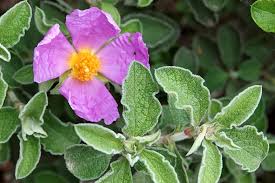
- Cistaceae (Rockrose Family): Also in Malvales, often have flowers with numerous stamens and capsule fruits, but they are typically shrubs or herbs of Mediterranean/temperate climates with simple, often opposite leaves and different seed characteristics.
- Other families with showy flowers/capsules: Distinguish Bixaceae by the combination of alternate, palmately veined/lobed leaves, numerous free stamens, caducous sepals (often), superior ovary, capsule fruit, and specialized seeds (hairy or pulpy).
Field Guide Quick Reference
Look For:
- Shrub, tree, or tuberous herb
- Alternate, simple leaves (often palmately lobed/veined)
- Showy flowers, 5 petals (yellow/pink/white)
- Numerous free stamens
- Superior ovary
- Capsule fruit (sometimes spiny)
- Seeds hairy or with red/orange pulp (Bixa)
Key Variations:
- Habit (tree vs. herb from tuber)
- Leaf shape (entire vs. lobed)
- Flower color
- Capsule surface (spiny vs. smooth)
- Seed covering (pulp vs. hairs)
Notable Examples
The family includes the economically important source of annatto dye, as well as ornamentals and tuberous herbs.

Bixa orellana
Annatto, Achiote, Lipstick Tree
A shrub or small tree native to tropical America, now cultivated pantropically. Known for its pink or white flowers and distinctive spiny, reddish capsules containing seeds covered in a bright red-orange pulp. This pulp yields annatto, a widely used natural food coloring (e.g., for cheese, butter) and dye.

Cochlospermum vitifolium
Buttercup Tree, Silk-cotton Tree, Mountain Cotton
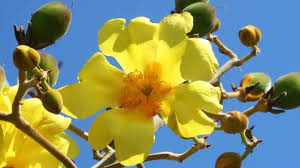
A deciduous shrub or small tree native to tropical America, often planted as an ornamental for its large, bright yellow, poppy-like flowers that appear before or with the leaves. Leaves are palmately lobed. The fruit is a smooth capsule containing seeds covered in silky hairs (hence 'silk-cotton').

Amoreuxia palmatifida
Mexican Poppy, Saíya
A perennial herb native to Mexico and the southwestern US, growing from a large tuberous root. It has palmately lobed leaves and large, showy yellow or orange flowers. The capsule fruit is ribbed. The tuber is edible and has traditional uses.
Phylogeny and Classification
Bixaceae is placed within the order Malvales, a large group within the Malvid clade of Rosid eudicots. The modern circumscription of Bixaceae, based heavily on molecular phylogenetic evidence, includes genera that were previously recognized in separate families: Cochlospermaceae (containing Cochlospermum and Amoreuxia) and the monotypic Diegodendraceae (Diegodendron from Madagascar).
Within Malvales, Bixaceae belongs to the core Malvales group and appears closely related to families like Malvaceae (mallows, cotton, hibiscus), Cistaceae (rockroses), and Thymelaeaceae (daphnes). The unification of Bixa, Cochlospermum, Amoreuxia, and Diegodendron into a single family reflects deeper evolutionary connections revealed by DNA data, despite some morphological differences.
Position in Plant Phylogeny
- Kingdom: Plantae
- Clade: Angiosperms (Flowering plants)
- Clade: Eudicots
- Clade: Rosids
- Clade: Malvids
- Order: Malvales
- Family: Bixaceae
Evolutionary Significance
Bixaceae, in its expanded sense, is significant for several evolutionary themes:
- Phylogenetic Reclassification: Serves as a good example of how molecular data can reshape understanding of family boundaries, uniting morphologically somewhat disparate genera based on shared ancestry.
- Habit Diversity: Shows considerable variation in growth form within a relatively small family, from trees to tuberous geophytes, reflecting adaptation to different tropical environments.
- Biogeography: The pantropical distribution of the combined family, with endemic elements like Diegodendron in Madagascar, points to complex histories involving ancient connections and dispersal events.
- Economic Botany: Bixa orellana is a classic example of a plant utilized for natural pigments for millennia, highlighting human interaction with plant biodiversity.
- Floral Evolution: The showy flowers with numerous stamens are characteristic features within Malvales, representing adaptations for attracting pollinators.