Anisophylleaceae
Anisophyllea Family
Anisophylleaceae is a small family of trees and shrubs belonging to the order Cucurbitales. Found in tropical rainforests across South America, Africa, and Asia, they are often characterized by anisophylly – having leaves of different sizes arranged in distinct ranks along branches. The family includes four genera, with Anisophyllea being the largest and most widespread.
Overview
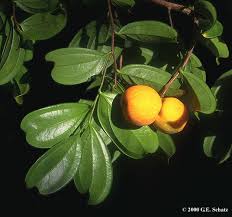
Anisophylleaceae is a small family comprising 4 genera (Anisophyllea, Combretocarpus, Poga, Polygonanthus) and about 35-40 species. These evergreen trees and shrubs have a pantropical but markedly disjunct distribution: Anisophyllea occurs in tropical America, Africa, and Asia; Combretocarpus in Southeast Asia; Poga in West Africa; and Polygonanthus in the Amazon basin. They typically inhabit tropical lowland and montane rainforests, sometimes in swampy areas or on nutrient-poor soils.
A notable feature of many species, particularly in the genus Anisophyllea, is anisophylly on horizontal (plagiotropic) branches. This involves having ranks of small leaves and ranks of larger leaves arranged distinctly along the stem, often appearing two-ranked (distichous). The flowers are generally small, often unisexual, with parts typically in 3s or 4s, and borne in relatively inconspicuous clusters in leaf axils or on older wood. The ovary is inferior, developing into a drupe or, in Combretocarpus, a winged samara.
Economically, the family is of minor importance. Poga oleosa seeds yield an edible oil in West Africa. Timber from some Anisophyllea species may be used locally. The main significance of the family is botanical, representing an early-diverging lineage within the order Cucurbitales and exhibiting interesting morphological features like anisophylly.
Quick Facts
- Scientific Name: Anisophylleaceae
- Common Name: Anisophyllea family (no widely used common name)
- Number of Genera: 4
- Number of Species: Approximately 35-40
- Distribution: Pantropical, disjunct (Tropical America, Africa, SE Asia)
- Evolutionary Group: Eudicots - Rosids - Cucurbitales
- Current Date: March 29, 2025
Key Characteristics
Growth Form and Habit
Evergreen trees and shrubs, inhabiting tropical rainforests.
Leaves
Leaves are alternate, simple, entire-margined, and often leathery (coriaceous). A distinctive feature in many species is anisophylly, especially on horizontal branches, where leaves of markedly different sizes are arranged in different ranks (often appearing as two rows of large leaves and two rows of much smaller leaves). Petioles are usually short. Stipules are small and caducous (falling early) or absent.
Inflorescence
Inflorescences are typically small axillary spikes, racemes, or cymes, often borne below the leaves on older stems (ramiflory/cauliflory) or in the axils of current leaves. Flowers are numerous but small.
Flowers
Flowers are small, actinomorphic (radially symmetrical), and usually unisexual (plants monoecious or dioecious). Floral parts are typically in 3s or 4s (sometimes 5s).
- Calyx: 3-4(-5) sepals, distinct or basally fused, persistent on the fruit.
- Corolla: 3-4(-5) petals, distinct, often smaller than the sepals, sometimes deeply lobed, cleft, or fringed. Petals are sometimes absent.
- Androecium: Stamens usually 6 or 8 (twice the number of sepals/petals), typically arranged in two whorls. Filaments distinct. Anthers small, basifixed. Staminodes may be present in female flowers.
- Gynoecium: Ovary is inferior (or possibly half-inferior), composed of 3-4 fused carpels forming 3-4 locules. Placentation is axile or apical-axile, with typically 1 (sometimes 2) pendulous ovule per locule. Styles are 3-4, distinct and short, often recurved. A pistillode is often present in male flowers.
Fruits and Seeds
The fruit is usually a drupe (fleshy with 1-4 hard stones/pyrenes), crowned by the persistent calyx lobes. In the genus Combretocarpus, the fruit is a dry, winged samara.
Seeds are typically 1-4 per fruit, depending on how many ovules develop. They contain a large embryo and little or no endosperm.
Chemical Characteristics
The family contains tannins and ellagic acid. Accumulation of aluminum has been reported in some species. They lack the cucurbitacins found in the related Cucurbitaceae.
Field Identification
Identifying Anisophylleaceae involves recognizing their tree/shrub habit, characteristic leaf arrangement (anisophylly), small flowers with inferior ovaries, and fruit type within their specific tropical forest habitats:
Primary Identification Features
- Habit and Location: Trees or shrubs in pantropical rainforests (America, Africa, Asia).
- Anisophylly (Often Present): Distinct difference in leaf size and arrangement on horizontal branches (e.g., two ranks of large leaves, two ranks of small leaves).
- Alternate, Simple, Entire Leaves: Leaves usually leathery.
- Small Flowers (3-4(-5) parts): Inconspicuous flowers in axillary or ramiflorous clusters.
- Inferior Ovary: Ovary positioned below the sepals and petals (which are often small, lobed/fringed, or absent).
- Fruit a Drupe or Samara: Fleshy drupe (most genera) or winged samara (Combretocarpus), crowned by persistent sepals.
- Stamens Double Sepal/Petal Number (Usually): Typically 6 or 8 stamens.
Secondary Identification Features
- Unisexual Flowers Common: Plants often monoecious or dioecious.
- Absence of Stipules (or minute/caducous).
- Leathery Leaf Texture.
Seasonal Identification Tips
- Year-round: The evergreen tree/shrub habit and particularly the presence of anisophylly (if developed) are key vegetative features.
- Flowering Season: Variable in tropics. Flowers are small and may require close inspection to determine parts and ovary position.
- Fruiting Season: Variable. Look for the developing drupes or samaras, often identifiable by the persistent calyx lobes at the apex.
Common Confusion Points
Anisophylly, when present, is quite distinctive. Other potential confusion points relate to general features:
- Rhizophoraceae (Mangrove family): Some inland members are trees/shrubs with simple, often opposite (sometimes alternate) leathery leaves. Flowers have a superior or inferior ovary, often 4-5 merous, and fruit is typically a berry or capsule, often viviparous in mangrove species. Lack marked anisophylly.
- Other families in Cucurbitales: While related, Cucurbitaceae are typically vines with tendrils and very different flowers/fruits (pepos). Begoniaceae are mostly herbs with asymmetric leaves. Datiscaceae are herbs/trees with pinnately compound leaves.
- Families with Inferior Ovaries and Drupes: Several unrelated families have this combination (e.g., Cornaceae, some Rubiaceae), but they differ significantly in leaf arrangement (often opposite), presence of stipules (Rubiaceae), flower structure (often 4-5 merous with distinct petals), stamen number, etc.
- Families with Ramiflory/Cauliflory: This feature occurs sporadically across many tropical families (e.g., Fabaceae, Annonaceae, Lauraceae), but these differ greatly in other vegetative and floral characteristics.
Focus on the combination of anisophylly (if present), alternate simple entire leathery leaves, small 3-4(-5) merous flowers with an inferior ovary, and fruit type (drupe/samara) in a tropical tree/shrub.
Field Guide Quick Reference
Look For:
- Trees/shrubs (Pantropical rainforests)
- Anisophylly (often distinct leaf sizes/ranks)
- Alternate, simple, entire, leathery leaves
- Small flowers (3-4(-5) parts)
- Flowers often unisexual, in axillary/ramiflorous clusters
- Inferior ovary (3-4 carpels)
- Fruit a drupe or samara
- Stamens 2x sepal/petal number (usually 6 or 8)
Key Variations:
- Anisophylly: Present vs. Absent/Indistinct
- Flower parts: 3 vs 4 (vs 5)
- Petals: Present (often lobed/fringed) vs. Absent
- Fruit: Drupe vs. Samara (Combretocarpus)
- Plant sexuality: Monoecious vs. Dioecious
Notable Examples
The family consists of four distinct genera found across the tropics:

Anisophyllea sp.
(Genus Anisophyllea)
The largest genus, with species distributed across tropical America, Africa, and Asia. They are trees or shrubs often exhibiting marked anisophylly on horizontal branches. Flowers are small, 3-4 merous, typically unisexual, borne in axillary clusters. Fruit is usually a drupe.

Combretocarpus rotundatus
(Wing-fruited Anisophyllea relative)
A tree found in peat swamp forests of Borneo and surrounding regions (Malesia). This genus is distinct within the family for having a dry, winged fruit (samara) adapted for wind dispersal, rather than a fleshy drupe. Leaves are alternate, simple, and leathery.

Poga oleosa
(African Oil Seed Tree)
A large tree native to tropical West Africa. It is notable for its seeds which yield an edible oil ('Poga oil' or 'Ovoga oil'). It has large, simple, alternate leaves and produces drupaceous fruits containing the oil-rich seeds.

Polygonanthus sp.
(Amazonian Genus)
A genus of small trees endemic to the Amazon basin in South America. They share the family characteristics of alternate simple leaves and small flowers with an inferior ovary, contributing to the Neotropical component of the family's disjunct distribution.
Phylogeny and Classification
Anisophylleaceae is placed in the order Cucurbitales, which belongs to the fabid lineage (eurosids I) of rosid eudicots. This order includes familiar families like Cucurbitaceae (gourds, melons, cucumbers) and Begoniaceae (begonias), as well as several smaller families, many with restricted distributions.
Molecular phylogenetic studies consistently place Anisophylleaceae as one of the earliest diverging lineages within the Cucurbitales. It is often resolved as the sister group to all other families in the order combined. This basal position suggests that Anisophylleaceae retains some ancestral features for the order, while other families like Cucurbitaceae and Begoniaceae represent more derived radiations. Its inclusion in Cucurbitales was initially surprising based on morphology alone but is strongly supported by molecular data.
Position in Plant Phylogeny
- Kingdom: Plantae
- Clade: Angiosperms (Flowering plants)
- Clade: Eudicots
- Clade: Rosids
- Clade: Fabids (Eurosids I)
- Order: Cucurbitales
- Family: Anisophylleaceae
Evolutionary Significance
Anisophylleaceae offers important evolutionary perspectives:
- Basal Cucurbitales Lineage: Its position as potentially sister to the rest of the order makes it crucial for understanding the ancestral traits and early evolution of the Cucurbitales, including the origins of features like tendrils (Cucurbitaceae) or extreme asymmetry (Begoniaceae).
- Anisophylly: Provides striking examples of the developmental phenomenon of producing differently sized leaves on the same plant, likely an adaptation related to light capture and branch architecture in the forest understory.
- Biogeography: The pantropical disjunct distribution across America, Africa, and Asia points to an ancient origin, likely Gondwanan, with subsequent fragmentation and diversification across continents.
- Morphological Puzzle: Its inclusion within Cucurbitales, despite lacking the obvious tendrils of gourds or asymmetric leaves of begonias, highlights the power of molecular data in revealing deep evolutionary relationships sometimes obscured by divergent morphology.