Bryaceae
Bryum Moss Family / Thread Moss Family
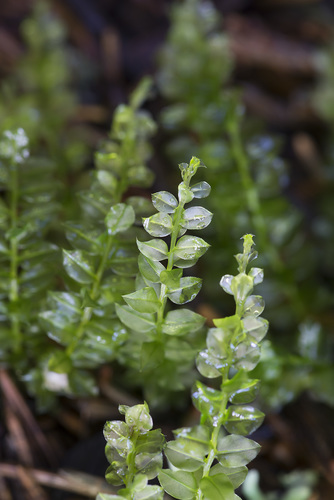
Bryaceae is a large, diverse, and cosmopolitan family of primarily acrocarpous mosses (sporophytes terminal on stems). These mosses typically form tufts or cushions and are ubiquitous in many habitats, especially on soil and rock. Key identifying features often include ovate-lanceolate leaves, frequently with a distinct leaf border, a strong costa, relatively large smooth leaf cells, and characteristically pendulous (nodding or hanging), often pyriform (pear-shaped) capsules borne on long setae.
Overview
The Bryaceae family is one of the largest moss families, containing around 15 genera and perhaps 800 species worldwide, with the genus Bryum itself being notoriously large and taxonomically complex. Bryaceae are found in virtually all terrestrial ecosystems, from polar regions to the tropics, and from sea level to high alpine zones. They are particularly common as pioneers on disturbed soil, bare ground, rock crevices, walls, paths, and waste places, but also occur in woodlands, grasslands, and tundra.
These mosses typically grow as erect stems forming tufts or cushions, though some species grow as scattered individuals. Many species are readily recognizable in the field when fertile due to their characteristic sporophytes: long stalks (setae) bearing nodding or hanging capsules that are often distinctly pear-shaped. The leaves are also helpful, often having a noticeable border of different cells along the margin, visible with a hand lens. Asexual reproduction via specialized bulbils or gemmae is common in some genera like Pohlia and some Bryum species.
Ecologically, Bryaceae are important primary colonizers, contributing to soil formation and stabilization. Some species, like Bryum argenteum, are well-adapted to urban environments and pollution. Phylogenetically, Bryaceae is the type family for the order Bryales, a major order within the class Bryopsida.
Quick Facts
- Scientific Name: Bryaceae
- Common Name: Bryum Moss Family, Thread Moss Family
- Number of Genera: Approximately 15
- Number of Species: Approximately 800
- Distribution: Cosmopolitan, in a vast range of habitats, especially soil and rock.
- Evolutionary Group: Bryophytes - Mosses (Class: Bryopsida, Order: Bryales)
Key Characteristics
Growth Form and Habit
Bryaceae are primarily acrocarpous mosses, forming tufts, cushions, or sometimes growing as scattered stems. Size varies from small to medium.
Stems
Stems are erect, usually simple or forked, often with rhizoids clustered at the base.
Leaves
Leaves are highly variable in shape but commonly ovate, lanceolate, or oblong-lanceolate, often concave, and typically larger and more crowded towards the stem apex (comal tuft). The apex is usually acute or acuminate. A distinctive feature in many species, especially in Bryum, is a leaf border composed of one or more rows of narrow, elongated, often thick-walled cells, contrasting with the main leaf cells. The costa (midrib) is single and typically strong, usually ending near the apex or extending beyond it (excurrent). Leaf cells are generally relatively large, smooth, thin-walled (parenchymatous), and often rhomboidal or hexagonal in the upper part, becoming more rectangular towards the base. Leaves are typically not plicate or strongly papillose.
Asexual Reproduction
Asexual reproduction is common in some groups via specialized structures like axillary bulbils (small bud-like structures in leaf axils, common in Pohlia), rhizoidal tubers or gemmae, or sometimes deciduous leaves or branchlets.
Sporophytes (Reproductive Structures)
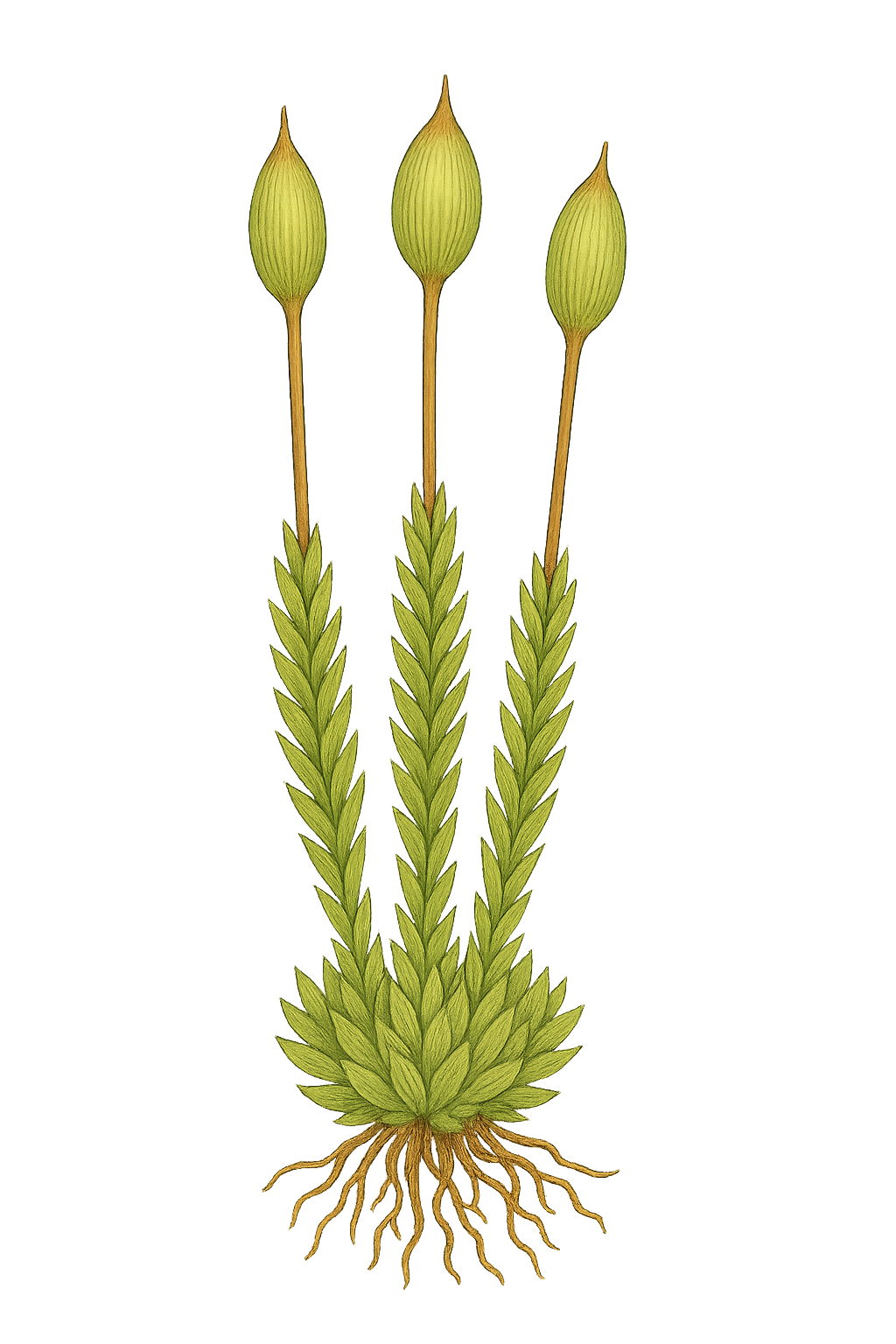
Sporophytes are terminal on main stems. The capsule is elevated on a long, typically smooth seta. The capsule is highly characteristic: typically pyriform (pear-shaped) to clavate (club-shaped), usually symmetric, and distinctly pendulous (nodding or hanging downwards) due to a curve in the seta just below the capsule (at the neck/apophysis). The capsule wall is smooth. The peristome is double (diplolepidous) and typically complex and well-developed (the 'Bryoid' type), with 16 outer teeth and 16 inner segments usually bearing well-developed cilia. The operculum (lid) is usually small, conic or mammillate (with a small central bump).
Habitat
Extremely varied. Very common on disturbed or bare soil, soil banks, paths, walls, roofs, rock crevices (acidic or calcareous), rotting wood, tree bases, grasslands, tundra, and occasionally in wetter habitats. Many species are pioneers.
Field Identification
Identifying Bryaceae often relies on recognizing the acrocarpous habit combined with leaf features (especially the border) and the highly characteristic pendulous, pear-shaped capsules.
Primary Identification Features
- Growth Habit: Acrocarpous, forming tufts or cushions, often on soil or rock.
- Capsule (Key Feature): Look for capsules borne on long setae that are distinctly pendulous (nodding/hanging) and typically pyriform (pear-shaped).
- Leaf Border: Many common species (esp. Bryum) have a visible border of narrow cells along the leaf margin (use hand lens).
- Costa: Single and strong, often reaching near or beyond the leaf tip.
- Habitat: Very broad range, frequently found in disturbed areas, soil, rocks, walls.
Secondary Identification Features
- Leaf Cells (Microscopic): Relatively large, smooth, rhomboidal/hexagonal upper cells.
- Asexual Propagules: Look for bulbils in leaf axils (esp. Pohlia) or other gemmae.
- Operculum: Small, conic or mammillate.
Seasonal Identification Tips
- Year-round: The gametophyte tufts are visible year-round. Leaf borders can be checked anytime.
- Sporophyte Timing: Sporophytes are very common in many species and can be found throughout much of the year, though maturation often peaks in spring or summer. The pendulous capsule shape is distinctive even when immature or old.
Common Confusion Points
Bryaceae can be confused with other acrocarpous families:
- Mniaceae: Also in Bryales, often have broad leaves with strong borders, but capsules are typically less strongly pendulous and less distinctly pyriform. Plants often larger.
- Funariaceae: Often on soil, but capsules are frequently asymmetric, peristome differs, and leaf cells are typically larger and laxer without distinct borders.
- Pottiaceae: Common on soil/rock, but leaves often have papillose cells, capsules are usually erect or inclined (not pendulous), peristome differs greatly.
- Ditrichaceae / Dicranaceae: Leaves often narrower (subulate), cells different shape, capsules usually erect or inclined, peristome differs.
The combination of acrocarpous habit, often bordered leaves, and pendulous, pyriform capsules on long setae is highly characteristic of Bryaceae.
Field Guide Quick Reference
Look For:
- Acrocarpous tufts/cushions
- Leaves often with visible border
- Costa single, strong
- Capsule on long seta
- Capsule pendulous (nodding/hanging)
- Capsule often pyriform (pear-shaped)
- Habitat: Soil, rock, walls, disturbed areas
Key Variations:
- Leaf shape (ovate to lanceolate)
- Presence/absence of leaf border
- Presence/absence of asexual propagules
- Plant color (green, reddish, silvery)
Notable Examples
This large family includes many very common and widespread mosses:

Bryum argenteum
Silvery Bryum / Silver-moss
An extremely common cosmopolitan moss, especially in urban areas, paths, pavement cracks, roofs, and disturbed soil. Forms dense, low cushions that appear distinctively whitish or silvery when dry due to large, hyaline upper leaf cells. Capsules are reddish, pendulous.

Bryum capillare
Capillary Thread-moss
Very common on walls, rocks, tree bases, and soil. Forms green to reddish-brown tufts. Leaves are typically broad, obovate with a distinct border, and strongly twisted around the stem when dry. Costa often excurrent. Capsules pendulous, pyriform.

Pohlia nutans
Nodding Thread-moss
Common and widespread, often on acidic soil, peat, rotting wood, or disturbed ground. Forms loose green tufts. Leaves lanceolate, typically without a distinct border. Capsules pendulous, pyriform to oblong, often light brown. Axillary bulbils sometimes present (but often absent).

Leptobryum pyriforme
Golden Thread-moss
A distinctive moss with very long, narrow, flexuose upper leaves forming a comal tuft. Common as a weed in greenhouses, on burnt ground, and disturbed soil. Forms pale green or yellowish patches. Capsules distinctly pyriform, pendulous on very long, slender setae.
Phylogeny and Classification
Bryaceae is the type family of the order Bryales, one of the major orders within the subclass Bryidae and the class Bryopsida. The family traditionally included a vast number of species, particularly within the genus Bryum. Modern molecular studies have led to significant rearrangements, with some groups formerly in Bryaceae now recognized as separate families (e.g., Mniaceae was once included) and large genera like Bryum being split into smaller, more natural genera (e.g., Rosulabryum, Ptychostomum).
Despite taxonomic changes, Bryaceae remains a large and central family within the Bryales. The order Bryales itself is characterized by acrocarpous habit, often large leaf cells, and typically well-developed double peristomes of the 'Bryoid' type. Bryaceae represents a major radiation within this order, adapting to a huge variety of ecological niches worldwide.
Position in Plant Phylogeny
- Kingdom: Plantae
- Division: Bryophyta (Mosses)
- Class: Bryopsida
- Subclass: Bryidae
- Order: Bryales
- Family: Bryaceae
Evolutionary Significance
Bryaceae is significant for several evolutionary reasons:
- Core Bryales Lineage: Represents a major component of one of the largest and most diverse orders of acrocarpous mosses.
- Ecological Radiation: Demonstrates incredible adaptability, colonizing nearly all terrestrial environments.
- Peristome Evolution: Exhibits the complex and highly functional 'Bryoid' double peristome, considered advanced within mosses.
- Taxonomic Challenges: The historical complexity of genera like Bryum highlights challenges in species delimitation and classification based solely on morphology.
- Pioneer Species: Many species play crucial roles as early colonizers of disturbed habitats.