Posidoniaceae
Neptune Grass Family / Strap-weed Family
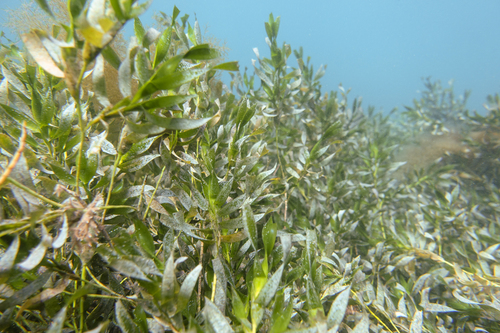
The Posidoniaceae family comprises a single genus, Posidonia, commonly known as Neptune grass or strap-weed. These are marine flowering plants (seagrasses) that form extensive underwater meadows in the coastal waters of the Mediterranean Sea and southern Australia. They play a crucial role as ecosystem engineers in these marine environments.
Overview
Posidoniaceae is a small but ecologically vital family of marine angiosperms, belonging to the order Alismatales. Unlike terrestrial plants, these seagrasses complete their entire life cycle submerged in saltwater. The family contains only one genus, Posidonia, with species endemic to either the Mediterranean Sea or the temperate and subtropical coasts of Australia.
Posidonia meadows are among the most productive ecosystems on Earth, providing critical habitat, food sources, and nursery grounds for a diverse array of marine life, including fish, invertebrates, and sea turtles. They also play a significant role in coastal protection by stabilizing sediments and buffering wave energy, and contribute substantially to carbon sequestration, earning them the nickname "lungs of the Mediterranean" for P. oceanica.
These long-lived, slow-growing plants face threats from coastal development, pollution, trawling, and climate change. Their conservation is essential for maintaining the health and biodiversity of coastal marine ecosystems. The unique adaptations of Posidoniaceae to a fully marine existence make them a fascinating subject of study in plant evolution.
Quick Facts
- Scientific Name: Posidoniaceae
- Common Name: Neptune Grass Family, Strap-weed Family
- Number of Genera: 1 (Posidonia)
- Number of Species: Approximately 9
- Distribution: Coastal waters of the Mediterranean Sea and southern Australia
- Evolutionary Group: Monocots - Alismatales
Key Characteristics
Growth Form and Habit
Plants are perennial, rhizomatous, marine herbs. They possess robust, creeping rhizomes (horizontal underground stems) that anchor the plant in sandy or muddy substrates and allow for vegetative spread, forming extensive underwater meadows. Rhizomes can be thick and slow-growing, accumulating peat-like deposits over centuries (e.g., P. oceanica).
Leaves
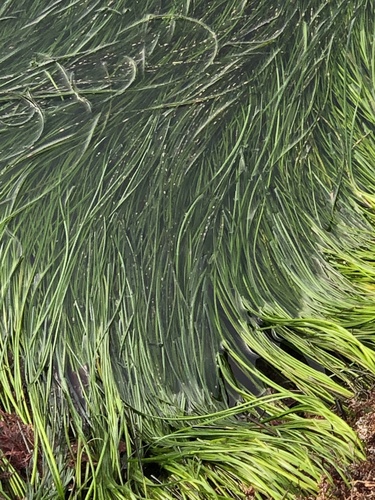
Leaves are strap-shaped (linear), long, and ribbon-like, arising in clusters (shoots) from the vertical parts of the rhizome system. They have sheathing bases that wrap around the stem and often persist after the blade decays. A small flap of tissue called a ligule is typically present at the junction of the sheath and blade. Leaves contain air channels (aerenchyma) for buoyancy and gas exchange, and numerous tannin cells, which may deter herbivores.
Inflorescence
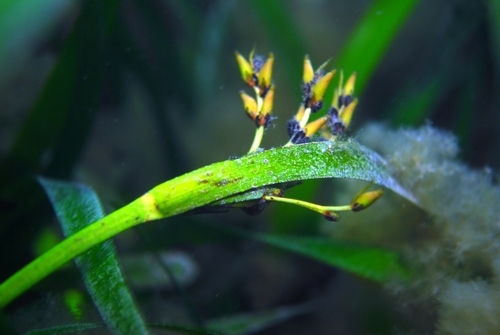
The inflorescence is a terminal or axillary spike or raceme, often borne on a flattened stalk (peduncle) that arises from the rhizome. The structure is relatively simple and inconspicuous compared to terrestrial flowering plants. Flowers are arranged along the floral axis, subtended by bracts.
Flowers
Flowers are small, greenish, and adapted for hydrophilous (water) pollination. They lack a showy perianth (petals and sepals are absent or reduced to tiny scales). Flowers can be hermaphrodite (bisexual) or unisexual (male or female), depending on the species and sometimes position within the inflorescence.
- Perianth: Absent or scale-like.
- Androecium: Typically 3 stamens with sessile (stalkless) anthers that release filamentous pollen into the water.
- Gynoecium: Superior ovary composed of a single carpel containing a single ovule. The stigma is often branched or feathery to capture water-borne pollen.
Fruits and Seeds
The fruit is a unique, fleshy, buoyant, drupe-like structure (though technically an achene with a fleshy pericarp) that detaches from the parent plant and floats, facilitating dispersal by water currents. The fruit contains a single seed that lacks endosperm; the embryo is well-developed and nourished by the cotyledon. Germination often occurs while the fruit is still floating or after it settles.
Chemical Characteristics
Posidoniaceae species are characterized by high concentrations of phenolic compounds, particularly tannins, in their tissues. These compounds likely play roles in defense against herbivores and pathogens, and contribute to the slow decomposition rates of Posidonia litter. They are adapted to survive in saline marine environments.
Field Identification
Identifying Posidoniaceae primarily involves recognizing it as a seagrass within its specific marine habitat. Key features distinguish it from other seagrasses and seaweeds:
Primary Identification Features
- Habitat: Exclusively marine, forming meadows in coastal waters (Mediterranean or Australia).
- Rhizomes: Presence of distinct, often robust, creeping rhizomes anchoring the plant in sediment.
- Leaves: Long, strap-shaped (ribbon-like) leaves arising in clusters from the rhizome. Leaf width varies by species but generally broader than many other seagrasses like Zostera.
- Fruits: Look for the distinctive buoyant, fleshy, grape-like fruits floating in the water or washed ashore (seasonal).
Secondary Identification Features
- Leaf Sheaths: Examine the persistent fibrous sheaths at the base of leaf clusters.
- Ligule: Presence of a ligule at the sheath/blade junction (may require close examination).
- Rhizome Structure: Thickness and growth pattern (horizontal vs. vertical growth) can vary. P. oceanica forms significant vertical rhizome structures ('mattes').
- Fibrous Balls (Egagropili): Decaying leaf fibers often form dense balls rolled by wave action, commonly found washed ashore near Posidonia meadows (especially P. australis).
Seasonal Identification Tips
- Year-round: Meadows and strap-like leaves are present throughout the year.
- Spring/Summer: Flowering occurs, but flowers are inconspicuous and rarely observed without targeted searching.
- Summer/Autumn: Fruits develop and are released, becoming visible floating or washed ashore.
- All Seasons: Shed leaves and fibrous egagropili can be found on beaches adjacent to meadows.
Common Confusion Points
- Other Seagrasses:
- Zosteraceae (Zostera, Eelgrass): Generally narrower leaves, different inflorescence structure, smaller fruits.
Cymodoceaceae (Cymodocea, Syringodium): Can have broader leaves but differ in rhizome structure, leaf tip morphology, and fruit/flower details. Syringodium has cylindrical leaves.
Field Guide Quick Reference
Look For:
- Marine habitat (meadows)
- Creeping rhizomes
- Strap-like leaves in clusters
- Persistent leaf sheaths
- Buoyant, fleshy fruits (seasonal)
- Fibrous balls on shore
Key Distinctions:
- True flowering plant (vs. algae)
- Broader leaves than Zostera
- Distinct rhizome structure
- Unique fleshy fruit type
- Mediterranean or Australian distribution
Notable Examples
The family contains only one genus, Posidonia. Here are the most well-known species:

Posidonia oceanica
Neptune Grass
Endemic to the Mediterranean Sea, this species forms vast, ancient meadows crucial to the Mediterranean ecosystem. It is very slow-growing and can live for thousands of years. Its decaying rhizomes and roots build up thick 'mattes' over time, sequestering large amounts of carbon. It is highly sensitive to pollution and physical disturbance.

Posidonia australis
Fibre-ball Weed, Strapweed
Found along the coasts of southern Australia, this species forms extensive meadows in sheltered bays and estuaries. It plays a similar ecological role to P. oceanica. It is known for producing large quantities of fibrous balls (egagropili) from decaying leaf matter that wash up on beaches. Some clones are estimated to be tens of thousands of years old.

Posidonia sinuosa
(No common name widely used)
Also native to southern Australia, often growing alongside P. australis but typically in slightly deeper or more exposed waters. Its leaves are generally narrower and rhizomes less robust than P. australis. It contributes significantly to the structure and function of Australian seagrass ecosystems.
Phylogeny and Classification
Posidoniaceae belongs to the order Alismatales, a group within the monocots that includes many aquatic and wetland plants, including all seagrass families. This placement is strongly supported by molecular phylogenetic studies. The Alismatales represent an early-diverging lineage within the monocots.
The evolution of seagrasses, including Posidoniaceae, represents a remarkable instance of flowering plants returning to the marine environment, likely from freshwater ancestors. This required significant adaptations for survival, growth, pollination, and dispersal in saltwater. Posidoniaceae is thought to have diverged from other seagrass lineages relatively early, with its current disjunct distribution (Mediterranean and Australia) suggesting a possible origin during the Tethys Sea era.
Position in Plant Phylogeny
- Kingdom: Plantae
- Clade: Angiosperms (Flowering plants)
- Clade: Monocots
- Order: Alismatales
- Family: Posidoniaceae
Evolutionary Significance
The Posidoniaceae family exemplifies significant evolutionary adaptations:
- Return to the Sea: Represents a successful transition of flowering plants back to a fully marine existence.
- Hydrophilous Pollination: Evolution of mechanisms for pollination entirely underwater, including filamentous pollen.
- Hydrochorous Dispersal: Development of buoyant fruits for dispersal by ocean currents.
- Salinity Tolerance: Physiological adaptations to survive and thrive in high-salinity environments.
- Ecosystem Engineering: Formation of extensive, long-lived meadows that fundamentally shape coastal ecosystems, support high biodiversity, and sequester carbon.