Cymodoceaceae
Manatee Grass Family / Seagrass Family
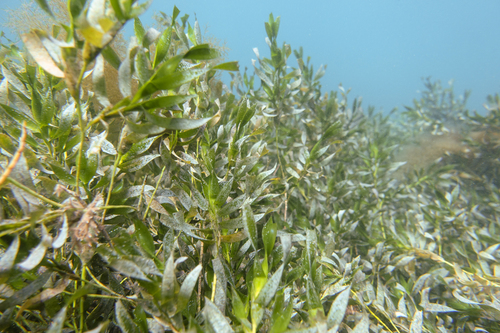
Cymodoceaceae is a family of marine flowering plants (seagrasses) belonging to the monocot order Alismatales. These perennial herbs are fully adapted to submerged life in saline waters, typically forming meadows on sandy or muddy substrates in tropical and subtropical coastal areas worldwide. They reproduce via highly reduced flowers adapted for underwater pollination (hydrophily).
Overview
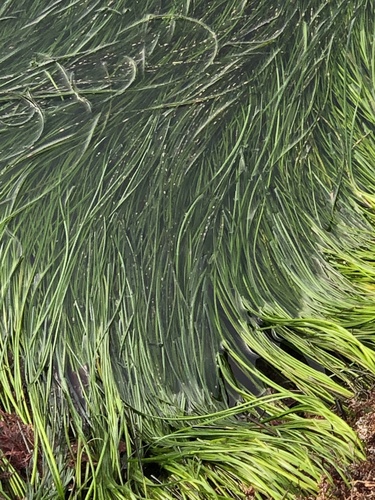
The Cymodoceaceae family includes 5 genera and about 16-18 species of true seagrasses. Unlike seaweeds (algae), seagrasses are true angiosperms with roots, stems (rhizomes), leaves, flowers, and fruits, completing their entire life cycle underwater. They inhabit shallow coastal waters, estuaries, and lagoons, forming extensive underwater meadows that are critical ecosystems, providing habitat, food, and nursery grounds for diverse marine life, stabilizing sediments, and improving water quality.
Key characteristics include their creeping rhizomes that anchor the plant and allow for vegetative spread, linear or cylindrical leaves with basal sheaths, and highly specialized reproductive features. Flowers are unisexual (plants usually dioecious), lack a perianth, and produce unique filamentous pollen transported by water currents. Fruits are small and nut-like. Cymodoceaceae is part of the core seagrass clade within the order Alismatales.
Seagrasses globally face threats from coastal development, pollution, dredging, and climate change, making their conservation important.
Quick Facts
- Scientific Name: Cymodoceaceae Vines
- Common Name: Manatee Grass Family, Seagrass Family (in part)
- Number of Genera: 5
- Number of Species: Approximately 16-18
- Distribution: Marine: Tropical and subtropical coastlines worldwide (Indo-Pacific, Atlantic, Mediterranean).
- Evolutionary Group: Angiosperms - Monocots - Alismatales
Key Characteristics
Growth Form and Habit
Members are submerged, perennial, marine herbaceous plants (seagrasses). They possess well-developed, creeping, sympodial or monopodial rhizomes that grow horizontally in the sediment, anchoring the plant with roots produced at the nodes. Erect, short shoots bearing leaves arise from the rhizome nodes.
Leaves
Leaves are arranged alternately or distichously on the erect shoots, or sometimes clustered at rhizome nodes. Leaf blades are typically linear (strap-shaped) or, uniquely in Syringodium, terete (cylindrical). Leaf tips can be rounded, pointed, or serrated (important for identification). Venation is parallel. Leaves have a distinct basal sheath which is typically open and may possess auricles (ear-like lobes) at the top. Small, scale-like structures (intravaginal squamules) are usually present within the sheath. Leaves lack stipules.
Inflorescence
Flowers are borne solitarily or in small, inconspicuous cymose clusters, located terminally or axillary on the shoots, often enclosed by bracts or foliage leaves.
Flowers
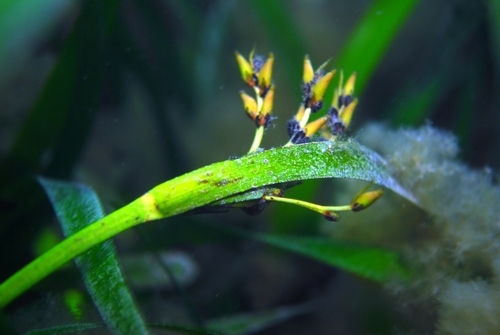
Flowers are small, highly reduced, and unisexual, with plants typically being dioecious (separate male and female plants). They are adapted for underwater pollination (hydrophily). A perianth (sepals/petals) is typically absent or reduced to minute scales.
- Male flowers: Usually consist of only 2 stamens, which are often fused back-to-back or appear as a single structure with 4 pollen sacs (thecae). Anthers release distinctive filamentous (thread-like) pollen grains, which lack the typical outer wall (exine) and are adapted for dispersal in water.
- Female flowers: Typically consist of 2 free carpels (sometimes reduced to 1). Each carpel forms a superior ovary containing a single, pendulous ovule. Styles are usually 2 or 3 per carpel, often long and thread-like (filiform), functioning as stigmas to capture the filamentous pollen from the water.
Fruits and Seeds
The fruit is a small, hard, one-seeded, indehiscent unit, typically classified as an achene or small drupelet (nut-like). The seed lacks endosperm and has a straight embryo. Vivipary (seed germination while the fruit is still attached to the parent plant) occurs in the genera Amphibolis and Thalassodendron.
Chemical Characteristics
Plants possess physiological adaptations for survival in saline marine environments. They often contain phenolic compounds, including tannins and flavonoid sulfates, which may play roles in defense or adaptation.
Field Identification
Identifying Cymodoceaceae seagrasses requires observation of their underwater habitat and specific vegetative features:
Primary Identification Features
- Submerged marine habitat: Found rooted in sediments in shallow coastal waters (not freshwater, not algae).
- Rhizomatous growth: Presence of creeping underground stems (rhizomes) anchoring the plant.
- Linear or terete leaves: Leaves are either strap-like or cylindrical.
- Basal leaf sheath: Each leaf arises from a sheath at the base of the erect shoot.
- Reduced flowers/fruits (if present): Look for inconspicuous structures; flowers lack petals, fruits are small and nut-like.
Secondary Identification Features
- Leaf tip morphology: The shape of the leaf tip (rounded, serrated, tridentate) is crucial for distinguishing genera like Cymodocea and Halodule.
- Leaf cross-section: Cylindrical leaves are characteristic of Syringodium.
- Dioecious nature: Meadows often consist of patches of male and female plants.
- Viviparous seedlings: In Amphibolis and Thalassodendron, seedlings may be seen attached to female plants.
Seasonal Identification Tips
Vegetative features are the most reliable year-round identifiers:
- Year-round: Rhizomes, leaf shape (linear/terete), leaf sheaths, and leaf tip morphology are always present. Habitat is key.
- Flowering/Fruiting Season (Varies, often inconspicuous): Finding the highly reduced flowers or small, hard fruits requires careful searching, often underwater. Filamentous pollen released in the water is diagnostic but rarely observed directly. Washed-up leaves on beaches can often be identified.
Common Confusion Points
Distinguishing Cymodoceaceae from other seagrasses and algae:
- Zosteraceae (Eelgrass family): Also has rhizomes and linear leaves, but differs in rhizome branching, leaf sheath (often closed), and flower/inflorescence details (spadix-like structure enclosed in a spathe-like bract). Found more often in temperate waters.
- Posidoniaceae (Neptune Grass family): Robust seagrasses with thick rhizomes often covered in fibrous remains of old sheaths. Linear leaves, but flowers/fruits differ. Primarily Mediterranean and Australian.
- Hydrocharitaceae (includes Halophila, Thalassia): Diverse family including some seagrasses. Halophila has small, ovate leaves; Thalassia (Turtle Grass) has broad, strap-like leaves but different rhizome and flower structure.
- Marine Algae (Seaweeds): Lack true roots, rhizomes, leaves, flowers, and fruits. Structure is simpler (holdfast, stipe, blade). Reproduction via spores or gametes, not seeds.
- Focus on the combination: Marine + Rhizome + Sheathed Linear/Terete Leaves + Specific Leaf Tip Shape + Reduced Flowers/Achene-like Fruit = Cymodoceaceae.
Field Guide Quick Reference
Look For:
- Submerged marine herb (seagrass)
- Creeping rhizomes in sediment
- Leaves: Linear OR Terete (cylindrical)
- Basal leaf sheath (open)
- Reduced unisexual flowers (dioecious)
- Small, hard, achene-like fruit
Key Variations:
- Leaf tip shape (serrated, rounded, etc.)
- Leaf cross-section (flat vs. round)
- Rhizome branching pattern
- Vivipary present in some genera
- Tropical/Subtropical distribution
Notable Examples
Genera within Cymodoceaceae are widespread in tropical and subtropical seagrass meadows:

Syringodium filiforme
Manatee Grass
Common in the Caribbean and Gulf of Mexico. Easily recognized by its distinctive cylindrical (terete), spaghetti-like leaves. Forms meadows often mixed with other seagrasses.

Halodule wrightii
Shoal Grass
A widely distributed species found in the Atlantic, Pacific, and Indian Oceans. Characterized by thin, flat, linear leaves with a tridentate (three-pointed) leaf tip. Often colonizes disturbed areas.

Cymodocea nodosa
(No common name)
A key species forming meadows in the Mediterranean Sea and adjacent Atlantic coasts. Has flat, linear leaves with rounded or slightly serrated tips and prominent leaf scars on the rhizome.

Amphibolis antarctica
Sea Nymph / Wire Weed
Endemic to southern Australia. Unique among seagrasses for its branching, somewhat woody erect stems and viviparous reproduction, where seedlings develop while attached to the mother plant before anchoring.
Phylogeny and Classification
Cymodoceaceae is placed in the order Alismatales, a large and diverse order of monocots that includes many aquatic families, including all true seagrass lineages. Cymodoceaceae belongs to the "core seagrass" clade within Alismatales, indicating a close relationship with other major seagrass families like Posidoniaceae and Ruppiaceae, and slightly more distantly to Zosteraceae.
The evolution of the seagrass habit (returning to a fully submerged marine life) occurred independently multiple times within the Alismatales. Cymodoceaceae represents one of these successful transitions, involving complex adaptations for reproduction (hydrophily, filamentous pollen), nutrient uptake, and survival in a saline, submerged environment. Other families in Alismatales include freshwater aquatics (e.g., Potamogetonaceae) and even terrestrial plants (Araceae).
Position in Plant Phylogeny
- Kingdom: Plantae
- Clade: Angiosperms (Flowering plants)
- Clade: Monocots
- Order: Alismatales
- Family: Cymodoceaceae
Evolutionary Significance
Cymodoceaceae is significant for understanding plant adaptation and marine ecosystems:
- Adaptation to Marine Life: Represents a successful evolutionary return of flowering plants to the sea, requiring numerous physiological and reproductive adaptations.
- Hydrophilous Pollination: Exhibits specialized mechanisms for pollination entirely underwater, including unique filamentous pollen.
- Ecological Keystone Species: Cymodoceaceae species form vital seagrass meadows that support high biodiversity, function as carbon sinks, and protect coastlines.
- Convergent Evolution: Studying Cymodoceaceae alongside other seagrass lineages reveals convergent evolutionary pathways for adapting to the marine environment.
- Biogeography: The family's distribution provides insights into historical connections between tropical oceans.