Petrosaviaceae
The Petrosaviaceae family is a small but evolutionarily significant family of monocotyledonous flowering plants, placed in its own order, Petrosaviales. It comprises only two genera: Japonolirion, a photosynthetic herb endemic to Japan, and Petrosavia, a genus of non-photosynthetic, mycoheterotrophic herbs found in East and Southeast Asia. This unique combination of trophic strategies within a single small family, along with its isolated phylogenetic position, makes Petrosaviaceae crucial for understanding early monocot evolution.
Overview
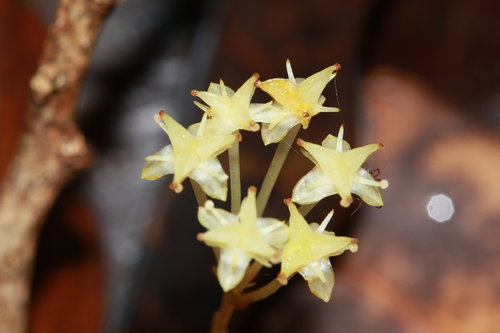
Petrosaviaceae represents a distinct lineage of monocots, formally recognized in its own order, Petrosaviales, by the Angiosperm Phylogeny Group (APG). The family consists of just four species in two remarkably different genera. Japonolirion osense is a small, green, photosynthetic herb with grass-like basal leaves, found only in specific alpine regions of Japan. In contrast, the three species of Petrosavia (e.g., P. sakuraii, P. stellaris) are achlorophyllous (lacking chlorophyll) mycoheterotrophs, obtaining nutrients through symbiotic relationships with fungi in the shaded understories of forests across East and Southeast Asia.
This divergence in nutritional strategies within such a small family is exceptional. Both genera share fundamental characteristics like rhizomatous growth, small flowers with 6 tepals and 6 stamens, and ovaries composed of 3 relatively free carpels, features considered potentially ancestral among monocots. Their phylogenetic position, often resolved as sister to the vast majority of monocots (excluding only Acorales and Alismatales), underscores their importance in studying the evolutionary history of this major plant group.
Due to their rarity and specific habitat requirements, members of Petrosaviaceae have no significant economic uses but are of high scientific value.
Quick Facts
- Scientific Name: Petrosaviaceae
- Common Name: (None widely established)
- Number of Genera: 2 (Japonolirion, Petrosavia)
- Number of Species: 4
- Distribution: Japan (Japonolirion); East and Southeast Asia (China, Japan, SE Asia, Borneo, New Guinea - Petrosavia).
- Evolutionary Group: Monocots - Petrosaviales
Key Characteristics
Growth Form and Habit
Plants are small, perennial herbs arising from slender rhizomes.
- Japonolirion: Photosynthetic, autotrophic herb.
- Petrosavia: Non-photosynthetic, achlorophyllous, mycoheterotrophic herb (appears whitish, yellowish, or brownish).
Leaves
- Japonolirion: Possesses a basal rosette of linear, grass-like leaves with parallel venation.
- Petrosavia: Lacks basal leaves; stem leaves are reduced to small, alternate, non-green scale-like structures.
Inflorescence
Flowers are borne in terminal racemes or sometimes corymb-like clusters (Japonolirion). Floral bracts are present.
Flowers
Flowers are small, actinomorphic (radially symmetrical), and bisexual. Key features include:
- Perianth: Consists of 6 persistent tepals in two whorls of 3. The outer tepals are typically smaller than the inner ones. Tepals are usually whitish, yellowish, or greenish.
- Androecium: Features 6 stamens, arranged in two whorls, opposite the tepals. Filaments may be shortly fused to the base of the tepals.
- Gynoecium: Composed of 3 carpels that are either entirely free (apocarpous) or fused only at the base. The ovary position is superior (Japonolirion) or partly inferior (Petrosavia). Each carpel contains numerous ovules. Styles are 3, free, often recurved. Septal nectaries are typically present at the base of the carpels.
Fruits and Seeds
The fruit consists of a cluster of 3 dehiscent units: typically follicles (dehiscing along one suture) or sometimes interpreted as loculicidal capsules when carpels are basally fused. Fruits contain numerous, very small seeds, which are often winged or have hair-like appendages.
Chemical Characteristics
Detailed chemical profiles are limited. The mycoheterotrophic nature of Petrosavia necessitates specialized metabolic interactions with symbiotic fungi. Photosynthetic pathways are active in Japonolirion.
Field Identification
Identifying members of Petrosaviaceae requires careful observation, especially for the inconspicuous mycoheterotrophic genus Petrosavia. Identification relies on recognizing features specific to each genus within their respective habitats and geographic ranges:
Primary Identification Features
- Japonolirion osense (Japan):
- Small, photosynthetic herb with a basal rosette of narrow, grass-like leaves.
- Terminal raceme or corymb of small, whitish flowers with 6 tepals and 6 stamens.
- Ovary superior, composed of 3 free or nearly free carpels.
- Fruit a cluster of 3 follicles.
- Habitat: Alpine meadows/wetlands in Japan.
- Petrosavia spp. (E/SE Asia):
- Small, non-photosynthetic (achlorophyllous - whitish/yellowish/brownish) herb.
- Stem bears only small, alternate, scale-like leaves; no basal green leaves.
- Terminal raceme of small flowers with 6 tepals and 6 stamens.
- Ovary partly inferior, composed of 3 basally fused carpels.
- Fruit a capsule or group of follicles.
- Habitat: Shaded forest floor, dependent on mycorrhizal fungi.
Secondary Identification Features (Common to Both)
- Rhizomatous perennial herbs.
- Flowers with 6 tepals and 6 stamens.
- Gynoecium of 3 free or basally fused carpels.
- Fruit dehiscent, containing numerous tiny seeds.
Seasonal Identification Tips
- Flowering typically occurs in summer months.
- Petrosavia is easily overlooked due to its small size and lack of green color; search carefully on the forest floor among leaf litter.
- Japonolirion is visible during the growing season in its alpine habitat.
Common Confusion Points
- Japonolirion: May resemble other small monocots with grass-like leaves (e.g., Juncaceae, Cyperaceae, small Liliaceae sensu lato), but the combination of 6 tepals, 6 stamens, and 3 free/basally fused carpels forming follicles is distinctive.
- Petrosavia: Can be confused with other mycoheterotrophic plants (e.g., some orchids, Burmanniaceae, Triuridaceae). Distinguishing features include the specific flower structure (actinomorphic, 6 tepals, 6 stamens, 3 carpels) and fruit type.
Field Guide Quick Reference (Petrosaviaceae)
Japonolirion (Japan)
- Photosynthetic herb
- Basal grass-like leaves
- Flowers: 6 tepals, 6 stamens
- Ovary: Superior, 3 free/basal carpels
- Fruit: Follicles
Petrosavia (E/SE Asia)
- Mycoheterotrophic herb (no green)
- Stem leaves scale-like only
- Flowers: 6 tepals, 6 stamens
- Ovary: Partly inferior, 3 basal carpels
- Fruit: Capsules/Follicles
Notable Examples
The family comprises only two distinct genera:

Japonolirion osense
The single species in its genus, endemic to high-altitude wetlands and grasslands in central and northern Japan. It is a small, photosynthetic perennial herb with narrow basal leaves and a raceme or corymb of delicate white flowers. Its superior ovary with free carpels is considered an ancestral trait.

Petrosavia sakuraii (example species)
This genus includes three species of mycoheterotrophic herbs found in the shaded understory of forests from Japan and China south through Southeast Asia to New Guinea. They lack chlorophyll, appearing whitish or brownish, and have only scale leaves on their flowering stems. They rely entirely on symbiotic fungi for nutrition. P. sakuraii is one example from this genus.
Phylogeny and Classification
Petrosaviaceae holds a unique and critical position in monocot phylogeny. It is the sole family in the order Petrosaviales. Molecular phylogenetic studies consistently place Petrosaviales as one of the earliest diverging lineages within the monocots, after Acorales (Acoraceae) and Alismatales (Araceae, etc.).
Specifically, Petrosaviales is often found to be the sister group to the large clade containing most other monocot orders, including Liliales, Asparagales, Pandanales, Dioscoreales, Arecales, Poales, Commelinales, and Zingiberales. This pivotal position makes Petrosaviaceae extremely important for inferring ancestral characteristics and understanding the major evolutionary branching events early in monocot history.
Features like the relatively undifferentiated tepals and the nearly apocarpous gynoecium (free or basally fused carpels) seen in Petrosaviaceae are sometimes considered indicative of ancestral monocot traits.
Position in Plant Phylogeny
- Kingdom: Plantae
- Clade: Angiosperms (Flowering plants)
- Clade: Monocots
- Order: Petrosaviales
- Family: Petrosaviaceae
Evolutionary Significance
Petrosaviaceae is highly significant for several reasons:
- Its pivotal phylogenetic position near the base of the monocot tree is crucial for reconstructing early monocot evolution.
- The presence of both photosynthetic (Japonolirion) and mycoheterotrophic (Petrosavia) members in one small family provides a unique system to study the evolution of nutritional strategies.
- Features like nearly free carpels may represent ancestral states (plesiomorphies) for monocots or specific lineages.
- It highlights the ancient diversification of monocots and the existence of small, relictual lineages.