Montiniaceae
(No widely accepted common name)
Montiniaceae is a small family of flowering plants consisting of shrubs and small trees, placed in the order Solanales within the Lamiids clade. The family has a disjunct distribution in Africa and Madagascar and comprises only three genera: Montinia, Grevea, and Kaliphora. Plants are typically dioecious with small flowers and inferior ovaries, producing fruit that is either a capsule or a drupe.
Overview
The Montiniaceae family is very small, containing only three genera and about five species in total. Montinia is found in southern Africa, Grevea occurs in eastern Africa and Madagascar, and Kaliphora is endemic to Madagascar. These plants are woody shrubs or small trees adapted to relatively dry or seasonally dry environments.
Historically, the placement of these genera was uncertain. Kaliphora, in particular, was sometimes placed in its own family (Kaliphoraceae) due to some differing characteristics (like occasionally opposite leaves and drupaceous fruit). However, molecular phylogenetic studies have shown they form a cohesive group closely related to Solanaceae and Convolvulaceae, leading to their inclusion within the order Solanales and the unified family Montiniaceae in the APG classification system.
The family has little direct economic importance, but its phylogenetic position is significant for understanding relationships within the Solanales order and the broader Lamiid clade.
Quick Facts
- Scientific Name: Montiniaceae Nakai
- Common Name: (None widely used)
- Number of Genera: 3 (Montinia, Grevea, Kaliphora)
- Number of Species: Approximately 5
- Distribution: Disjunct: Southern Africa, Eastern Africa, Madagascar.
- Evolutionary Group: Eudicots - Lamiids - Solanales
Key Characteristics
Growth Form and Habit
Shrubs or small trees, typically deciduous or semi-evergreen.
Leaves
Leaves are simple, entire, and usually alternate (sometimes opposite or subopposite, especially in Kaliphora). They lack stipules (exstipulate).
Inflorescence
Flowers are borne in terminal or axillary cymes, or sometimes solitary (especially female flowers).
Flowers
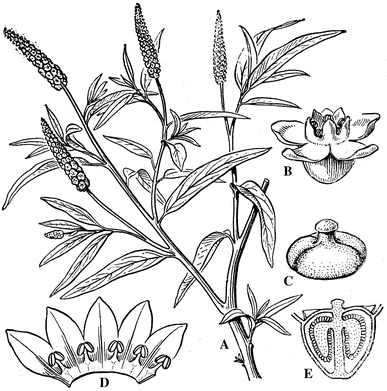
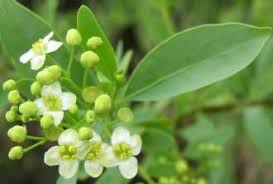
Flowers are typically unisexual (plants dioecious), actinomorphic (radially symmetrical), and relatively small. Key features include:
- Calyx: Consists of (3-)4-5 small sepals, fused at the base, persistent in fruit.
- Corolla: Consists of (3-)4-5 petals, usually free, often small and white or greenish (petals sometimes absent in female flowers of Grevea).
- Androecium (Male Flowers): Stamens (3-)4-5, alternating with the petals, filaments free. A rudimentary pistil (pistillode) may be present.
- Gynoecium (Female Flowers): Ovary is inferior, composed of typically 2 fused carpels (syncarpous). It is usually bilocular (two chambers) with axile placentation. Ovules are few per locule. Style(s) are short, with often broad or lobed stigmas. Staminodes (sterile stamens) may be present.
Fruits and Seeds
The fruit is either a loculicidal capsule, often ribbed or winged, opening from the apex (Montinia, Grevea), or a fleshy drupe (Kaliphora). Seeds are few, sometimes winged.
Chemical Characteristics
Members are known to contain iridoids, a class of secondary metabolites common in some Asterid groups, including other families within Solanales.
Field Identification
Identifying Montiniaceae relies on recognizing their shrubby/tree habit, simple alternate (mostly) leaves, dioecious nature, small flowers with inferior ovaries, and specific fruit type (capsule or drupe), combined with their restricted African/Madagascan distribution.
Primary Identification Features
- Habit: Shrubs or small trees.
- Leaves: Simple, entire, mostly alternate, exstipulate.
- Sexuality: Dioecious (separate male and female plants).
- Flowers: Small, actinomorphic, unisexual.
- Ovary (Female Flowers): Inferior, typically 2 carpels/locules.
- Fruit: Capsule (often ribbed/winged) or Drupe.
- Distribution: Southern Africa, Eastern Africa, Madagascar only.
Secondary Identification Features
- Flower Parts: Typically in 4s or 5s (sepals, petals, stamens).
- Petals: Small, sometimes absent in female flowers of Grevea.
- Placentation: Axile.
Seasonal Identification Tips
- Flowering/Fruiting Season: Varies by species and location, often linked to rainy seasons. Flowers and especially fruits are crucial for identification.
- Vegetative Season: The combination of habit, leaf arrangement, and geographic location can narrow possibilities, but reproductive features are generally needed for confirmation.
Common Confusion Points
- Solanaceae / Convolvulaceae: While related at the order level, these families typically have bisexual flowers and superior ovaries (though some exceptions exist).
- Other African/Madagascan Shrubs: Many unrelated families share a similar shrubby habit and simple leaves. Key distinguishing features for Montiniaceae are the combination of dioecy, inferior ovary, and specific fruit type within its geographic range. For example, Celastraceae might have alternate/opposite leaves and capsules/drupes but usually have bisexual flowers with a prominent nectar disc and superior ovary.
Field Guide Quick Reference
Look For:
- Shrubs/small trees (Africa/Madagascar)
- Leaves simple, entire, mostly alternate
- Dioecious plants
- Small unisexual flowers
- Inferior ovary (female flowers)
- Capsule (ribbed/winged) or Drupe
Key Variations:
- Fruit type (Capsule vs. Drupe - genus specific)
- Presence/absence of petals (female Grevea)
- Leaf arrangement (alternate vs. sometimes opposite in Kaliphora)
Notable Examples
The family consists of only three genera:

Montinia caryophyllacea
(Pepper Bush)
The sole species in its genus, found in arid regions of southern Africa (Namibia, South Africa). A dioecious shrub with alternate leaves and small white flowers. The fruit is a distinctive ribbed, woody capsule.

Grevea spp.
(Grevea)
Contains about 3 species of dioecious shrubs or small trees found in eastern Africa (Kenya, Tanzania) and Madagascar. They typically have alternate leaves and capsular fruits similar to Montinia. Female flowers may lack petals.

Kaliphora madagascariensis
(Kaliphora)
The sole species in its genus, endemic to Madagascar. A shrub or small tree that differs from the other genera in having sometimes opposite or subopposite leaves and fruit that is a drupe rather than a capsule.
Phylogeny and Classification
Montiniaceae is placed in the order Solanales, within the Lamiids (Euasterids I) clade of eudicots. This placement is well-supported by molecular phylogenetic analyses.
Within Solanales, Montiniaceae is considered sister to the large family Solanaceae (nightshade family). Together with Solanaceae, Convolvulaceae (morning glory family), Sphenocleaceae, and Hydroleaceae, it forms the core group of the order. Its inclusion highlights the diversity of floral forms (e.g., inferior vs. superior ovaries) and fruit types within this major angiosperm order.
Position in Plant Phylogeny
- Kingdom: Plantae
- Clade: Angiosperms (Flowering plants)
- Clade: Eudicots
- Clade: Asterids
- Clade: Lamiids (Euasterids I)
- Order: Solanales
- Family: Montiniaceae
Evolutionary Significance
Despite its small size, Montiniaceae is important for understanding Solanales evolution:
- Sister Group to Solanaceae: Its position helps polarize character evolution within Solanaceae and understand the ancestral traits of this major family.
- Evolution of Ovary Position: Represents a lineage within Solanales that evolved or retained an inferior ovary, contrasting with the predominantly superior ovaries in Solanaceae and Convolvulaceae.
- Biogeography: The disjunct African/Madagascan distribution provides clues about the historical biogeography of Solanales, suggesting ancient connections or dispersal events.
- Dioecy: The evolution of dioecy in this family contrasts with the predominantly bisexual flowers in its closest relatives.