Menyanthaceae
Bogbean Family
The Menyanthaceae, commonly known as the Bogbean family, is a small family of aquatic and wetland flowering plants in the order Asterales. Comprising about 5-6 genera and 60-70 species, these plants are distributed nearly worldwide, primarily in freshwater habitats. They are characterized by their often floating or creeping habit, distinctive leaves, and often showy, fringed flowers.
Overview
The Menyanthaceae family consists primarily of perennial, rhizomatous, aquatic or semi-aquatic herbs. They thrive in marshes, bogs, ponds, and slow-moving streams across temperate and tropical regions. While sharing the Asterales order with the massive Asteraceae family, Menyanthaceae represents a distinct lineage adapted to wet environments.
Members of this family often exhibit adaptations for their aquatic lifestyle, such as floating leaves (similar to water lilies in some species like Nymphoides) or creeping rhizomes that anchor them in mud. Their flowers, while individually distinct (unlike the composite heads of Asteraceae), are often attractive with characteristic fringed or textured petals.
Economically, the family is of minor importance, although some species like Menyanthes trifoliata (Bogbean) have traditional medicinal uses, and several Nymphoides species (Floating Hearts) are cultivated as ornamental plants for ponds and water gardens. Some Nymphoides species can become invasive outside their native range.
Quick Facts
- Scientific Name: Menyanthaceae Dumort.
- Common Name: Bogbean family, Buckbean family
- Number of Genera: Approximately 5-6
- Number of Species: Approximately 60-70
- Distribution: Cosmopolitan, predominantly in aquatic and wetland habitats.
- Evolutionary Group: Eudicots - Asterids
Key Characteristics
Growth Form and Habit
Plants are typically perennial herbs, adapted to aquatic or marshy environments. They often possess well-developed rhizomes or stolons, allowing them to creep or float. Stems can be submerged, floating, or emergent.
Leaves
Leaves are usually alternate, though sometimes basal or appearing opposite due to short internodes. They are typically simple or palmately compound (notably trifoliate in Menyanthes). Leaf shapes vary, including entire, heart-shaped (cordate), or round (orbicular), often with long petioles. Floating leaves are common in genera like Nymphoides. Stipules are absent.
Inflorescence
Flowers are borne solitarily or arranged in inflorescences such as racemes, panicles, fascicles (clusters), or umbel-like cymes. Unlike the Asteraceae, Menyanthaceae do not form composite flower heads (capitula). The inflorescences often arise from nodes along floating stems or from the base of the plant.
Flowers
Individual flowers are generally bisexual, actinomorphic (radially symmetrical), and typically pentamerous (parts in fives), though sometimes tetramerous (parts in fours). Key features include:
- Calyx: Consists of (4-)5 separate or basally fused sepals.
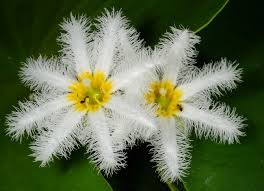
- Corolla: Consists of (4-)5 petals, fused at the base to form a tube. The petal lobes are often distinctively fringed (fimbriate), bearded, or winged along the margins or inner surface. Colors are commonly white or yellow.
- Androecium: (4-)5 stamens, alternating with the corolla lobes and attached to the corolla tube. Anthers dehisce longitudinally. Unlike Asteraceae, the anthers are distinct, not fused into a tube.
- Gynoecium: A single superior or half-inferior ovary composed of two fused carpels, containing few to numerous ovules on parietal placentas. The style is single, with a 2-lobed stigma.
Fruits and Seeds
The fruit is typically a capsule, which may be fleshy or dry, dehiscing by valves or irregularly. In some species, the fruit may be indehiscent or berry-like. Seeds are few to many, sometimes winged or hairy, facilitating water dispersal.
Chemical Characteristics
Members of the Menyanthaceae are known to produce iridoids, bitter compounds that may serve as defense against herbivores. They typically store carbohydrates as oligosaccharides rather than the inulin found in many Asteraceae.
Field Identification
Identifying members of the Menyanthaceae family often relies on recognizing their aquatic/wetland habitat combined with specific leaf and flower characteristics.
Primary Identification Features
- Habitat: Found in bogs, marshes, ponds, lakeshores, and slow streams.
- Habit: Aquatic or wetland herbs, often with floating leaves or creeping rhizomes/stolons.
- Flowers: Individual, radially symmetrical flowers (not composite heads). Petals often distinctively fringed, bearded, or winged, typically white or yellow.
- Leaves: Alternate or basal, simple or compound (e.g., trifoliate in Menyanthes), often long-petioled.
- Ovary Position: Superior or half-inferior (contrast with inferior ovary in Asteraceae).
Secondary Identification Features
- Rhizomes/Stolons: Presence of prominent creeping underground or surface stems.
- Petal Texture: Look closely for the unique fringing or hairs on the inner surface or margins of the petals.
- Fruit Type: Capsules (sometimes fleshy) containing few to many seeds.
- Lack of Milky Latex: Unlike some Asteraceae (e.g., Cichorieae), these plants do not typically exude milky sap.
Seasonal Identification Tips
- Spring/Summer: Best time for identification, as plants are typically flowering. Look for emergent or floating leaves and characteristic flowers.
- Fall: Fruits (capsules) may be present. Vegetative features like rhizomes and leaf shape remain useful.
- Winter: Often die back to rhizomes, making identification difficult, although submerged winter buds or basal rosettes may persist in some species or milder climates.
Common Confusion Points
- Nymphoides vs. Water Lilies (Nymphaeaceae): Floating-leaved Nymphoides species resemble small water lilies but have pentamerous flowers with fringed petals and superior/half-inferior ovaries, unlike the numerous petals and stamens of Nymphaeaceae.
- Menyanthes vs. Other Trifoliate Wetland Plants: The distinctive trifoliate leaves of Bogbean might be confused with unrelated plants like clovers (Fabaceae) or buckwheats (Polygonaceae) in wet areas, but the unique fringed white/pink flowers and thick rhizome are diagnostic for Menyanthes.
- Other Aquatic Plants (e.g., Potamogetonaceae, Alismataceae): While sharing the habitat, these families have very different flower structures (often inconspicuous, or with 3 petals/sepals in Alismataceae).
Field Guide Quick Reference
Look For:
- Aquatic or wetland habitat
- Rhizomatous or stoloniferous habit
- Alternate or basal leaves (simple or compound)
- Individual, actinomorphic flowers
- Petals (often 5) typically fringed or bearded
- Stamens (often 5) distinct
- Superior or half-inferior ovary
Key Variations:
- Floating vs. emergent leaves
- Simple vs. trifoliate leaves
- Flower color (white, yellow, pinkish)
- Inflorescence type (solitary, raceme, cluster)
- Fruit (capsule, sometimes fleshy)
Notable Examples
The Menyanthaceae family includes several well-known aquatic and wetland plants:

Menyanthes trifoliata
Bogbean, Buckbean
A circumboreal species found in bogs and shallow water. Recognizable by its thick, creeping rhizome, distinctive alternate trifoliate leaves held above the water, and showy racemes of white to pinkish flowers with conspicuously fringed petals. Used traditionally in herbal medicine as a bitter tonic.

Nymphoides peltata
Yellow Floating Heart, Fringed Water Lily
Native to Eurasia, this species has floating, heart-shaped leaves resembling small water lilies. It produces bright yellow, five-petaled flowers with fringed margins, held just above the water surface. Often cultivated for ponds, it has become invasive in North America and other regions.

Nymphoides indica
Water Snowflake, Floating Heart
A pantropical species with floating, rounded leaves and clusters of white flowers arising from the petiole just below the leaf blade. The petals are densely covered with feathery hairs, giving them a snowflake-like appearance. Popular in tropical water gardens.

Villarsia spp.
Villarsia
A genus primarily found in Australia and South Africa, typically growing as emergent marsh plants with basal leaves and panicles or racemes of yellow flowers. Unlike Nymphoides, the leaves are usually not floating, and the petal margins may be entire or only slightly fringed/winged in some species.
Phylogeny and Classification
Menyanthaceae belongs to the order Asterales, positioned within the large asterid clade of eudicots. Molecular phylogenetic studies place Menyanthaceae as a distinct lineage within the Asterales, often considered sister to the clade comprising Asteraceae, Calyceraceae, and Goodeniaceae (though exact relationships can vary slightly between studies). Its divergence from these other families occurred early in the evolution of the order.
The family's adaptation to aquatic and wetland environments represents a significant ecological shift compared to the predominantly terrestrial radiation seen in its close relatives like the Asteraceae. The relatively small size of the family (compared to Asteraceae) suggests a more constrained diversification, possibly linked to its specialized habitat.
Position in Plant Phylogeny
- Kingdom: Plantae
- Clade: Angiosperms (Flowering plants)
- Clade: Eudicots
- Clade: Asterids
- Order: Asterales
- Family: Menyanthaceae
Evolutionary Significance
The Menyanthaceae family is significant for understanding the diversification within the Asterales order, particularly the adaptation to aquatic habitats. Key evolutionary aspects include:
- Adaptation to Aquatic Life: Represents a specialized lineage within Asterales that successfully colonized freshwater wetlands worldwide.
- Floral Morphology: Retention of distinct flowers (not forming capitula) and superior/half-inferior ovaries contrasts with the derived features of the closely related Asteraceae. The fringed petals are a notable specialization within the family.
- Biogeography: The cosmopolitan distribution despite being a small family suggests effective dispersal mechanisms (likely water-dispersed seeds/fragments) and ancient origins.