Goodeniaceae
Fan-flower Family
Goodeniaceae is a family of flowering plants predominantly found in Australia, with some species extending to New Zealand, Pacific islands, and coastal regions elsewhere. Belonging to the order Asterales, they are mostly herbs and shrubs known for their often showy, bilaterally symmetrical flowers and a unique pollen-presentation mechanism involving a structure called an indusium below the stigma.
Overview
The Goodeniaceae family comprises around 12 genera and over 400 species, with its center of diversity firmly in Australia, where members occupy a vast range of habitats from coastal dunes to alpine regions and arid interiors. Familiar genera include Goodenia, Scaevola (fan-flowers), Dampiera, and Lechenaultia.
A defining feature of the family is the specialized structure called an indusium, a cup or pocket located on the style just below the stigma. Before the flower opens (anthesis), the anthers deposit pollen into this indusium. As the style elongates, it presents the pollen to pollinators (secondary pollen presentation), a strategy also seen, though achieved differently, in the related Asteraceae and Campanulaceae families.
Many Goodeniaceae species are cultivated as ornamentals due to their attractive and often unusually shaped flowers, which come in shades of blue, purple, yellow, white, and red. They play an important ecological role as nectar sources and pioneer plants in various Australian ecosystems.
Quick Facts
- Scientific Name: Goodeniaceae
- Common Name: Fan-flower Family, Goodenia Family
- Number of Genera: Approximately 12
- Number of Species: Approximately 430
- Distribution: Primarily Australia, also New Zealand, Pacific islands, Southeast Asia, coasts of Indian and Atlantic Oceans.
- Evolutionary Group: Angiosperms - Eudicots - Asterids - Asterales
Key Characteristics
Growth Form and Habit
Members are mostly perennial or annual herbs and shrubs. Some species can be small trees or subshrubs. Stems and leaves are often covered in various types of hairs (glandular or non-glandular), sometimes giving a silvery or woolly appearance.
Leaves
Leaves are usually alternate, but sometimes opposite or arranged in basal rosettes. They are typically simple, with margins ranging from entire to toothed or deeply lobed. Stipules are absent.
Flowers
Flowers are generally bisexual and showy, exhibiting strong bilateral symmetry (zygomorphic). They are borne singly or in various types of inflorescences (cymes, racemes, spikes).
- Calyx: Typically consists of 5 sepals, often small and fused at the base.
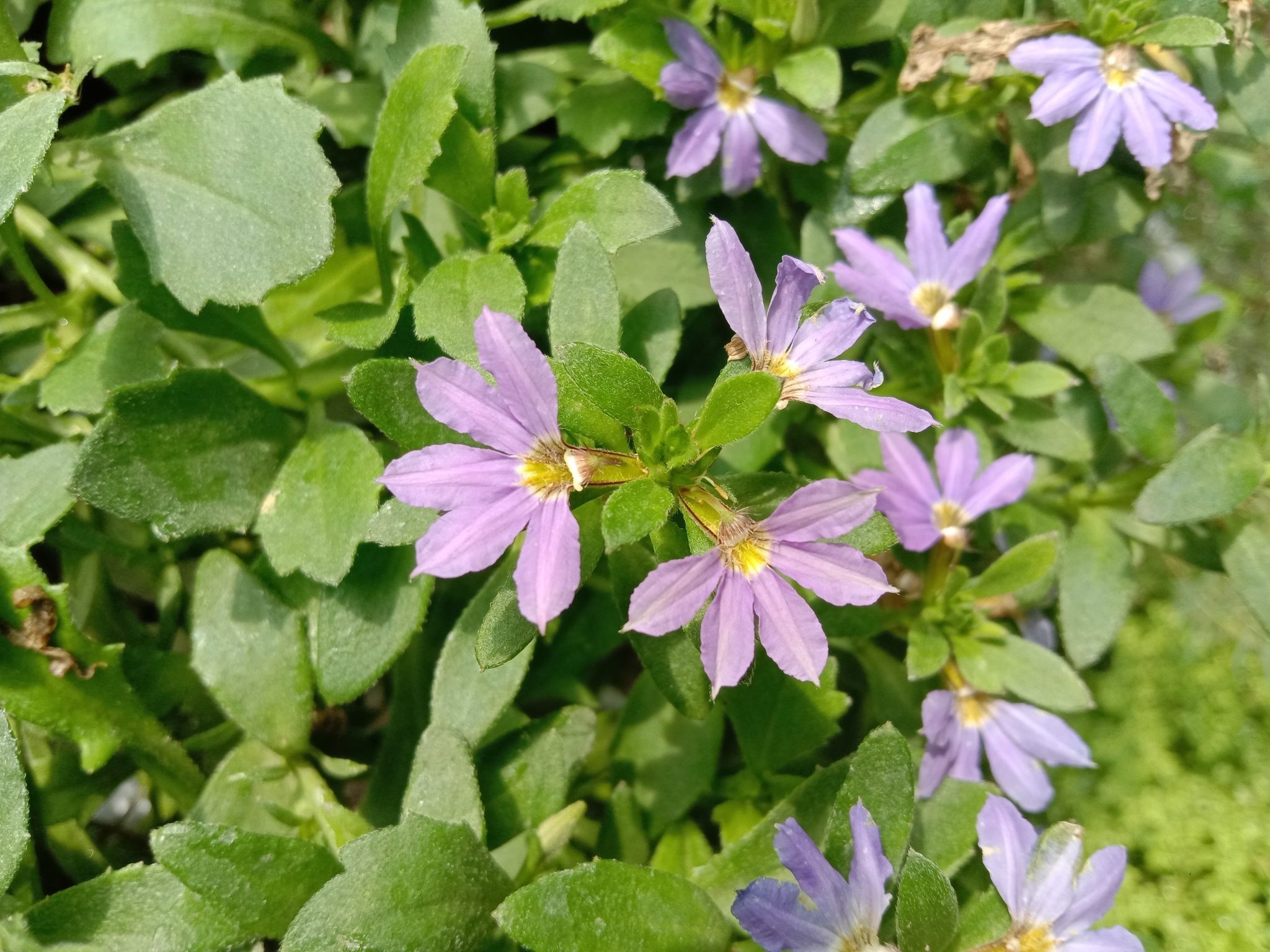
- Corolla: Consists of 5 petals, fused into a tube at the base. The corolla tube is often split down one side (adaxial side), and the lobes may be winged. In Scaevola, the corolla is split to the base, creating a distinctive fan-like appearance. Flower color is diverse, including blue, purple, yellow, white, pink, orange, and red.
- Androecium: Stamens are 5, usually free from each other or only slightly attached to the corolla base. The anthers often surround the style (connivent) but are not fused into a tube (unlike Asteraceae).
- Gynoecium: The ovary is usually inferior (sometimes superior or half-inferior), typically composed of 2 fused carpels forming one or two locules. The style is simple, terminating in a unique, cup-like or two-lipped structure called the indusium, situated just below the stigma(s). The indusium collects pollen from the anthers before the flower opens.
Pollen Presentation
The indusium is the most characteristic feature of the family. It functions in secondary pollen presentation. Pollen is shed into the indusium before the flower opens. As the style elongates, the indusium presents the pollen to pollinators. The stigma(s) become receptive only after the pollen has been removed.
Fruits and Seeds
The fruit type is variable depending on the genus. It can be a dehiscent capsule (e.g., Goodenia, Lechenaultia), a fleshy drupe (e.g., Scaevola), or a small, dry, indehiscent nut (e.g., Dampiera). Seeds are often flattened and sometimes winged.
Chemical Characteristics
Plants in this family often store carbohydrates as inulin (similar to Asteraceae) and may produce iridoid compounds.
Field Identification
Identifying Goodeniaceae relies heavily on recognizing the unique floral structure, particularly the indusium, combined with other features like leaf arrangement and flower symmetry.
Primary Identification Features
- Habit: Mostly herbs or shrubs.
- Leaves: Usually alternate, simple, often hairy, lacking stipules.
- Flowers: Zygomorphic (bilaterally symmetrical), 5-lobed corolla (often split or fan-like).
- Indusium: Presence of a distinct cup or pocket (indusium) on the style below the stigma(s) (key diagnostic feature).
- Ovary: Usually inferior.
- Stamens: 5, anthers often clustered around style but not fused into a tube.
Secondary Identification Features
- Predominantly Australian distribution.
- Often showy flowers, frequently blue, yellow, or white.
- Fruit type variable (capsule, drupe, or nut).
Seasonal Identification Tips
- Flowering Season: Varies greatly with climate. In temperate Australia, spring and summer are peak times. In arid zones, flowering often follows rainfall. Many species have long flowering periods.
- Indusium Visibility: The indusium is best observed on fresh flowers, often requiring close inspection or a hand lens.
Common Confusion Points
- Asteraceae: Have composite flower heads made of multiple tiny florets, and stamens fused into a tube (syngenesious anthers). Goodeniaceae have individual flowers (though sometimes in clusters) and free or connivent anthers, plus the indusium.
- Campanulaceae (Lobelioideae): Some lobelias have zygomorphic flowers and inferior ovaries, but they lack an indusium and often have fused anthers (though different from Asteraceae).
- Lamiaceae: Have zygomorphic flowers but typically opposite leaves, square stems, and a superior ovary divided into four nutlets.
- The indusium is the most reliable feature to distinguish Goodeniaceae.
Field Guide Quick Reference
Look For:
- Herbs or shrubs (mostly Australian)
- Alternate simple leaves (often hairy)
- Zygomorphic flowers
- Indusium (cup/pocket below stigma)
- Inferior ovary (usually)
- 5 stamens, anthers not fused in a tube
Key Variations:
- Flower color (blue, yellow, white, red, etc.)
- Corolla shape (fan-like, bilabiate, etc.)
- Fruit type (capsule, drupe, nut)
- Leaf shape and hairiness
Notable Examples
Several genera contain well-known or horticulturally important species.

Scaevola aemula
Fairy Fan-flower, Common Fan-flower
A sprawling perennial herb or subshrub native to southern Australia. Widely cultivated globally as a groundcover or container plant, valued for its tolerance to heat and drought and its profuse blue, purple, or white fan-shaped flowers produced over a long season.

Goodenia ovata
Hop Goodenia
A common shrub found in forests and woodlands of southeastern Australia. It has bright green, slightly sticky leaves and produces abundant bright yellow, zygomorphic flowers mainly in spring and summer. It is adaptable and resprouts after fire.

Lechenaultia formosa
Red Leschenaultia
A small, often short-lived shrub endemic to southwestern Western Australia, famous for its incredibly vibrant red, orange, or pink flowers. It grows in sandy or gravelly soils and is a popular but sometimes difficult plant in cultivation, requiring excellent drainage.

Dampiera stricta
Blue Dampiera
A small perennial herb or subshrub common in heathland and woodland in southeastern Australia. It spreads via rhizomes and produces upright stems with relatively few leaves and striking blue to purple flowers, typically in spring. The genus Dampiera is named after the explorer William Dampier.
Phylogeny and Classification
Goodeniaceae is placed within the large order Asterales, which belongs to the Asterids, one of the major clades of eudicot flowering plants. Within Asterales, Goodeniaceae is part of the core group that also includes Asteraceae (sunflower family), Campanulaceae (bellflower family), Menyanthaceae (bogbean family), Calyceraceae, and Stylidiaceae (triggerplant family).
Molecular studies confirm its close relationship with these families. Shared features within the order include the storage of carbohydrates as inulin and often the presence of iridoid compounds. The secondary pollen presentation mechanism seen in Goodeniaceae (via the indusium) is considered homologous or analogous to similar mechanisms in Asteraceae (plunger mechanism) and Campanulaceae (Lobelioideae subfamily), suggesting evolutionary experimentation with pollen presentation within the order.
Position in Plant Phylogeny
- Kingdom: Plantae
- Clade: Tracheophytes (Vascular Plants)
- Clade: Angiosperms (Flowering Plants)
- Clade: Eudicots
- Clade: Asterids
- Order: Asterales
- Family: Goodeniaceae
Evolutionary Significance
Goodeniaceae provides important insights into plant evolution:
- Secondary Pollen Presentation: The indusium represents a unique evolutionary solution for efficient pollen transfer, showcasing convergent evolution of complex pollination mechanisms within Asterales.
- Adaptive Radiation: The family demonstrates significant adaptive radiation, particularly within Australia, occupying diverse ecological niches.
- Asterales Relationships: Studying Goodeniaceae helps clarify evolutionary relationships and character evolution within the large and diverse Asterales order.
- Biogeography: Its distribution pattern provides clues about historical plant movements and connections, especially between Australia and surrounding regions.