Malpighiaceae
Barbados Cherry Family / Malpighia Family
Malpighiaceae is a large family of flowering plants in the order Malpighiales, comprising mostly woody lianas (vines), shrubs, and small trees. The family is predominantly tropical, with its greatest diversity in the Neotropics (Central and South America). Key characteristics often include opposite leaves, unique T-shaped hairs (Malpighiaceous hairs), glands on the sepals, clawed petals, and winged fruits (samaras).
Overview
Malpighiaceae is a significant tropical plant family with about 75 genera and over 1300 species. The majority of species are found in the New World tropics, but the family also occurs in tropical Africa, Madagascar, and Asia. The predominant life form is the woody liana, making this family a major component of the vine flora in Neotropical forests. Shrubs and small trees are also common, while herbaceous members are rare.
The family is well-known for several distinctive features. Many species possess unique unicellular hairs attached near the middle and lying flat against the surface (Malpighiaceous hairs). A remarkable feature, particularly in Neotropical species, is the presence of large oil or nectar glands on the outer surface of the sepals, involved in specialized pollination relationships, primarily with oil-collecting bees. The fruits are also often characteristic, frequently developing wings for wind dispersal (samaras or schizocarps splitting into winged segments). Economically, the family includes fruit sources like Acerola or Barbados Cherry (Malpighia emarginata), known for its extremely high Vitamin C content, and Nance (Byrsonima crassifolia). Some species of Banisteriopsis are components of the psychoactive brew Ayahuasca, while others like Stigmaphyllon and Galphimia are grown as ornamentals.
Quick Facts
- Scientific Name: Malpighiaceae
- Common Name: Barbados Cherry Family, Malpighia Family
- Number of Genera: Approximately 75
- Number of Species: Approximately 1300
- Distribution: Pantropical, especially diverse in the Neotropics.
- Habit: Mostly woody lianas, shrubs, small trees.
- Evolutionary Group: Eudicots - Rosids (Fabids) - Malpighiales
Key Characteristics
Growth Form and Habit
Predominantly woody plants, most commonly lianas (woody vines) or shrubs, also small trees. Perennial herbs are rare.
Hairs (Trichomes)
Often possess characteristic unicellular hairs attached near the middle by a short stalk, with the two arms lying parallel to the surface (Malpighiaceous hairs, also called medifixed or T-shaped hairs). Other hair types can also occur.
Leaves
Leaves are almost always opposite (rarely alternate or whorled), simple, and usually have entire (smooth) margins. Many species bear conspicuous pairs of glands, often cup-shaped or plate-like, typically located on the petiole or on the lower surface of the leaf blade near the margin or base. Small stipules are usually present, sometimes located between the petioles (interpetiolar) or on the petiole (intrapetiolar).
Inflorescence
Inflorescences are variable, often racemes, panicles, corymbs, or umbel-like clusters, usually terminal or axillary.
Flowers
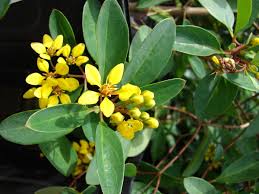
Flowers are typically actinomorphic (radially symmetrical) or slightly zygomorphic, bisexual, and 5-merous. They are often yellow, pink, orange, or reddish.
- Calyx: Consists of 5 sepals, usually free or slightly fused at the base. A key feature in most New World genera is the presence of large, paired glands (usually 8 or 10 total) on the outer (abaxial) surface of 4 or all 5 sepals. These glands secrete oils or sometimes nectar, attracting specialized pollinating bees. Old World species typically lack these sepal glands.
- Corolla: Consists of 5 free petals, often distinctly clawed (narrowed to a stalk-like base). The limb (expanded part) of the petal is frequently fimbriate (fringed), erose (irregularly toothed), or dentate (toothed). The posterior petal (banner or standard) may differ slightly in size, shape, or orientation from the other four.
- Androecium: Usually 10 stamens, often arranged in two whorls of 5. Filaments are frequently fused together (connate) at their bases, sometimes forming a noticeable tube. Anthers typically open via longitudinal slits.
- Gynoecium: The ovary is superior, typically composed of 3 (rarely 2 or 4) fused carpels. It usually has 3 locules (sometimes partially fused). Placentation is typically apical or apical-axile, with a single pendant ovule per locule (or per carpel if locules are fused). Styles are usually 3 (equal to carpel number), typically free, slender, and sometimes hooked or flattened at the tip. Stigmas are small.
Fruits and Seeds
Fruit type is highly variable but frequently adapted for wind dispersal. Common types include winged samaras or schizocarps that break apart into winged segments (mericarps). The wings can develop dorsally, laterally, or circumferentially, leading to diverse morphologies (e.g., resembling maple keys, elm samaras, or star-shaped structures). Fleshy fruits (drupes - e.g., Malpighia, Byrsonima) or nuts also occur in some genera. Each fruit segment or drupe typically contains a single seed.
Field Identification
Identifying Malpighiaceae often relies on a combination of vegetative and floral features, especially the distinctive hairs, glands, and fruits:
Primary Identification Features
- Opposite Leaves: This is a very consistent feature (present in >99% of species).
- Malpighiaceous Hairs: Look closely (often needs magnification) for T-shaped hairs lying flat on leaves, stems, or flower parts.
- Sepal Glands: Check the outside base of the sepals for large, paired oil or nectar glands (most common in New World species). Their presence is highly indicative.
- Clawed and Fringed Petals: Petals are typically narrowed at the base and often have fringed or toothed edges.
- Winged Fruits (often): Look for samaras or schizocarps with prominent wings adapted for wind dispersal.
- Woody Habit (Liana/Shrub): Most species are woody vines or shrubs.
- Leaf/Petiole Glands: Check petioles and leaf undersides for conspicuous glands.
Secondary Identification Features
- Usually 10 Stamens: Often fused at the base.
- Superior Ovary: Typically 3-carpellate.
- Flowers 5-merous: Often yellow or pink/red.
- Stipules present: Though often small.
Seasonal Identification Tips
- Flowering Season: Varies with tropical climates, often linked to wet/dry seasons. Flowers are needed to observe sepal glands and petal/stamen structure.
- Fruiting Season: The distinctive winged fruits are often present after flowering and are highly diagnostic.
- Vegetative Season: Opposite leaves combined with T-shaped hairs and/or leaf/petiole glands can strongly suggest Malpighiaceae even without flowers or fruits.
Common Confusion Points
Malpighiaceae, especially lianas, might be confused with other families having opposite leaves:
- Apocynaceae (Dogbane Family): Many vines/shrubs have opposite leaves, but typically lack Malpighiaceous hairs and sepal glands, often have milky latex, and possess different flower structures (e.g., fused petals forming a tube, often complex coronas, specialized pollinia in Asclepiadoids) and fruit types (often follicles).
- Rubiaceae (Coffee Family): Has opposite leaves and stipules (often prominent, interpetiolar), but always has an inferior ovary and different flower/fruit structure.
- Bignoniaceae (Trumpet Creeper Family): Many tropical lianas have opposite, often compound leaves (vs. simple in Malpighiaceae), lack Malpighiaceous hairs/sepal glands, have zygomorphic tubular flowers, and typically long capsule fruits with winged seeds.
- Loganiaceae (Strychnine Family): Some lianas (Strychnos) have opposite leaves, but flowers have fused corolla tubes, superior ovary, often different stamen numbers, and typically berry or capsule fruits. Lack sepal glands and usually T-shaped hairs.
Field Guide Quick Reference
Look For:
- Woody liana or shrub
- Opposite simple leaves
- Malpighiaceous (T-shaped) hairs (often needs lens)
- Glands on outside of sepals (esp. New World)
- Glands on petioles/leaves (common)
- 5 clawed, often fringed petals
- Usually 10 stamens
- Superior ovary (usually 3 carpels)
- Fruit often winged (samara/schizocarp)
Key Variations:
- Presence/absence of sepal glands (geographic)
- Fruit type (samara vs. drupe vs. nut)
- Wing morphology on samaras
- Flower color (yellow, pink, red)
- Liana vs. shrub/tree habit
Notable Examples
This large family includes plants known for edible fruits, ornamental value, and traditional uses:

Malpighia emarginata
Barbados Cherry, Acerola
A shrub or small tree native to the Caribbean and adjacent regions, cultivated for its bright red, fleshy drupe fruit, which is exceptionally rich in Vitamin C. Flowers are typically pink.

Banisteriopsis caapi & related spp.
Ayahuasca Vine
Large lianas native to the Amazon rainforest. The stems of B. caapi are one of the main ingredients in the traditional psychoactive brew Ayahuasca, containing harmala alkaloids. Flowers usually pinkish, fruits are winged samaras.

Stigmaphyllon spp.
Butterfly Vine, Orchid Vine
A genus of climbing vines, mostly from the Neotropics. Several species, like S. ciliatum, are cultivated as ornamentals for their showy clusters of bright yellow flowers with fringed petals. Leaves often have marginal glands.

Galphimia gracilis
Gold Shower, Thryallis
A shrub native to Mexico and Central America, widely cultivated in warm climates as an ornamental for its profuse display of small, bright yellow flowers borne in racemes. Lacks sepal glands but has clawed petals.

Byrsonima crassifolia
Nance, Golden Spoon
A shrub or small tree common in tropical American savannas and woodlands. It produces small, yellow, fleshy drupes (Nance fruit) with a pungent smell, which are eaten locally and used in drinks or sweets. Flowers are yellow, aging to reddish.
Phylogeny and Classification
Malpighiaceae is the type family for the large order Malpighiales, a major group within the Rosid clade (specifically Fabids or Eurosids I). This order contains roughly 40 families and over 16,000 species, exhibiting enormous diversity in habit, morphology, and ecology.
Within Malpighiales, Malpighiaceae belongs to a well-supported clade that includes families like Elatinaceae. Its relationships to other major families within the order, such as Euphorbiaceae, Passifloraceae, Salicaceae, Violaceae, and Rhizophoraceae, are complex and have been resolved through extensive molecular phylogenetic studies. The evolution of key traits like sepal glands and winged fruits has been studied within the family to understand its diversification, particularly in the Neotropics.
Position in Plant Phylogeny
- Kingdom: Plantae
- Clade: Angiosperms (Flowering plants)
- Clade: Eudicots
- Clade: Rosids
- Clade: Fabids (Eurosids I)
- Order: Malpighiales
- Family: Malpighiaceae
Evolutionary Significance
Malpighiaceae is evolutionarily significant for several reasons:
- Liana diversification: Represents a major radiation of woody vines, particularly in the Neotropics.
- Pollination mutualisms: The evolution of sepal glands producing oils (primarily) or nectar has led to specialized relationships with oil-collecting bees (e.g., Centridini, Tapinotaspidini), a fascinating example of co-evolution.
- Fruit diversity: The remarkable variation in winged fruit morphology provides excellent examples of adaptation for wind dispersal in different environments.
- Malpighiales relationships: As the type family, understanding Malpighiaceae is crucial for resolving the phylogeny of the entire large and complex Malpighiales order.
- Biogeography: Its pantropical distribution with a strong Neotropical center provides insights into Cretaceous and Tertiary plant dispersal and diversification.