Garryaceae
Silk Tassel Family
The Garryaceae is a small family of flowering plants in the order Garryales (Lamiid clade of Asterids), containing two genera: Garrya (Silk Tassels) from North/Central America and the Greater Antilles, and Aucuba from East Asia. These plants are evergreen shrubs or small trees characterized by opposite leaves, dioecious condition (separate sexes), and often inconspicuous, apetalous flowers borne in dense, sometimes catkin-like inflorescences.
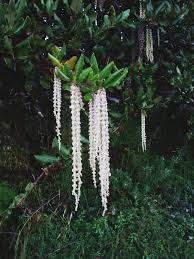
Overview
The Garryaceae family comprises about 15-20 species in two geographically separated genera: Garrya (around 13-18 species) found in western North America, Central America, and the Greater Antilles, and Aucuba (around 3-10 species) native to eastern Asia (Himalayas to Japan). These are typically evergreen shrubs or small trees inhabiting woodlands, chaparral, or forests.
Plants in this family are dioecious, meaning individual plants bear either male or female flowers, but not both. The flowers themselves are small, lack petals (apetalous), and are arranged in dense inflorescences which are famously long, pendulous, and catkin-like (resembling tassels) in male plants of many Garrya species. Female inflorescences are generally shorter and less conspicuous. The leaves are simple, leathery, and arranged oppositely on the stems.
Several species are cultivated as ornamentals. Garrya elliptica (Silk Tassel Bush) is popular for its dramatic winter display of long, silvery-gray male catkins. Aucuba japonica (Japanese Laurel), especially its variegated cultivars ('Variegata' or Gold Dust Plant), is widely grown as a shade-tolerant landscape shrub valued for its glossy foliage and red berries (on female plants).
Quick Facts
- Scientific Name: Garryaceae Lindl.
- Common Name: Silk Tassel Family
- Number of Genera: 2 (Garrya, Aucuba)
- Number of Species: Approximately 15-20
- Distribution: North & Central America, Greater Antilles (Garrya); East Asia (Aucuba).
- Evolutionary Group: Eudicots - Asterids - Lamiids - Garryales
- Key Feature: Evergreen shrubs/trees; opposite leaves; dioecious; apetalous flowers in dense inflorescences (often catkin-like); fruit a berry.
Key Characteristics
Growth Form and Habit
Members of Garryaceae are evergreen shrubs or small trees.
Leaves
Leaves are simple, arranged oppositely along the stem. They are typically leathery (coriaceous) in texture, with entire (untoothed) or sometimes toothed margins (especially in Aucuba). Stipules are absent (exstipulate), though the bases of opposite petioles may be connected by a line across the stem.
Dioecy
Plants are consistently dioecious, with male and female flowers borne on separate individual plants.
Inflorescence
Flowers are arranged in dense, axillary or terminal inflorescences, often described as catkin-like (aments), racemes, or panicles. In many Garrya species, especially the male plants, these are long, pendulous, and tassel-like, subtended by conspicuous paired bracts.
Flowers
Flowers are small, unisexual, actinomorphic (radially symmetrical), and lack petals (apetalous). Wind pollination is likely predominant in Garrya, while insect pollination may occur in Aucuba.
- Male Flowers: Typically possess 4 small sepals (sometimes reduced or absent) and 4 stamens alternating with the sepals. A rudimentary pistil (pistillode) may be present or absent.
- Female Flowers: Sepals are typically 2-4, small, or often absent. Stamens are absent (or present as tiny staminodes). The ovary is inferior (usually) or sometimes superior, composed of 2 or 3 fused carpels, typically forming a single locule with 1 or 2 ovules. Styles are 2 or 3, short and stout.
Fruits and Seeds
The fruit is a berry, typically globose, containing 1 or 2 seeds (rarely 3). The berry may be fleshy or somewhat dry at maturity, often dark purple, blue-black, or red (in Aucuba). Seeds contain endosperm.
Chemical Characteristics
The family is known to produce iridoid glycosides, including aucubin (especially prominent in Aucuba).
Field Identification
Identifying Garryaceae involves recognizing their shrubby habit, opposite leaves, dioecious nature, and characteristic inflorescences or fruits:
Primary Identification Features
- Habit: Evergreen shrubs or small trees.
- Leaves: Opposite, simple, leathery leaves, lacking stipules.
- Dioecious: Male and female flowers on separate plants.
- Inflorescences (Garrya): Dense, often long, pendulous, catkin-like structures ("silk tassels"), especially on male plants in winter/spring.
- Inflorescences (Aucuba): More upright panicles of small, purplish flowers.
- Flowers: Small, lacking petals.
- Fruit: Berry, often dark purple/black (Garrya) or red (Aucuba).
- Distribution: Western N./C. America (Garrya) or East Asia (Aucuba).
Secondary Identification Features
- Leaf Margins: Entire (Garrya) or sometimes toothed (Aucuba).
- Leaf Variegation: Common in cultivated Aucuba japonica ('Variegata').
- Bracts: Conspicuous paired bracts subtending flower clusters in Garrya inflorescences.
Seasonal Identification Tips
- Winter/Early Spring: Male Garrya plants are highly conspicuous due to their long, dangling catkins.
- Spring: Flowers of both genera appear.
- Late Summer/Fall/Winter: Berries mature on female plants.
- Year-round: Evergreen opposite leaves and shrubby habit are constant features.
Common Confusion Points
Garryaceae might be confused with other shrubs having opposite leaves:
- Cornaceae (Dogwood family): Some dogwoods are shrubs/trees with opposite leaves, but they typically have showy flowers (often with large bracts) and drupe fruits, not berries borne from apetalous flowers in catkins.
- Caprifoliaceae (Honeysuckle family - broad sense): Many shrubs with opposite leaves (e.g., Viburnum, Lonicera), but flowers are typically sympetalous (fused petals), often showy, and fruits are berries or drupes arising from flowers with petals.
- Oleaceae (Olive family): Shrubs/trees often with opposite leaves (e.g., Ligustrum, Forsythia, Fraxinus), but flowers typically have 4 fused petals and only 2 stamens. Fruits vary (drupe, samara, capsule).
- Rubiaceae (Coffee family): Often have opposite leaves, but are distinguished by the presence of interpetiolar stipules and typically sympetalous flowers with an inferior ovary.
Aucuba, especially variegated forms, is quite distinctive. Garrya is best recognized by its combination of opposite leathery leaves and the unique tassel-like catkins.
Field Guide Quick Reference
Look For:
- Evergreen shrub/small tree
- Opposite, simple, leathery leaves
- No stipules
- Dioecious (separate M/F plants)
- Dense inflorescences (catkin-like in Garrya)
- Apetalous (no petals) flowers
- Fruit a berry (often dark or red)
- Specific distribution (N/C America or E Asia)
Key Distinctions:
- Opposite leaves + no stipules (vs. Rubiaceae)
- Apetalous flowers (vs. Caprifoliaceae, Cornaceae)
- 4 stamens (male) / Inferior ovary (female) (vs. Oleaceae)
- Catkin-like tassels (male Garrya)
- Berry fruit
Notable Examples
The two genera contain well-known ornamental species:

Garrya elliptica
Silk Tassel Bush / Coast Silktassel
Native to the coastal ranges of California and Oregon. A large shrub popular in cultivation for the long (up to 30 cm), drooping, silvery-gray catkins produced on male plants in winter.

Aucuba japonica
Japanese Laurel / Spotted Laurel
Native to Japan and China. A shade-tolerant shrub widely cultivated for its glossy evergreen leaves. Cultivars like 'Variegata' (Gold Dust Plant) have yellow spots. Female plants produce clusters of bright red berries.
Phylogeny and Classification
Garryaceae is placed in the order Garryales, within the Lamiid clade of Asterids. This small order contains only one other family, the monotypic Eucommiaceae (containing Eucommia ulmoides), which is native to China. The sister relationship between the geographically disjunct Garryaceae (N America/E Asia) and Eucommiaceae (China) is strongly supported by molecular data and represents an interesting biogeographic pattern.
The order Garryales is one of the basal lineages within the large Lamiid clade, which also includes major orders like Gentianales, Lamiales, and Solanales. This placement indicates an early divergence from other Lamiid groups.
Position in Plant Phylogeny
- Kingdom: Plantae
- Clade: Angiosperms (Flowering plants)
- Clade: Eudicots
- Clade: Asterids
- Clade: Lamiids
- Order: Garryales
- Family: Garryaceae
Evolutionary Significance
Garryaceae is significant for understanding Lamiid evolution:
- Basal Lamiid Lineage: Along with Eucommiaceae, it represents an early branch within the Lamiids, helping to understand the ancestral traits of this large and important clade.
- Biogeography: The disjunct distribution between Garrya (Americas) and Aucuba (Asia), and its sister relationship to the Chinese Eucommia, points to ancient connections and vicariance events across the Northern Hemisphere.
- Floral Reduction: The apetalous, often wind-pollinated flowers (especially in Garrya) illustrate trends towards floral simplification seen in various angiosperm lineages.
- Dioecy: Provides examples of the evolution of separate sexes in woody plants.