Fontinalaceae
Water Moss / Fountain Moss Family
The Fontinalaceae family comprises primarily aquatic mosses, commonly known as water mosses or fountain mosses. They are typically found submerged in streams, rivers, lakes, and ponds, often attached to rocks or wood, and are characterized by their long, trailing stems and distinctive three-ranked leaves.
Overview
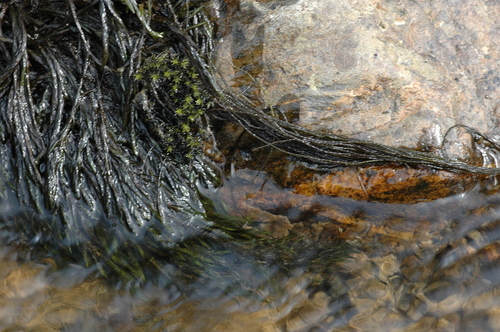
Fontinalaceae is a family of pleurocarpous mosses (meaning sporophytes arise from side branches, not the main stem tip) uniquely adapted to aquatic environments. Unlike most mosses, they spend their entire life cycle submerged or partially submerged in water. Their long, often branched stems can form dense mats or trailing strands in flowing or still water, providing habitat for aquatic invertebrates.
The family is most diverse in temperate regions of the Northern Hemisphere, though some species occur in the Southern Hemisphere. Their specific adaptations to aquatic life, such as the leaf arrangement and structure, make them relatively easy to distinguish from terrestrial mosses and many other aquatic plants.
While ecologically important in aquatic systems, they can sometimes be considered problematic in managed waterways. Sporophytes (capsules) are often produced infrequently or remain hidden among the leaves, making identification reliant primarily on gametophyte characteristics.
Quick Facts
- Scientific Name: Fontinalaceae
- Common Name: Water Moss Family, Fountain Moss Family, Brook Moss Family
- Number of Genera: Approximately 3 (Fontinalis, Dichelyma, Brachelyma)
- Number of Species: Approximately 20-30
- Distribution: Primarily temperate regions of the Northern Hemisphere; some Southern Hemisphere presence. Strictly aquatic.
- Evolutionary Group: Bryophytes - Mosses (Class: Bryopsida)
Key Characteristics
Growth Form and Habit
Plants are pleurocarpous, with long, slender, often branched stems that can range from a few centimeters to over a meter in length. They are typically dark green to brownish or blackish, especially older parts of the stem. Stems attach to submerged substrates (rocks, logs, bridge abutments) via rhizoids, usually near the base, allowing the rest of the plant to float or trail in the current. They often form dense, feathery masses.
Leaves
The most distinctive feature is the leaf arrangement: leaves are typically arranged in three distinct ranks along the stem (tristichous arrangement). Leaves are often keeled (folded lengthwise like the keel of a boat) or strongly concave. A midrib (costa) is usually absent, or very short and double. Leaf shape varies from lanceolate to ovate, and the apex can be pointed or rounded. The structure helps streamline the plant in water currents.
Sporophyte (Capsule)
Sporophytes are produced less frequently than in many terrestrial mosses. When present, they arise from short side branches. The seta (stalk) is very short, resulting in the capsule being partially or almost entirely immersed among the surrounding leaves (perichaetial leaves). The capsule is typically ovoid to cylindrical and possesses an operculum (lid) and a well-developed double peristome (teeth structure regulating spore release), although these features may be hidden by the leaves.
Habitat
Strictly aquatic, found submerged in a variety of freshwater habitats, including fast-flowing streams, slow rivers, lakes, ponds, springs, and ditches. They require permanent water or at least seasonally flooded conditions. Water quality tolerance varies by species.
Field Identification
Identifying Fontinalaceae relies heavily on habitat and the unique gametophyte morphology:
Primary Identification Features
- Aquatic Habitat: The plant must be growing submerged in water (streams, lakes, etc.).
- Three-Ranked Leaves: Carefully observe the stem; leaves should be clearly arranged in three rows. This is best seen near the growing tips.
- Keeled/Concave Leaves: Individual leaves are typically folded or deeply concave.
- Absence of Costa: Most species lack a distinct midrib running up the leaf (or it's very short/double).
- Long, Trailing Stems: Characteristic growth form in water.
Secondary Identification Features
- Leaf Shape: Specific shape (lanceolate, ovate) can help distinguish species within the family.
- Sporophytes (if present): Capsules immersed among leaves on short side branches.
- Color: Often dark green to almost black, especially older parts.
Seasonal Identification Tips
- Year-Round: As submerged aquatic plants in permanent water bodies, they can generally be found and identified throughout the year.
- Low Water Periods: In fluctuating water levels, they might be found stranded on banks but will still exhibit the key leaf characteristics.
Common Confusion Points
- Other Aquatic Mosses: Some Amblystegiaceae (e.g., Leptodictyum, Hygroamblystegium) or Hypnaceae (e.g., Drepanocladus) are aquatic but usually have flattened leaves (not 3-ranked/keeled) and often possess a single, strong costa.
- Aquatic Liverworts: Some liverworts (e.g., Chiloscyphus, Ricciocarpos) are aquatic but have a different structure (flattened thallus or leafy liverworts with underleaves, distinct from the 3-ranked moss leaves).
- Filamentous Algae: Dense growths of filamentous algae can superficially resemble mosses but lack stems and leaves upon closer inspection.
- Aquatic Vascular Plants: Some vascular plants (e.g., certain pondweeds, waterweeds) have small leaves, but their overall structure, presence of roots, and often flowers/seeds distinguish them.
Field Guide Quick Reference
Look For:
- Moss growing submerged in water
- Long, trailing/floating stems
- Leaves clearly in 3 ranks
- Leaves keeled or concave
- Leaves usually without a midrib (costa)
Key Variations:
- Genus Fontinalis most common
- Capsules (if found) immersed on short side branches
- Color often dark green to blackish
Notable Examples
The genus Fontinalis contains the most common and widespread species.

Fontinalis antipyretica
Common Water Moss / Antifever Fontinalis Moss
This is a widespread and often abundant species in the Northern Hemisphere, found in various aquatic habitats from swift streams to calm lakes. It forms large, dark green masses with long stems and distinctly keeled, three-ranked leaves that lack a costa. The specific name "antipyretica" derives from an old belief that it could be used to reduce fevers (due to its cool, wet nature).
Phylogeny and Classification
Fontinalaceae belongs to the Class Bryopsida. Its precise ordinal placement varies among classification systems, often placed within the Isobryales or sometimes associated with the Hypnales. It represents a distinct lineage of pleurocarpous mosses highly specialized for aquatic life.
Molecular data confirms its monophyly and its position among the pleurocarpous mosses. The adaptations for an aquatic existence, such as the tristichous, ecostate (costa-less), keeled leaves and submerged life cycle, are key evolutionary features of the family.
Position in Plant Phylogeny
- Kingdom: Plantae
- Division: Bryophyta (Mosses)
- Class: Bryopsida
- Order: Isobryales / Hypnales (placement varies)
- Family: Fontinalaceae
Evolutionary Significance
The Fontinalaceae family is significant for:
- Extreme Aquatic Specialization: Representing one of the most successful and widespread lineages of fully aquatic mosses.
- Morphological Adaptations: Demonstrating clear adaptations to life in water, such as the 3-ranked, keeled, ecostate leaves for streamlining and possibly gas exchange.
- Ecological Role: Forming important habitats and acting as primary producers in many freshwater ecosystems, contributing to biodiversity and ecosystem function.