Climaciaceae
Tree Moss Family
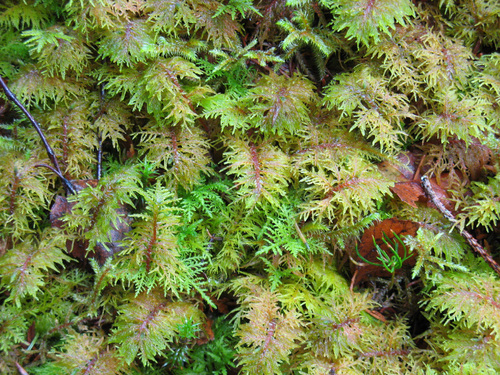
Climaciaceae is a monotypic family of large, robust mosses belonging to the order Hypnales. It contains the single genus Climacium. The family is instantly recognizable by its highly distinctive dendroid (tree-like) habit, resembling miniature trees, and its preference for wet habitats in the Northern Hemisphere.
Overview
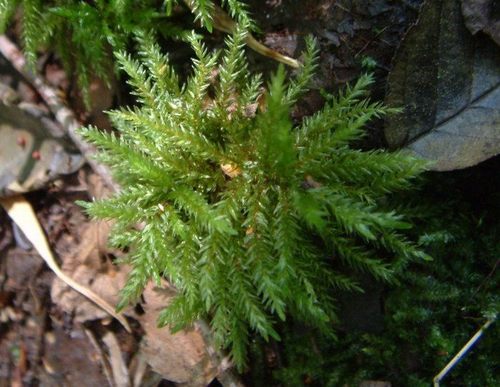
The Climaciaceae family, established by Kindberg, is unique and easily identified as it contains only the genus Climacium, making it monotypic. These are large, striking mosses, famous for their unmistakable dendroid growth form. They possess creeping, often subterranean primary stems (stolons) from which arise stout, erect secondary stems. These secondary stems are unbranched below (forming a 'trunk' or stipe) and then branch profusely above in a tree-like manner, creating a distinct crown or frond.
Climacium species are typically found in moist to wet environments, often forming extensive colonies in swamps, fens, wet meadows, along stream banks and lake shores, or in wet depressions within forests. They show a clear preference for neutral to slightly acidic conditions.
The family has a broad distribution across temperate and boreal regions of the Northern Hemisphere (North America, Europe, Asia). While historically sometimes placed in its own order (Climaciales) or near Leucodontales due to its unique habit, molecular data generally place Climaciaceae within the large pleurocarpous order Hypnales.
Quick Facts
- Scientific Name: Climaciaceae Kindb.
- Common Name: Tree Moss Family
- Number of Genera: 1 (Climacium F. Weber & D. Mohr)
- Number of Species: 1-2 (Primarily C. dendroides, sometimes C. americanum recognized)
- Distribution: Northern Hemisphere temperate and boreal regions.
- Evolutionary Group: Bryophytes - Mosses (Class Bryatae - Order Hypnales)
Key Characteristics (Moss Features)
Gametophyte (Leafy Plant)
The dominant stage. Plants large, robust, forming loose colonies or tufts with a distinct tree-like appearance.
- Habit: Unmistakably dendroid.
- Primary Stem (Stolon): Creeping horizontally, often subterranean or subsurface, bearing rhizoids and reduced scale-like leaves.
- Secondary Stem: Erect, stout, 'trunk-like' (stipitate) below, densely and repeatedly branched above (pinnately or fasciculately) forming a distinct crown resembling a miniature tree.
- Leaves (Phyllids): Clearly dimorphic. Stolon leaves are small, appressed, scale-like. Secondary stem (stipe) leaves are also somewhat appressed and scale-like. Branch leaves are larger, crowded, erect-spreading to spreading, broadly ovate, strongly concave, often somewhat plicate (pleated). Apex broadly acute to obtuse. Margins typically serrated, especially towards the apex.
- Costa (Midrib): Single and strong, prominent, extending almost to the leaf apex but usually ending just below it.
- Leaf Cells: Mostly rhomboidal to linear, smooth-walled. Alar cells at the basal corners are usually differentiated, forming distinct groups.
Reproductive Structures (Gametophyte)
Antheridia and archegonia are borne in lateral buds, typically on the primary stems (stolons) or near the base of the secondary stems.
Sporophyte (Spore-Producing Structure)
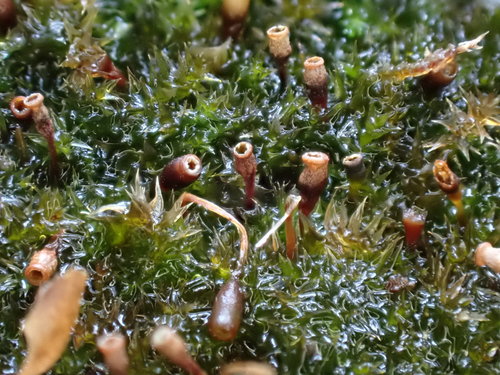
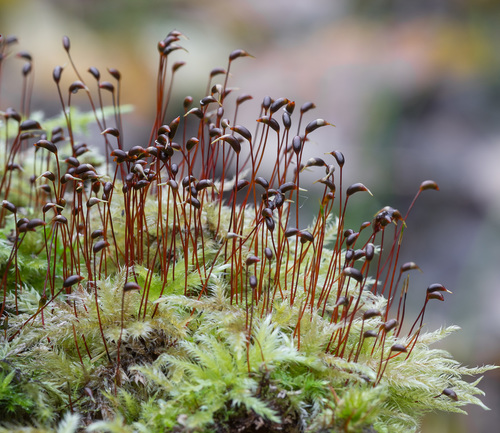
Arises laterally from the stolons or base of secondary stems, often produced infrequently. Consists of:
- Seta: Long, smooth, usually reddish.
- Capsule (Sporangium): Usually erect and symmetric or nearly so, cylindrical. Operculum typically conical to rostrate.
Peristome
Typically double and well-developed (hypnoid type). Consists of 16 outer exostome teeth and an inner endostome with segments and cilia.
Field Identification
Identifying Climaciaceae (Climacium) is usually straightforward due to its unique growth form:
Primary Identification Features
- Unmistakable Dendroid Habit: The most defining feature. Look for robust mosses growing like miniature trees, with erect, branched 'crowns' arising from creeping stems.
- Large Size: Plants are relatively large compared to many other mosses.
- Wet Habitat Preference: Typically found in swamps, fens, wet meadows, stream banks, lake shores, and other moist to wet environments.
- Northern Hemisphere Distribution: Found across temperate and boreal North America, Europe, and Asia.
- Branch Leaf Features: Branch leaves are broad, concave, often somewhat pleated, with a strong single costa (use hand lens).
Common Confusion Points
- Other Dendroid Mosses: While other moss families contain dendroid species (e.g., Hypnodendraceae, some Pterobryaceae), they generally differ significantly in geographic distribution (mostly Southern Hemisphere or tropical), branching patterns, leaf details (e.g., costa, cell structure), or sporophyte position/structure. In the Northern Hemisphere, Climacium is highly distinctive.
- Large Pleurocarps in Wet Areas: Some large Hylocomiaceae (like Hylocomium splendens) or Amblystegiaceae might grow nearby but lack the distinct 'trunk-and-crown' dendroid structure of Climacium.
Field Guide Quick Reference
Look For:
- Miniature tree-like (dendroid) moss (key!)
- Large, robust plants
- Erect branched 'crowns' on 'trunks'
- Creeping primary stems (may be hidden)
- Habitat: Swamps, fens, wet meadows, stream banks
- Branch leaves broad, concave, strong costa
- Northern Hemisphere
Key Variations:
- Density of crown branching
- Color (green to yellowish-brown)
- Frequency of sporophytes
- (Minor variations between C. dendroides and C. americanum if recognized)
Notable Examples
The family contains the single genus Climacium:

Climacium dendroides
European Tree Moss, Common Tree Moss
The most widespread species, found across the Northern Hemisphere. It perfectly exemplifies the family's dendroid habit, forming conspicuous colonies in wet habitats. Often used in floral arrangements or models due to its shape.

Climacium americanum
American Tree Moss
Found primarily in eastern North America. Very similar to C. dendroides and often treated as a variety or subspecies. It may differ subtly in branching density or capsule characteristics.
Phylogeny and Classification
Climaciaceae is classified within the Class Bryatae (true mosses). While its strikingly unique dendroid morphology led to historical suggestions of placement in its own order (Climaciales) or near Leucodontales, current molecular phylogenetic data generally place it within the large pleurocarpous order Hypnales.
Within Hypnales, Climaciaceae represents a morphologically highly divergent and somewhat isolated lineage. Its exact relationships to other families within the order are still subject to research, but it is clearly distinct from other dendroid moss families found predominantly in the Southern Hemisphere or tropics. Its evolution represents a remarkable case of specialized growth form adaptation within the pleurocarpous mosses.
Position in Plant Phylogeny
- Kingdom: Plantae
- Division: Bryophyta (Mosses)
- Class: Bryatae (or Bryopsida)
- Order: Hypnales
- Family: Climaciaceae
Evolutionary Significance
Climaciaceae is highly significant due to its dramatic dendroid growth form, one of the most striking examples of complex architecture among mosses. This 'miniature tree' structure is a remarkable adaptation, likely maximizing light capture and potentially aiding spore dispersal in its typical wet, open, or semi-shaded habitats. As a monotypic family with a wide Northern Hemisphere distribution, it provides insights into bryophyte evolution, adaptation, and biogeography within the Hypnales.