Escalloniaceae
Escallonia Family
The Escalloniaceae is a family of flowering plants comprising shrubs and trees, placed in its own order, Escalloniales, within the Campanulid clade of Asterids. The family is primarily distributed in the Southern Hemisphere, particularly South America (Andes), Australia, and New Zealand, with one genus on Réunion Island. It includes the widely cultivated ornamental genus Escallonia.
Overview
The Escalloniaceae family includes about 7-9 genera and approximately 130 species. These are woody plants, ranging from small shrubs to medium-sized trees, often evergreen. Their distribution is characteristically Southern Hemisphere temperate and montane, with notable diversity in the Andes mountains and Australasia.
Members of this family often have simple leaves that are frequently toothed and gland-dotted, lacking stipules. The flowers are typically 5-merous, with 5 distinct petals and 5 stamens, often arranged in terminal racemes or panicles. The ovary position can vary from superior to inferior within the family. The fruit is most commonly a capsule.
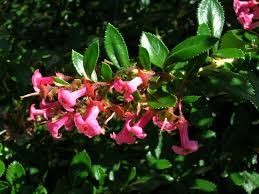
The genus Escallonia is widely cultivated in temperate regions worldwide for its attractive, often pink or red, tubular flowers and glossy evergreen foliage, frequently used as hedging plants. Other genera like Polyosma contribute to forest ecosystems in Australasia. The family now includes genera formerly placed in their own small families, such as Tribeles (Tribelaceae) and Eremosyne (Eremosynaceae).
Quick Facts
- Scientific Name: Escalloniaceae R.Br. ex Dumort.
- Common Name: Escallonia Family
- Number of Genera: Approximately 7-9 (e.g., Escallonia, Polyosma, Tribeles, Valdivia)
- Number of Species: Approximately 130
- Distribution: Primarily Southern Hemisphere (esp. South America, Australasia), Réunion Island.
- Evolutionary Group: Eudicots - Asterids - Campanulids - Escalloniales
- Key Feature: Shrubs/trees; simple, often serrated, gland-dotted leaves without stipules; 5-merous flowers with 5 stamens; fruit usually a capsule.
Key Characteristics
Growth Form and Habit
Members of Escalloniaceae are evergreen or deciduous shrubs and small to medium-sized trees.
Leaves
Leaves are usually simple (rarely pinnately lobed in Eremosyne), arranged alternately or oppositely (sometimes whorled). Leaf margins are typically serrated or crenated, sometimes entire. Leaves are often dotted with glands (visible as small dots) and lack stipules or have only minute ones.
Inflorescence
Flowers are arranged in terminal or axillary inflorescences, commonly racemes or panicles, sometimes cymes or solitary flowers.
Flowers
Flowers are usually actinomorphic (radially symmetrical), bisexual (rarely unisexual), and typically 5-merous (sometimes 4-9 merous).
- Calyx: Consists of 5 (or 4-9) sepals, usually fused at the base into a tube, persistent in fruit.
- Corolla: Consists of 5 (or 4-9) distinct (free) petals, often white, pink, or red, sometimes clawed at the base.
- Androecium: Stamens are typically 5 (equal in number to petals and alternating with them), inserted on or around a nectar-producing disc. Filaments are distinct.
- Gynoecium: Ovary position varies from superior to inferior depending on the genus. It is composed of 2-5 fused carpels, forming an equal number of locules (or sometimes 1 locule). Placentation is typically axile (sometimes parietal). Styles are usually fused into one (sometimes free), with a capitate or slightly lobed stigma. A nectar disc is usually present.
Fruits and Seeds
The fruit is most commonly a septicidal or loculicidal capsule containing numerous small seeds. Less often, the fruit can be a berry (e.g., in Polyosma). Seeds usually contain endosperm.
Chemical Characteristics
The family is known to produce iridoids, tannins, and saponins. Aluminum accumulation has been noted in some genera (e.g., Polyosma).
Field Identification
Identifying members of the Escalloniaceae family often relies on a combination of vegetative and floral characters, along with geographic location:
Primary Identification Features
- Habit: Shrubs or trees, often evergreen.
- Distribution: Primarily Southern Hemisphere temperate/montane regions.
- Leaves: Simple, alternate or opposite, often serrated margins, frequently gland-dotted (hold up to light).
- Stipules: Absent or minute.
- Flowers: Typically 5 petals and 5 stamens, often in terminal clusters (racemes/panicles).
- Fruit: Usually a capsule, sometimes a berry.
Secondary Identification Features
- Petal Shape: Petals often distinct and sometimes clawed.
- Ovary Position: Inferior (e.g., Escallonia, Polyosma) to superior (e.g., Tribeles) - varies by genus.
- Nectar Disc: Often present at the base of the ovary or surrounding the stamens.
- Habitat: Montane forests, shrublands, temperate woodlands.
Seasonal Identification Tips
- Flowering Season: Typically spring or summer, when the often showy flowers (especially in Escallonia) are present.
- Fruiting Season: Capsules or berries develop later. Persistent capsules can sometimes aid identification.
- Year-round: Leaf arrangement, shape, margin (serrated), presence of glandular dots, and absence of stipules are useful vegetative characters.
Common Confusion Points
Escalloniaceae can be confused with members of other families, especially those with simple, serrated leaves:
- Rosaceae (Rose family): Many shrubs/trees with simple, serrated leaves, but usually have numerous stamens (>10) and often possess stipules. Floral structure (hypanthium) differs.
- Grossulariaceae (Gooseberry family): Shrubs with often palmately lobed leaves, inferior ovary, and fruit a berry. Flowers have 5 stamens but different structure.
- Hydrangeaceae (Hydrangea family): Often shrubs with opposite leaves, flowers typically 4-5 merous with variable stamen number, inferior ovary, fruit a capsule. Lack glandular dots on leaves.
- Cunoniaceae: Often have opposite, compound leaves (though some simple), usually with conspicuous interpetiolar stipules.
Field Guide Quick Reference
Look For:
- Shrubs or trees (often S. Hemisphere)
- Simple leaves (alt/opp), often serrated
- Leaves often gland-dotted
- Stipules absent or minute
- 5 petals, 5 stamens (usually)
- Flowers often in terminal racemes/panicles
- Fruit usually a capsule
Key Distinctions:
- 5 stamens (vs. numerous in Rosaceae)
- Absence of stipules (vs. Rosaceae, Cunoniaceae)
- Glandular leaf dots often present
- Ovary position variable (inf/sup)
- Compare fruit type (capsule vs. berry/drupe)
Notable Examples
The family includes well-known ornamentals and ecologically significant species:

Escallonia rubra
Red Escallonia
A species native to Chile and Argentina, widely cultivated as an ornamental shrub or hedge, particularly in coastal areas. Known for its glossy green leaves and abundant clusters of red or deep pink tubular flowers.

Polyosma cunninghamii
Featherwood
A small tree native to rainforests of eastern Australia. Characterized by opposite, toothed leaves, fragrant white flowers in terminal racemes, and black, olive-like berry fruits.

Tribeles australis
No widely accepted common name
A small, creeping or mat-forming evergreen shrublet native to southern Chile, Argentina, and the Falkland Islands. Formerly placed in its own family (Tribelaceae), it has small leaves and inconspicuous flowers with a superior ovary.
Phylogeny and Classification
Escalloniaceae is placed in its own monofamilial order, Escalloniales, within the Campanulid clade of Asterids. This placement is strongly supported by molecular phylogenetic data. The Escalloniales represents an early diverging lineage within the Campanulids, sister to the large and diverse order Asterales (which includes Asteraceae, Campanulaceae, Menyanthaceae, Goodeniaceae, etc.).
The family's circumscription has been expanded based on molecular evidence to include genera previously placed in small families like Tribelaceae (Tribeles), Eremosynaceae (Eremosyne), and sometimes Polyosmaceae (Polyosma), confirming that these represent specialized lineages within a broader Escalloniaceae clade. This phylogenetic position highlights the family as an important link in understanding the early evolution of the Campanulid group.
Position in Plant Phylogeny
- Kingdom: Plantae
- Clade: Angiosperms (Flowering plants)
- Clade: Eudicots
- Clade: Asterids
- Clade: Campanulids
- Order: Escalloniales
- Family: Escalloniaceae
Evolutionary Significance
Escalloniaceae holds evolutionary importance due to:
- Basal Campanulid Position: As the sister group to the large Asterales order, it provides crucial insights into the ancestral characteristics and early diversification of the Campanulid clade.
- Biogeography: Its predominantly Southern Hemisphere distribution suggests ancient origins, possibly linked to the breakup of Gondwana, followed by diversification in specific regions like the Andes.
- Morphological Variability: The variation in ovary position (superior to inferior) within the family illustrates evolutionary transitions in floral architecture.
- Taxonomic History: The inclusion of formerly separate small families based on molecular data demonstrates the power of phylogenetics in refining classification systems.