Ebenaceae
Ebony / Persimmon Family
Ebenaceae is a family of flowering plants comprising trees and shrubs distributed throughout the tropics and some temperate regions. It is best known for producing valuable dark hardwood (ebony) and edible fruits (persimmons) from the large genus Diospyros. Key characteristics include simple, alternate leaves without stipules, usually unisexual flowers with fused petals, and berry fruits often subtended by an enlarged, persistent calyx. The family belongs to the order Ericales.
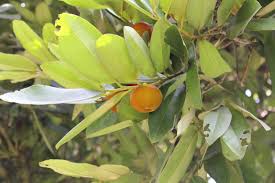
Overview
The Ebenaceae family includes about 4 genera and 750-800 species, overwhelmingly dominated by the genus Diospyros. The family has a pantropical distribution, extending into temperate zones in North America and East Asia. Members typically inhabit forests and woodlands across a range of altitudes.
These plants are trees or shrubs, often recognized by their hard, dark heartwood (ebony) in certain species. They typically have simple, alternate, entire leaves lacking stipules. Most species are dioecious, bearing small, inconspicuous, unisexual flowers with fused petals (sympetalous). A defining feature is the fruit, a fleshy berry, which is characteristically subtended or partially enclosed by the persistent and often significantly enlarged calyx lobes from the flower. Phylogenetically, Ebenaceae is placed within the Asterid order Ericales, related to families like Sapotaceae and Lecythidaceae.
The family holds significant economic importance for its valuable timber (ebony) used in fine furniture, musical instruments, and carving, and for its edible fruits (persimmons), which are cultivated worldwide.
Quick Facts
- Scientific Name: Ebenaceae Gürke
- Common Name: Ebony Family, Persimmon Family
- Number of Genera: Approximately 4
- Number of Species: Approximately 750-800
- Distribution: Pantropical, extending into temperate regions.
- Evolutionary Group: Angiosperms - Eudicots - Asterids - Ericales
- Habit: Trees or shrubs.
Key Characteristics
Growth Form and Habit
Plants are typically trees or shrubs, ranging from small shrubs to large trees. They are often evergreen but can be deciduous in temperate or seasonally dry areas. Many species, especially in Diospyros, develop very hard, dense, dark (often black) heartwood known as ebony.
Leaves
Leaves are usually arranged alternately (spirally, sometimes appearing 2-ranked), rarely opposite or whorled. They are simple with typically entire margins, and often have a leathery (coriaceous) texture. Leaves lack stipules. Small black dots (glandular structures) may be visible on the leaf undersurface in some species.
Inflorescence
Flowers are borne in small, axillary cymes or fascicles (clusters), or are sometimes solitary, especially female flowers.
Flowers
Flowers are usually unisexual (plants typically dioecious, less commonly monoecious or polygamous), sometimes bisexual (Lissocarpa). They are radially symmetrical (actinomorphic) and typically (3-)4-5(-7)-merous. Flowers are often relatively small and inconspicuous, usually whitish, cream, yellowish, or pinkish.
- Calyx: Consists of (3-)4-5(-7) sepals, which are fused at the base into a calyx tube. The calyx is notably persistent and often enlarges considerably after flowering, becoming leathery or woody and forming a cup or saucer structure at the base of the fruit.
- Corolla: Consists of (3-)4-5(-7) petals that are fused (sympetalous) for at least part of their length, typically forming an urn-shaped (urceolate), bell-shaped (campanulate), or tubular corolla with spreading lobes. The corolla usually falls off after flowering (deciduous).
- Androecium (Male or Bisexual Flowers): Stamens usually number (1-)2-4 times the number of corolla lobes (e.g., 8-20 stamens for a 4- or 5-lobed corolla), often arranged in 1-4 whorls. Filaments are typically short and attached to the base of the corolla tube (epipetalous) or the receptacle. Filaments can be free or fused in pairs or bundles. Anthers open by longitudinal slits. Male flowers usually contain a rudimentary, non-functional pistil (pistillode).
- Gynoecium (Female or Bisexual Flowers): Features a superior ovary composed of 2-8 (up to 16) fused carpels, forming an equal number of locules (chambers), or sometimes twice as many locules due to the formation of false septa. Styles are usually 2-8, free or fused only at the base, often forked (bifid). Each locule (or half-locule) typically contains 1 (sometimes 2) pendulous ovules attached near the apex (apical-axile placentation). Female flowers often possess sterile stamens (staminodes).
Fruits and Seeds
The fruit is a fleshy or sometimes leathery berry, often globose or ovoid. It typically contains 1 to several (up to 16) large seeds. A highly characteristic feature is that the berry is almost always subtended or partially enclosed by the persistent and enlarged calyx. Seeds are large with abundant, very hard endosperm (which can be smooth or ruminate - mottled/furrowed).
Chemical Characteristics
Plants often contain tannins (contributing to astringency of unripe fruit) and characteristic naphthoquinones (like diospyrin), which contribute to the dark color of the heartwood and bark. Triterpenoids are also common.
Field Identification
Identifying Ebenaceae often relies on vegetative features combined with the highly characteristic fruit:
Primary Identification Features
- Tree or shrub habit.
- Alternate, simple, entire leaves: Check arrangement, shape, and smooth margins.
- Lack of stipules: No appendages or scars at the petiole base.
- Dioecious condition common: Look for plants bearing only male or only female flowers/fruits.
- Small, sympetalous flowers: Flowers have fused petals, often urn- or bell-shaped, typically 4-5 parts.
- Berry fruit with enlarged persistent calyx: The most diagnostic feature. Look for fleshy berries sitting in or enclosed by the often woody, enlarged remnants of the sepals.
Secondary Identification Features
- Dark heartwood (Ebony): Visible in cut stems or logs of some Diospyros.
- Black dots on leaf underside (some species).
- Superior ovary (in flower).
- Distribution: Pantropical or temperate regions known for persimmons/ebonies.
Seasonal Identification Tips
Fruits and their persistent calyces are often key:
- Year-round: Habit, leaf arrangement/shape (often evergreen), and lack of stipules are constant. Old, persistent calyces might be visible on branches even after fruit has gone. Dark wood visible if cut.
- Flowering Season (Varies): Small, often inconspicuous sympetalous flowers appear in axillary clusters.
- Fruiting Season: Developing or mature berries subtended by the enlarging calyx are highly characteristic and often conspicuous (e.g., persimmons).
Common Confusion Points
Distinguishing Ebenaceae from families with some similar features:
- Sapotaceae: Also trees/shrubs in Ericales, often with simple alternate entire leaves, but frequently possess milky latex, flowers often have staminodes alternating with fertile stamens, and fruit is a berry usually without a significantly enlarged persistent calyx.
- Annonaceae: Tropical trees/shrubs with simple alternate entire leaves, but belong to Magnoliales, have different flower structure (often 3-merous, numerous stamens/carpels, free petals), and different fruit types (aggregates or syncarps).
- Lauraceae: Trees/shrubs with simple alternate entire leaves, but usually aromatic, lack stipules, flowers typically 6 tepals (3+3), superior ovary, fruit a drupe often with a cupule.
- Clusiaceae (Guttiferae): Often opposite leaves, frequently with latex, different flower structure (often numerous stamens), superior ovary, fruit a berry or capsule, calyx not typically enlarging around fruit.
- Focus on the combination: Tree/Shrub + Alternate Simple Entire Leaves + No Stipules + Dioecious (often) + Sympetalous Flowers + Superior Ovary + Berry Fruit with Enlarged Persistent Calyx = Ebenaceae.
Field Guide Quick Reference
Look For:
- Tree or shrub
- Leaves: Alternate (usually), Simple, Entire
- No stipules
- Dioecious common
- Flowers: Small, (3-)4-5(-7)-merous
- Corolla: Petals fused (sympetalous)
- Ovary: Superior
- Fruit: Berry
- Calyx: Persistent and Enlarged around fruit base
- Dark heartwood (Ebony) possible
Key Variations:
- Number of floral parts (4 vs. 5 common)
- Degree of calyx enlargement varies
- Fruit size and color varies greatly
- Presence/absence of valuable ebony wood
Notable Examples
The family is dominated by the large genus Diospyros, source of persimmons and ebonies:

Diospyros kaki
Japanese Persimmon / Kaki
A widely cultivated deciduous tree native to East Asia, grown for its large, sweet, orange berry fruits which have a prominent persistent calyx. Numerous cultivars exist.

Diospyros virginiana
American Persimmon
A deciduous tree native to the eastern United States. Produces smaller, highly astringent fruits (until fully ripe) than D. kaki. Wood is hard and durable.

Diospyros ebenum
Ceylon Ebony / Indian Ebony
Native to southern India and Sri Lanka. A source of true, jet-black, fine-grained ebony wood, highly valued for furniture, carving, and musical instrument parts (e.g., piano keys).

Euclea crispa
Blue Guarri
A common shrub or small tree in southern Africa, representing the genus Euclea. Often has wavy leaf margins and produces small, dark berry fruits subtended by a small calyx. Used in traditional medicine.
Phylogeny and Classification
Ebenaceae is placed within the large order Ericales, a major lineage within the Asterid clade of eudicots. This placement is strongly supported by molecular phylogenetic studies.
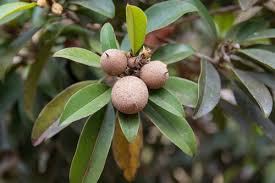
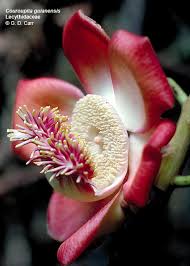
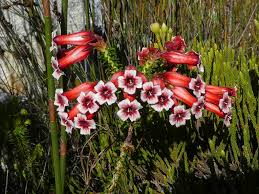
Within Ericales, Ebenaceae forms a well-supported clade with the families Sapotaceae (Sapodilla family) and Lecythidaceae (Brazil Nut family). This group represents one of the major lineages within the order, characterized by woody habit and often tropical distributions. The inclusion of the small family Lissocarpaceae (one genus, Lissocarpa) within Ebenaceae is also supported by recent molecular work. Ericales itself is highly diverse, containing families ranging from heaths and blueberries (Ericaceae) to teas (Theaceae), primroses (Primulaceae), and even carnivorous pitcher plants (Sarraceniaceae).
Position in Plant Phylogeny
- Kingdom: Plantae
- Clade: Angiosperms (Flowering plants)
- Clade: Eudicots
- Clade: Asterids
- Order: Ericales
- Family: Ebenaceae
Evolutionary Significance
Ebenaceae is significant for several reasons:
- Economic Importance: Provides globally important resources: valuable hardwood (ebony) and edible fruits (persimmons).
- Pantropical Distribution: Its wide distribution across tropical and some temperate regions makes it important for biogeographic studies understanding the evolution and dispersal of tropical floras.
- Chemical Diversity: Produces characteristic secondary metabolites like naphthoquinones, relevant to wood properties and potentially plant defense.
- Phylogenetic Position: Its relationship with Sapotaceae and Lecythidaceae helps define major clades within the diverse Ericales order.
- Dioecy: The prevalence of separate sexes (dioecy) in the family provides systems for studying the evolution of plant reproductive strategies.