Droseraceae
Sundew Family
Droseraceae is a family of carnivorous flowering plants, famous for including the sundews (Drosera), the Venus flytrap (Dionaea muscipula), and the waterwheel plant (Aldrovanda vesiculosa). These mostly perennial herbs are adapted to nutrient-poor environments worldwide and capture prey using active traps involving sticky glandular hairs or rapid snap mechanisms. The family belongs to the order Caryophyllales.
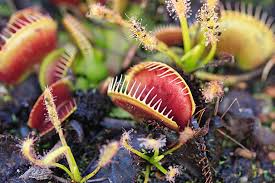
Overview
The Droseraceae family comprises 3 genera and over 200 species, with the vast majority belonging to the cosmopolitan genus Drosera (sundews). Dionaea (Venus flytrap) is monotypic and endemic to the Carolinas (USA), while Aldrovanda (waterwheel plant) is also monotypic and has a scattered distribution across the Old World and Australia. These plants typically inhabit nutrient-poor, acidic wetlands such as bogs, fens, and seepages.
The defining characteristic of the family is carnivory, achieved through highly modified leaves functioning as active traps. Sundews use stalked glands (tentacles) producing sticky mucilage, often combined with leaf movement, to ensnare and digest prey. The Venus flytrap and waterwheel plant utilize rapid snap-trap mechanisms triggered by sensitive hairs. Flowers are typically 5-parted and borne on stalks (scapes) that elevate them above the traps. Phylogenetically, Droseraceae is a core member of the carnivorous clade within the order Caryophyllales, closely related to Nepenthaceae (pitcher plants) and Drosophyllaceae.
Many species are popular in cultivation among carnivorous plant enthusiasts, but some face threats in the wild due to habitat destruction and poaching.
Quick Facts
- Scientific Name: Droseraceae Salisb.
- Common Name: Sundew Family
- Number of Genera: 3 (Drosera, Dionaea, Aldrovanda)
- Number of Species: Approximately 200+
- Distribution: Cosmopolitan (all continents except Antarctica), especially diverse in Australia and South Africa.
- Evolutionary Group: Angiosperms - Eudicots - Core Eudicots - Caryophyllales
- Habit: Carnivorous herbs (mostly perennial), often forming rosettes.
Key Characteristics
Growth Form and Habit
Plants are mostly perennial (rarely annual) carnivorous herbs. Many form basal rosettes of leaves (e.g., most Drosera, Dionaea). Some Drosera species have erect, scrambling, or climbing stems. Aldrovanda is a free-floating, rootless aquatic herb.
Leaves
Leaves are usually arranged alternately or in basal rosettes. They are simple but highly modified into active traps for capturing small invertebrates (mostly insects).
- Drosera (Sundews): Leaves bear stalked glands (tentacles) that secrete sticky mucilage droplets (resembling dew, hence "sundew"). Insects are trapped by the mucilage, and often the tentacles and/or the entire leaf blade will bend or curl inwards to increase contact and aid digestion (flypaper trap). Leaf shape is highly variable across the genus (e.g., round, linear, paddle-shaped, forked).
- Dionaea (Venus Flytrap): Leaves consist of a flat petiole and a hinged, bilobed blade forming a snap trap. The inner surface has sensitive trigger hairs (usually 3 per lobe). When triggered appropriately, the lobes snap shut rapidly along the midrib, trapping prey within marginal interlocking "teeth" (modified leaf edge).
- Aldrovanda (Waterwheel Plant): Leaves are arranged in whorls along the floating stem. Each leaf is modified into a small (few mm), underwater snap trap, similar in function to Dionaea, capturing small aquatic invertebrates.
Stipules are present or absent; if present, they are often membranous or fused to the petiole.
Inflorescence
In Drosera and Dionaea, flowers are typically borne on a leafless stalk (scape) arising from the center of the rosette or stem apex. The inflorescence is usually a cyme or raceme, often one-sided and uncoiling as flowers open (scorpioid cyme). The scape elevates the flowers above the traps. In Aldrovanda, flowers are solitary on short pedicels arising from the leaf whorls.
Flowers
Flowers are usually bisexual, radially symmetrical (actinomorphic), and typically 5-merous (sometimes 4- to 8-merous).
- Calyx: Usually consists of 5 sepals (range 4-8), free or fused at the base, persistent in fruit.
- Corolla: Usually consists of 5 free petals (range 4-8), often white or pink (sometimes other colors), typically twisted (convolute) in bud and sometimes closing after flowering.
- Androecium: Usually contains 5 stamens (range 4-20), alternating with the petals. Filaments are free. Anthers have two pollen sacs and open via longitudinal slits. Pollen grains are often released united in tetrads.
- Gynoecium: Features a superior ovary composed of 3 (sometimes up to 5) fused carpels, forming a single chamber (unilocular). Ovules are numerous, attached to parietal placentas (on the ovary wall) or a basal placenta. Styles are usually 3 (or as many as carpels), free or fused only at the base, often branched, forked, or divided, with various stigma shapes.
Fruits and Seeds
The fruit is typically a loculicidal capsule, opening by 3 (or more) valves corresponding to the number of carpels. It contains numerous, very small seeds. Endosperm is present.
Chemical Characteristics
Plants produce various digestive enzymes (proteases, phosphatases, chitinases) secreted by glands on the leaves to break down captured prey. They also contain characteristic pigments, including naphthoquinones like plumbagin (giving reddish hues) and ellagic acid.
Field Identification
Identifying Droseraceae relies primarily on recognizing their carnivorous nature and specific trap types:
Primary Identification Features
- Carnivorous habit: Plants clearly adapted for trapping invertebrates.
- Active traps on leaves: Look for either:
- Sticky glandular tentacles covering leaf surface (Drosera - Sundews).
- Hinged, bilobed snap traps with trigger hairs/teeth (Dionaea - Venus Flytrap; or tiny underwater versions in Aldrovanda).
- Herbaceous form, often basal rosettes: Most are small, non-woody plants growing low to the ground (except Aldrovanda which is aquatic).
- Flowers on scapes (usually): Flowers typically elevated on leafless stalks above the rosette (Drosera, Dionaea).
- 5-parted flowers (usually): Flowers typically have 5 sepals, 5 petals, 5 stamens.
- Superior ovary / Capsule fruit: Ovary sits above petal/sepal attachment; fruit is a dry capsule.
Secondary Identification Features
- Nutrient-poor, wet habitats: Typically found in bogs, fens, seepages, wet sands, or acidic soils (or free-floating aquatic for Aldrovanda).
- Reddish coloration: Many species develop red pigments (naphthoquinones) in sunlight.
- Pollen in tetrads: Microscopic feature.
Seasonal Identification Tips
Traps are often the most reliable feature:
- Growing Season: Leaves with active traps are present and diagnostic. Basal rosettes or specific stem forms are visible.
- Flowering Season (Often spring/summer): Flowers appear on scapes (or axillary in Aldrovanda).
- Dormant Season (Temperate/Alpine species): May die back to a dormant bud (hibernaculum) or rootstock. Evergreen species retain leaves.
Common Confusion Points
Distinguishing Droseraceae from other carnivorous or rosette-forming plants:
- Lentibulariaceae (Pinguicula - Butterworts): Also have sticky "flypaper" traps, but glands are sessile (flat on leaf surface), not stalked tentacles. Flowers are strongly bilateral (zygomorphic) with a spur. Different order (Lamiales).
- Lentibulariaceae (Utricularia - Bladderworts): Aquatic or terrestrial herbs with highly complex underground or underwater suction traps (bladders). Flowers also bilateral with spurs.
- Saxifragaceae (Saxifrage family): Many form rosettes in similar habitats (e.g., bogs, rocks), but lack carnivorous traps and usually have free petals and different gynoecium structure.
- Focus on the trap type: Stalked sticky glands = Drosera. Hinged snap trap = Dionaea (terrestrial) or Aldrovanda (aquatic). Combine with radial 5-parted flowers (usually) on scapes (usually) and superior ovary/capsule fruit.
Field Guide Quick Reference
Look For:
- Carnivorous herb (often rosette)
- Active traps on leaves:
- Sticky stalked glands (Tentacles - Drosera)
- Hinged Snap Traps (Dionaea, Aldrovanda)
- Flowers usually on scapes
- Flowers: Usually 5-parted, radial
- Petals free
- Stamens usually 5
- Ovary: Superior, 3(-5) carpels, unilocular
- Fruit: Capsule
- Nutrient-poor wet habitats
Key Variations:
- Trap type (sticky vs. snap)
- Habit (rosette vs. stemmed vs. aquatic)
- Leaf shape highly variable (Drosera)
- Flower color (white, pink common)
Notable Examples
The family includes some of the most well-known carnivorous plants:

Drosera rotundifolia
Round-leaved Sundew
A widespread species found across the Northern Hemisphere in bogs and wet habitats. Forms a basal rosette of round, spoon-shaped leaves covered in red sticky tentacles. Produces a scape with small white flowers.

Drosera capensis
Cape Sundew
Native to South Africa, this is one of the most commonly cultivated sundews due to its ease of care. Has long, strap-shaped leaves covered in prominent tentacles and produces scapes of pink flowers. Tentacles show noticeable movement.

Dionaea muscipula
Venus Flytrap
Iconic carnivorous plant endemic to coastal plain bogs in North and South Carolina, USA. Forms a rosette of leaves modified into hinged snap traps that close rapidly when trigger hairs are stimulated. Produces a scape of white flowers.

Aldrovanda vesiculosa
Waterwheel Plant
A free-floating, rootless aquatic carnivorous plant with a scattered Old World/Australian distribution. Possesses whorls of small leaves modified into underwater snap traps, functioning similarly to the Venus flytrap but much faster. Flowers are small, solitary.
Phylogeny and Classification
Droseraceae belongs to the order Caryophyllales, a large order within the core eudicots. Molecular phylogenetics has robustly placed Droseraceae within a well-supported "carnivorous clade" inside this order.
This carnivorous clade includes families possessing various trapping mechanisms: Droseraceae (sticky tentacles, snap traps), Nepenthaceae (Old World pitcher traps), Drosophyllaceae (sticky flypaper traps), Ancistrocladaceae (lianas with hooks, non-carnivorous), and Dioncophyllaceae (hooks and sometimes sticky traps). This grouping suggests a single origin or predisposition for carnivory (or related glandular structures) within this lineage of Caryophyllales. Droseraceae itself is likely sister to Nepenthaceae or a clade containing Nepenthaceae and Drosophyllaceae.
Position in Plant Phylogeny
- Kingdom: Plantae
- Clade: Angiosperms (Flowering plants)
- Clade: Eudicots
- Clade: Core Eudicots
- Order: Caryophyllales
- Family: Droseraceae
Evolutionary Significance
Droseraceae is highly significant for studying plant evolution:
- Evolution of Carnivory: Provides outstanding examples of the evolution of complex biological mechanisms for nutrient acquisition in poor environments. The different trap types (flypaper, snap traps) within the family illustrate diversification of carnivorous strategies.
- Plant Movement: The rapid movements of tentacles in Drosera and snap traps in Dionaea and Aldrovanda are model systems for studying plant physiology, biomechanics, and signal transduction.
- Adaptation to Extreme Environments: Demonstrates remarkable adaptations for survival in nutrient-poor, often waterlogged or acidic habitats worldwide.
- Phylogenetic Relationships: Its position within the Caryophyllales carnivorous clade helps understand the evolutionary history and origins of plant carnivory.
- Biogeography: The cosmopolitan distribution of Drosera contrasts with the highly restricted ranges of Dionaea and Aldrovanda, offering insights into dispersal and diversification patterns.