Caprifoliaceae
Honeysuckle Family (sensu lato)
Caprifoliaceae, the honeysuckle family, as defined under the modern APG system, is a large and diverse family of about 42 genera and nearly 900 species. This broad circumscription (sensu lato) now includes groups formerly treated as separate families, such as Valerianaceae (valerians), Dipsacaceae (teasels, scabious), Linnaeaceae (twinflowers), and Morinaceae. Members are typically shrubs, vines, or herbs, characterized primarily by opposite leaves and often tubular or two-lipped flowers with an inferior ovary. Fruit types are highly variable across the different lineages within the family.
Overview
The Honeysuckle family, in its expanded sense, has a predominantly Northern Hemisphere temperate distribution, with some extensions into tropical mountains. This redefined family brings together morphologically diverse groups based on strong molecular phylogenetic evidence. While the core group includes familiar honeysuckles (Lonicera), snowberries (Symphoricarpos), and ornamentals like Weigela and Abelia, it now also encompasses herbaceous groups known for medicinal uses like Valerian (Valeriana) and distinctive wildflowers like teasels (Dipsacus) and pincushion flowers (Scabiosa).
Despite the diversity, common threads include typically opposite leaves (simple or compound), flowers that are often zygomorphic (bilaterally symmetric) and tubular or bell-shaped with fused petals, and an inferior ovary. However, details of flower structure, inflorescence type (from paired flowers to dense heads), and fruit type (berry, capsule, achene) vary significantly among the included subfamilies (e.g., Caprifolioideae, Linnaeoideae, Valerianoideae, Dipsacoideae).
Many species are important horticulturally, cultivated for their showy, often fragrant flowers (honeysuckles, weigelas) or attractive fruits (snowberries, coralberries). Some native species, like Trumpet Honeysuckle (Lonicera sempervirens) and Coralberry (Symphoricarpos orbiculatus), are found in Oklahoma (current location as of March 2025) and valued in landscaping and ecological restoration. However, some non-native honeysuckles, particularly Japanese Honeysuckle (Lonicera japonica), are highly invasive in North America.
Quick Facts
- Scientific Name: Caprifoliaceae Juss. (sensu lato)
- Common Name: Honeysuckle family
- Number of Genera: Approximately 42
- Number of Species: Approximately 890
- Distribution: Primarily temperate Northern Hemisphere, also mountains in tropics; widespread but not typically dominant.
- Evolutionary Group: Eudicots - Asterids (Campanulids)
- Order: Dipsacales
Key Characteristics
Growth Form and Habit
Highly diverse, including deciduous or evergreen shrubs, lianas (woody vines, often twining, e.g., Lonicera), perennial herbs (often rhizomatous, e.g., Valeriana, Patrinia, some Dipsacoideae), and rarely small trees.
Leaves
Leaves are predominantly arranged oppositely on the stem. They can be simple or pinnately compound (e.g., some Lonicera; note: Sambucus which is compound-leaved is now in Adoxaceae). Leaf margins vary: entire, serrated, dentate, or lobed. Stipules are usually absent, but if present, they are small and sometimes interpetiolar. In some Lonicera species, the uppermost pair of leaves below the inflorescence is fused around the stem (connate-perfoliate).
Inflorescence
Inflorescence structure is highly variable. Flowers may be in axillary pairs (Lonicera), terminal or axillary cymes, panicles, corymbs, or condensed into dense heads surrounded by an involucre of bracts (characteristic of subfamily Dipsacoideae, e.g., Dipsacus, Scabiosa).
Flowers
Flowers are typically bisexual and often zygomorphic (bilaterally symmetric), though sometimes actinomorphic (radially symmetric). Key features include:
- Calyx: Usually small, with 5 lobes or teeth fused at the base, situated atop the ovary. In subfamilies Valerianoideae and Dipsacoideae, the calyx is often reduced or modified into plumose bristles or awns (pappus-like structure) that persist and aid in fruit dispersal.
- Corolla: Composed of fused petals (sympetalous), typically 5-lobed (sometimes 4-lobed). The corolla shape is variable: often tubular, funnelform, or rotate, and frequently bilabiate (two-lipped) with lobes of different sizes/shapes (e.g., common in Lonicera). Nectar spurs are sometimes present.
- Androecium: Stamens typically 4 or 5 (sometimes 1-3 in Valerianoideae), alternate with the corolla lobes and attached to the corolla tube (epipetalous).
- Gynoecium: Ovary is inferior, composed of 2-5 fused carpels, but often only one locule and/or ovule develops successfully. The style is usually slender, topped by a capitate (head-like) or slightly lobed stigma.
Fruits and Seeds
Fruit type is diverse and reflects the different lineages included in the broad family concept:
- Berry: Fleshy fruit with multiple seeds (e.g., Lonicera, Symphoricarpos).
- Capsule: Dry fruit that splits open to release seeds (e.g., Diervilla, Weigela).
- Achene: Dry, single-seeded fruit that does not split open. Often enclosed by persistent bracts or topped by a persistent, modified calyx (pappus-like structure), especially common in Valerianoideae and Dipsacoideae.
- (Drupes with multiple stones are characteristic of Viburnum and Sambucus, now placed in the sister family Adoxaceae).
Chemical Characteristics
The family often produces iridoids (a class of defensive compounds). Saponins and tannins are also common. Some groups produce characteristic essential oils (e.g., valepotriates in Valeriana, responsible for its distinctive odor and medicinal properties). Alkaloids are less common than in some related orders.
Field Identification
Identifying Caprifoliaceae (sensu lato) requires recognizing the common feature of opposite leaves combined with an inferior ovary and fused petals, while being aware of the diversity in habit, flower shape, and fruit type.
Primary Identification Features
- Opposite Leaves: This is the most consistent vegetative feature (simple or compound).
- Inferior Ovary: Flower parts (especially sepals) arise from the top of the ovary.
- Sympetalous Corolla: Petals are fused, at least at the base, often forming a tube.
- Flower Symmetry: Often zygomorphic (bilaterally symmetric, e.g., two-lipped honeysuckle flowers), but can be actinomorphic.
- Fruit Type Variable: Look for berries, capsules, or achenes (often with pappus/bracts) – not typically a multi-stoned drupe (Adoxaceae) or a dry schizocarp (Apiaceae).
Secondary Identification Features
- Bilabiate Flowers: Corolla distinctly two-lipped (common in Lonicera).
- Connate-Perfoliate Leaves: Uppermost leaf pairs fused around the stem below flowers (some Lonicera).
- Head-like Inflorescences: Dense heads of flowers with an involucre of bracts (Teasels, Scabious - Dipsacoideae).
- Pappus-like Calyx: Feathery bristles crowning the achene fruit (Valerians, some Dipsacoideae).
- Habit: Shrub, twining vine, or herb.
- Scent: Distinctive odor of crushed roots/rhizomes in Valeriana. Fragrant flowers common in Lonicera.
Seasonal Identification Tips
- Spring/Summer: Main flowering period. Observe flower shape, symmetry, ovary position, and leaf arrangement.
- Summer/Fall: Fruits mature. Note whether berries, capsules, or achenes (check for pappus/bracts).
- Winter: Opposite branching pattern is visible on woody species. Dried teasel heads are distinctive. Evergreen honeysuckles retain leaves. (In Oklahoma, look for the opposite branching of dormant honeysuckles or the persistent red berries of Coralberry).
- (Current Time Context: Late March in Oklahoma - Early leaves may be emerging on shrubs/vines like Lonicera and Symphoricarpos. Some early Valerians elsewhere might show basal growth).
Common Confusion Points
- Adoxaceae (Sambucus, Viburnum): Sister family, also has opposite leaves and inferior ovaries. Differs in having mostly small, actinomorphic flowers and fruit consistently a drupe with multiple stones.
- Rubiaceae (Coffee Family): Opposite leaves, inferior ovary, sympetalous corolla. Key difference: Rubiaceae usually have conspicuous interpetiolar stipules (or whorled leaves which are stipules modified to look like leaves). Flowers often actinomorphic.
- Oleaceae (Olive Family - Ligustrum, Forsythia): Opposite leaves, sympetalous corolla. Key difference: Superior ovary, usually only 2 stamens, flowers often 4-parted.
- Lamiaceae (Mint Family): Opposite leaves, often zygomorphic flowers. Key difference: Square stems (often), superior ovary (usually deeply 4-lobed), fruit typically 4 nutlets.
- Verbenaceae (Vervain Family): Often opposite leaves, sometimes zygomorphic flowers. Key difference: Superior ovary.
Check: Leaf arrangement (opposite), ovary position (inferior), stipule presence (usually absent/small in Caprifoliaceae vs. interpetiolar in Rubiaceae), stem shape (round vs. square in Lamiaceae), fruit type.
Field Guide Quick Reference
Look For:
- Opposite leaves (simple or compound)
- Inferior ovary
- Fused petals (sympetalous corolla)
- Flowers often zygomorphic/bilabiate
- Fruit a berry, capsule, or achene (often with pappus/bracts)
- Stipules usually absent or small
Key Variations:
- Habit: Shrub, vine, herb
- Flower symmetry: Zygomorphic or actinomorphic
- Inflorescence: Paired, cymose, heads
- Calyx modification (pappus-like)
- Fruit type diversity
Notable Examples
Reflecting its broad definition, the Honeysuckle family includes familiar vines, shrubs, and herbs.

Lonicera sempervirens
Trumpet Honeysuckle / Coral Honeysuckle
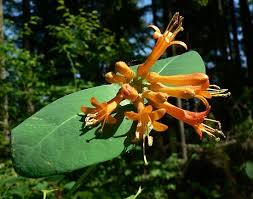
A twining woody vine native to the eastern and southeastern US, including Oklahoma. Valued ornamentally for its showy, trumpet-shaped red flowers with yellow interiors, attractive to hummingbirds. Leaves are opposite, simple, and the uppermost pairs are typically connate-perfoliate (fused around the stem). Fruit is a red berry.

Symphoricarpos orbiculatus
Coralberry / Buckbrush
A low-growing deciduous shrub native to central and eastern North America, common in Oklahoma. Forms thickets via rhizomes. Has small, opposite, simple oval leaves and inconspicuous pinkish flowers in axillary clusters. Most notable for its persistent clusters of small, purplish-red berries that remain on the stems through winter.

Valeriana officinalis
Common Valerian
A perennial herb native to Europe and parts of Asia, naturalized elsewhere. Known for its dissected, pinnately compound leaves and tall stems bearing dense terminal clusters (cymes) of small, fragrant pink or white flowers. The roots contain essential oils and valepotriates, used medicinally as a sedative. Fruit is an achene topped with a feathery, pappus-like calyx.

Dipsacus fullonum
Fuller's Teasel
A tall biennial herb native to Eurasia, widely naturalized and often considered weedy. Forms a basal rosette in the first year, then bolts with a prickly stem bearing opposite, lanceolate leaves (often connate at the base forming cups that hold water). Flowers are tiny, purplish, densely packed into an egg-shaped head subtended by spiny bracts. Dried heads were historically used for carding wool.

Weigela florida
Weigela
A deciduous shrub native to East Asia, widely popular as an ornamental for its profuse spring display of funnel-shaped flowers, typically pink but varying in cultivars. Has opposite, simple, serrated leaves. Represents the Linnaeoideae lineage within the broad Caprifoliaceae. Fruit is a capsule.

Scabiosa columbaria
Pincushion Flower
A perennial herb native to Europe, Africa, and Asia, with many cultivars grown as ornamentals. Features basal leaves that are often simple or lobed, and stem leaves that are typically pinnately dissected. Flowers are grouped into long-stalked, flattened heads resembling pincushions, often blue, lavender, or white. Represents the Dipsacoideae lineage.
Phylogeny and Classification
Caprifoliaceae is placed in the order Dipsacales, within the Campanulid clade of Asterids. Molecular phylogenetics has drastically reshaped the understanding of this family. The current broad circumscription (Caprifoliaceae sensu lato) unites several groups previously recognized as distinct families (Valerianaceae, Dipsacaceae, Linnaeaceae, Morinaceae) with the traditional 'core' Caprifoliaceae based on strong evidence of a shared common ancestor.
Within Dipsacales, the redefined Caprifoliaceae forms a large clade that is sister to the family Adoxaceae (which now includes Sambucus and Viburnum, genera formerly often placed in Caprifoliaceae). The various subfamilies within the expanded Caprifoliaceae (Linnaeoideae, Caprifolioideae, Valerianoideae, Dipsacoideae, etc.) represent distinct evolutionary lineages that diversified significantly in form and reproductive strategy.
Position in Plant Phylogeny
- Kingdom: Plantae
- Clade: Angiosperms (Flowering plants)
- Clade: Eudicots
- Clade: Asterids
- Clade: Campanulids
- Order: Dipsacales
- Family: Caprifoliaceae (sensu lato)
Evolutionary Significance
The modern concept of Caprifoliaceae exemplifies how molecular data can reveal evolutionary relationships obscured by morphological diversity. The family demonstrates multiple transitions between woody and herbaceous habits. Key evolutionary trends include the development of zygomorphic, often tubular flowers specialized for pollinators like bees and hummingbirds (e.g., Lonicera), the aggregation of flowers into dense heads mimicking single large flowers (Dipsacoideae), and the modification of the calyx into a pappus-like structure for wind dispersal of achenes (Valerianoideae, Dipsacoideae). This broad family showcases a wide array of reproductive and dispersal strategies within a single major lineage of the Dipsacales order.


