Calycanthaceae
Spice Bush Family / Sweetshrub Family
Calycanthaceae is a small family of aromatic deciduous or evergreen shrubs and small trees, comprising 3-4 genera and about 10-12 species. It is known for species like Sweetshrub (Calycanthus) and Wintersweet (Chimonanthus). The family has a distinct disjunct distribution across North America, China, and Australia. Characteristic features include opposite simple leaves, fragrant flowers with numerous spirally arranged tepals and stamens borne on a fleshy receptacle (hypanthium), and fruit consisting of achenes enclosed within the persistent hypanthium. Calycanthaceae belongs to the Magnoliid order Laurales, representing an early diverging angiosperm lineage.
Overview
The Calycanthaceae, or Spice Bush family, is a small but ancient lineage of flowering plants. Its members are typically aromatic shrubs or small trees valued for their fragrant flowers and sometimes bark or leaves. The family exhibits a classic disjunct distribution, with Calycanthus species in North America, Chimonanthus in China, and the remarkable Idiospermum in a tiny area of rainforest in Queensland, Australia. This fragmented pattern suggests an old origin, likely dating back to the time of the Gondwana supercontinent.
Botanically, the family is fascinating due to its position among the Magnoliids, a major clade that diverged early in angiosperm evolution, separate from the larger Monocot and Eudicot groups. Calycanthaceae flowers often display features considered ancestral, such as numerous floral parts (tepals, stamens, carpels) arranged spirally or in indistinct whorls on a cup-shaped receptacle (hypanthium). The fruit structure, where multiple individual achenes are enclosed within the fleshy persistent hypanthium, is also distinctive.
Several species are cultivated ornamentally, particularly Calycanthus floridus (Carolina Allspice or Sweetshrub) for its fragrant, reddish-brown flowers and Chimonanthus praecox (Wintersweet) for its highly fragrant, yellow, winter-blooming flowers.
Quick Facts
- Scientific Name: Calycanthaceae
- Common Name: Spice Bush Family, Sweetshrub Family
- Number of Genera: 3-4
- Number of Species: Approximately 10-12
- Distribution: Disjunct: E & W North America, China, NE Australia.
- Evolutionary Group: Angiosperms -> Magnoliids -> Laurales
- Habit: Aromatic shrubs or small trees.
Key Characteristics
Growth Form and Habit
Deciduous or evergreen shrubs or small trees. Plants are typically aromatic due to ethereal oils present in bark, leaves, and flowers.
Leaves
Leaves are arranged oppositely on the stem, are simple, and usually have entire margins (sometimes finely toothed). They are relatively large, typically ovate to elliptical, and lack stipules (exstipulate). Oil glands (pellucid dots) may be visible.
Flowers
Flowers are borne solitary (terminally or axillary) or sometimes in small clusters. They are medium to large, often showy, usually strongly fragrant, bisexual, and radially symmetrical (actinomorphic). The floral parts arise from the rim or inner surface of a well-developed, cup-shaped or urn-shaped fleshy receptacle (hypanthium).
- Perianth: Composed of numerous (15-30+) undifferentiated tepals, which are spirally arranged or in indistinct whorls. The tepals gradually transition from outer, smaller, sepal-like structures to inner, larger, petal-like structures. They are typically thick or fleshy, colored reddish-brown, maroon, purple (Calycanthus) or yellow to white (Chimonanthus, Idiospermum).
- Stamens: Numerous (ranging from 5 to many), also spirally arranged on the hypanthium. Filaments are short and stout. Anthers open outwards (extrorse) via longitudinal slits. The innermost series of stamens are often sterile (staminodes), sometimes petaloid or glandular.
- Ovary: Distinctively apocarpous, consisting of multiple (5 to many) separate carpels. These carpels are enclosed within the cavity of the fleshy hypanthium but are individually superior. Each carpel contains 1 or 2 ovules and has its own elongated style and terminal stigma.
Fruits and Seeds
The fruit is a unique pseudocarp (false fruit). It consists of multiple, one-seeded, dry, indehiscent fruits (achenes) that develop from the separate carpels, all enclosed within the enlarged, persistent, fleshy or leathery hypanthium, which often becomes pear-shaped or fig-shaped.
The exception is Idiospermum, which produces a large, fleshy, drupe-like fruit lacking achenes inside and containing 1-3 very large seeds with 3-4 fleshy cotyledons. Seeds of Calycanthus and Chimonanthus contain endosperm; Idiospermum seeds lack endosperm. Embryo is large.
Chemical Characteristics
Plants produce ethereal oils contributing to their characteristic strong fragrance. Various alkaloids, such as calycanthine (which can be toxic), are present, along with tannins and cyclitols.
Field Identification
Identifying Calycanthaceae relies on recognizing its aromatic nature, opposite simple leaves, unique flower structure, and distinctive pseudocarp fruit:
Primary Identification Features
- Habit: Aromatic shrub or small tree.
- Leaves: Opposite, simple, entire (usually), lacking stipules.
- Flowers: Solitary (usually), fragrant, with numerous spirally arranged tepals (petal-like, not distinct sepals/petals), often reddish-brown or yellowish/white.
- Floral Structure: Numerous stamens and multiple separate carpels borne inside a fleshy cup-like hypanthium.
- Fruit: An aggregate of achenes enclosed within the enlarged, persistent fleshy/leathery hypanthium (forming a pseudocarp), OR a large fleshy fruit (Idiospermum).
Secondary Identification Features
- Distribution: Native range restricted to E & W North America, China, or NE Australia.
- Perianth: Tepals often numerous (15+), thick or fleshy.
- Stamens: Innermost often sterile (staminodes).
Seasonal Identification Tips
- Year-round: Aromatic bark or crushed leaves can provide clues anytime. Opposite leaf arrangement visible during growing season (check if deciduous).
- Flowering Season: The fragrant, uniquely structured flowers are key identifiers when present (spring/summer for Calycanthus, winter/spring for Chimonanthus).
- Fruiting Season: The persistent pseudocarp fruit (fig-like or pear-shaped structure containing achenes) is highly distinctive and often remains on the plant after leaves fall in deciduous species.
Common Confusion Points
- Magnoliaceae: Also Magnoliids with numerous spiral floral parts. Differ in having alternate leaves with stipules, flowers typically with distinct petals/sepals (though numerous), carpels borne on an elongated receptacle (not enclosed in hypanthium), and fruit an aggregate of follicles or samaras.
- Lauraceae: Also aromatic Laurales. Differ in usually having alternate leaves, small 3-merous flowers (6 tepals, 9 stamens typically), a single superior carpel, and fruit being a simple drupe or berry (not enclosed).
- Monimiaceae/Atherospermataceae: Also Laurales, can have opposite leaves and flowers with parts enclosed in a hypanthium producing achenes. Differ in details like tepal arrangement (often whorled, fewer), stamen morphology, and specific hypanthium/fruit structure.
- Cornus (Dogwoods - Cornaceae): Some shrubby dogwoods have opposite simple leaves, but their flowers (often in heads with showy bracts) have 4 distinct petals, fewer stamens, an inferior ovary, and produce drupes. Belong to Asterids.
The combination of aromatic shrub/tree habit, opposite simple exstipulate leaves, flowers with numerous spiral tepals/stamens borne on/in a hypanthium, and apocarpous ovary developing into achenes within a pseudocarp is characteristic of Calycanthaceae (except Idiospermum's fruit).
Field Guide Quick Reference
Look For:
- Aromatic shrub or small tree
- Opposite, simple, entire leaves
- No stipules
- Flowers solitary, fragrant
- Perianth of numerous spiral tepals
- Numerous stamens (+ staminodes)
- Ovary of multiple separate carpels inside hypanthium
- Fruit: Aggregate of achenes in fleshy hypanthium (pseudocarp)
Key Variations:
- Flower color (reddish-brown vs. yellow/white)
- Leaf deciduous vs. evergreen
- Idiospermum: Fruit large, fleshy, drupe-like with few large seeds (3-4 cotyledons).
Notable Examples
The family includes well-known fragrant shrubs and a unique Australian "living fossil".

Calycanthus floridus
Carolina Allspice, Eastern Sweetshrub
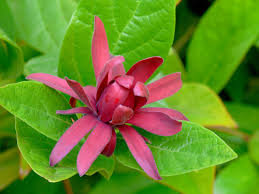
A deciduous shrub native to the southeastern United States. Valued for its highly fragrant, reddish-brown to maroon flowers with numerous strap-like tepals produced in late spring/early summer. Bark and leaves are also aromatic. Fruit is a fig-shaped pseudocarp.

Chimonanthus praecox
Wintersweet
A deciduous shrub native to China, renowned for its intensely fragrant, nodding yellow flowers with purplish centers, borne on bare stems in late winter or early spring. Tepals are waxy. Cultivated as an ornamental for its winter fragrance.

Idiospermum australiense
Idiot Fruit, Ribbonwood
An evergreen tree endemic to a very small area of tropical rainforest in North Queensland, Australia. Considered a "living fossil" due to its unique features. Flowers are large, whitish or reddish. Fruit is large, brown, poisonous, containing 1-3 massive seeds, each with 3 or 4 large fleshy cotyledons (highly unusual). It lacks the typical achenes-in-hypanthium fruit structure.
Phylogeny and Classification
Calycanthaceae is classified within the order Laurales, which belongs to the Magnoliid clade. Magnoliids represent a major lineage of flowering plants that diverged before the split between monocots and eudicots, making them crucial for understanding early angiosperm evolution. They are distinct from the ANITA grade (the very first branching lineages like Nymphaeales).
Within the Laurales order (which includes Lauraceae - laurels, Monimiaceae, etc.), Calycanthaceae is often considered an early-diverging lineage, possibly sister to the rest of the order or forming a basal clade with families like Siparunaceae and Gomortegaceae. Its retention of features considered ancestral among angiosperms (like numerous spirally arranged floral parts and separate carpels) supports its placement among these early branches. The family's striking disjunct distribution across North America, China, and Australia strongly suggests an ancient origin tracing back to the Gondwanan supercontinent.
Position in Plant Phylogeny
- Kingdom: Plantae
- Clade: Angiosperms (Flowering plants)
- Clade: Magnoliids
- Order: Laurales
- Family: Calycanthaceae
Note: Magnoliids are distinct from Monocots and Eudicots, representing an earlier diverging major lineage.
Evolutionary Significance
Calycanthaceae is highly significant in evolutionary botany:
- Early Angiosperm Lineage: As part of the Magnoliid clade (specifically Laurales), it provides vital clues about the characteristics and evolution of flowering plants shortly after their origin, bridging the gap between the earliest lineages and the more derived monocots/eudicots.
- Ancestral Traits: Retains features considered ancestral ("primitive") among angiosperms, such as numerous floral parts arranged spirally, undifferentiated tepals, and separate carpels (apocarpy), helping reconstruct the appearance of early flowers.
- Gondwanan Biogeography: Its disjunct distribution across widely separated continents is a textbook example reflecting ancient connections via the Gondwana supercontinent and subsequent fragmentation and extinction events.
- Unique Biology (Idiospermum): Idiospermum australiense is particularly notable as a relictual species ("living fossil") with extremely unusual features like its massive seeds with 3-4 cotyledons, offering unique insights into plant development and evolution.