Burmanniaceae
Burmanniaceae is a fascinating family of monocots, comprising about 10 genera and 130-150 species of small herbs found pantropically. The family is notable for including many species that are mycoheterotrophic, lacking chlorophyll and obtaining nutrients from fungi. They are characterized by 3-merous flowers, often with a distinctively winged perianth tube, an inferior ovary, and capsule fruits containing numerous tiny seeds. Burmanniaceae belongs to the order Dioscoreales.
Overview
Burmanniaceae is a primarily tropical family of small, often inconspicuous herbs typically found in the damp, shaded understory of forests, often growing in humus-rich soil. The most striking aspect of the family is the prevalence of mycoheterotrophy. Many genera (Gymnosiphon, Thismia, parts of Burmannia) consist entirely of species that lack chlorophyll and appear white, yellow, red, or purple. These plants obtain their carbon and nutrients indirectly from photosynthetic plants via a shared mycorrhizal fungal network. Some species within the genus Burmannia, however, are autotrophic, possessing green leaves (usually in a basal rosette) and performing photosynthesis.
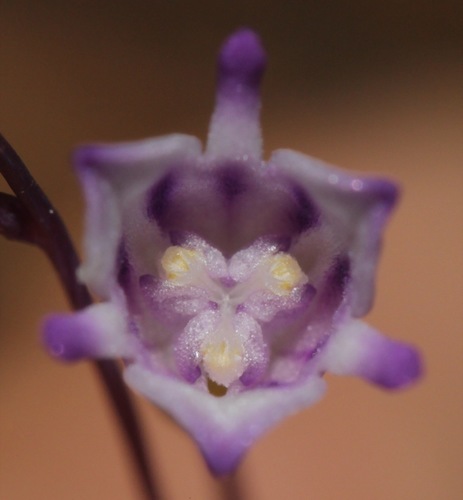
The flowers, though often small, can be brightly colored (blue is common in Burmannia) or possess bizarre and intricate shapes, especially in the genus Thismia (sometimes called 'fairy lanterns'). Key floral features include the fusion of tepals into a tube (often winged) and the inferior ovary. The family belongs to the monocot order Dioscoreales, which also includes yams (Dioscoreaceae).
Due to their small size, specialized habitat, and often non-green appearance, many Burmanniaceae are easily overlooked or mistaken for fungi or saprophytes (though they are truly parasites on fungi).
Quick Facts
- Scientific Name: Burmanniaceae
- Common Name: (None widely used)
- Number of Genera: Approximately 9-10 (incl. Thismia)
- Number of Species: Approximately 130-150
- Distribution: Pantropical.
- Evolutionary Group: Monocots - Dioscoreales
- Habit: Small herbs, often mycoheterotrophic (non-green).
Key Characteristics
Growth Form and Habit
Small annual or perennial herbs. Many are mycoheterotrophic, lacking chlorophyll and appearing white, yellow, red, or purplish; they depend on mycorrhizal fungi for nutrition. Some species (Burmannia subg. Burmannia) are autotrophic with green leaves. Stems are slender, often simple or sparsely branched. Plants often arise from tuberous rhizomes or fleshy roots.
Leaves
Leaf morphology depends on trophic strategy. Mycoheterotrophic species have leaves reduced to small, non-photosynthetic scale-like structures arranged alternately along the stem, often lacking basal leaves. Autotrophic species typically have a basal rosette of linear or lanceolate green leaves, plus smaller scale-like leaves along the flowering stem. Venation is parallel.
Flowers and Inflorescence
Flowers are usually borne solitary or in terminal branched or unbranched cymes, which can sometimes appear head-like or umbel-like. Flowers are generally bisexual, radially symmetrical (actinomorphic) or occasionally slightly zygomorphic (Thismia), and typically 3-merous.
- Perianth: Consists of 6 petal-like tepals fused below into a distinct perianth tube, crowned by 6 free lobes in two whorls (3 outer, 3 inner). The tube is often characteristically 3-winged or 3-angled, with the wings corresponding to the position of the outer tepals. The lobes may be equal, or the inner lobes smaller or highly modified (Thismia). The perianth persists on top of the developing fruit.
- Stamens: Either 3 (opposite inner tepals) or 6 (in two whorls), inserted within the perianth tube (epitepalous). Filaments are very short. Anthers often have broad connectives and may bear appendages.
- Ovary: Distinctly inferior, composed of 3 fused carpels. It forms either 1 locule with parietal placentation or 3 locules with axile placentation. Ovules are numerous and small. Septal nectaries are often present. A single short style terminates in 3 stigmas, which can be simple, lobed, or elaborate (e.g., funnel-shaped, horseshoe-shaped).
Fruits and Seeds
The fruit is a dry, dehiscent capsule, which remains crowned by the persistent perianth tube. Dehiscence (opening) occurs in various ways, often transversely (like a lid), irregularly between the wings/ribs, or sometimes via longitudinal slits (loculicidally).
Seeds are numerous and very small (dust-like). They contain endosperm.
Chemical Characteristics
Mycoheterotrophic species lack chlorophyll and rely entirely on associated fungi for carbon and nutrients. Autotrophic species photosynthesize normally. Specific secondary metabolite profiles are less studied compared to major plant families.
Field Identification
Identifying Burmanniaceae often involves spotting small, unusual herbs in forest understories and recognizing their distinct floral features:
Primary Identification Features
- Habit: Small, slender herbs, very often non-green (white, yellow, red, purple) due to mycoheterotrophy.
- Flowers: 3-merous (6 tepals), with tepals fused into a distinct perianth tube.
- Perianth Tube Shape: Tube characteristically 3-winged or 3-angled.
- Ovary Position: Ovary is inferior (located below the attachment of the perianth).
- Fruit: A capsule topped by the persistent perianth tube.
Secondary Identification Features
- Leaves: Reduced to scales in non-green species; basal and linear in green species (Burmannia p.p.).
- Habitat: Found in moist, shaded forest floors, often in rich humus. Pantropical distribution.
- Inflorescence: Flowers solitary or in terminal cymes/clusters.
- Stamens: 3 or 6, located inside the perianth tube.
- Seeds: Numerous and dust-like.
Seasonal Identification Tips
- Appearance: Often ephemeral, appearing above ground mainly during wet seasons conducive to flowering and fungal activity.
- Visibility: Their small size and often non-green color make them difficult to find; requires careful searching of the forest floor litter.
- Flowers/Fruits: The distinctive flowers (especially the winged tube) and capsules crowned by the persistent perianth are key for identification when present.
Common Confusion Points
- Mycoheterotrophic Orchids (Orchidaceae): Share the non-green, mycoheterotrophic habit. However, orchids have highly zygomorphic flowers (bilaterally symmetrical) with a specialized lip (labellum) and fused stamen/style (column). Burmanniaceae flowers are mostly actinomorphic (radially symmetric) with separate stamens and style.
- Triuridaceae (Pandanales): Another family of non-green mycoheterotrophic monocots, but they have unisexual flowers, typically separate tepals (not a tube), separate carpels (apocarpous), and different fruit types.
- Small Fungi: Non-green species can be mistaken for fungi at first glance, but close inspection reveals flower structures (perianth tube, ovary, etc.).
The combination of small herb habit (often non-green), 3-merous flowers with a winged/angled perianth tube, inferior ovary, and capsule fruit topped by the persistent perianth is diagnostic for Burmanniaceae.
Field Guide Quick Reference
Look For:
- Small herb, often non-green (mycoheterotrophic)
- Flowers 3-merous
- Perianth of 6 tepals fused into a tube
- Perianth tube often 3-winged or 3-angled
- Ovary inferior
- Fruit a capsule crowned by persistent perianth
- Seeds tiny, numerous
- Habitat: Moist forest floor
Key Variations:
- Plant color (green vs. white/yellow/red/purple)
- Leaf form (basal leaves vs. scales only)
- Flower color (blue, white, yellow, purple)
- Ovary locules (1 vs. 3)
- Stamen number (3 vs. 6)
- Flower shape (esp. bizarre in Thismia)
Notable Examples
The family includes both photosynthetic and non-photosynthetic genera, found across the tropics.

Burmannia coelestis
(No common name)
An example of an autotrophic species within the family, found in tropical Asia and Australia. It has basal green leaves and produces slender stems bearing terminal clusters of small, bright blue flowers with a prominently 3-winged perianth tube.

Gymnosiphon species
(No common name)
Represents a genus of entirely mycoheterotrophic species found pantropically. These are delicate, non-green (usually white) herbs with scale-like leaves. They produce small, often inconspicuous white flowers with a typically 3-winged perianth tube and an inferior ovary.

Thismia species
Fairy Lanterns
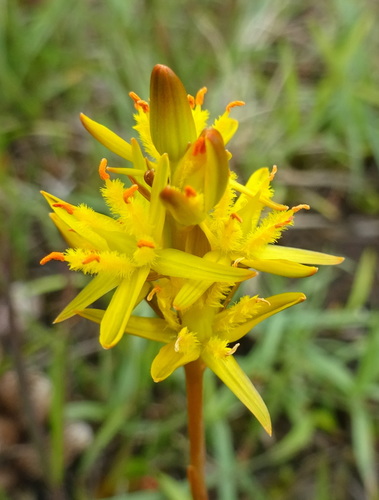
A genus of mycoheterotrophic herbs (sometimes placed in its own family, Thismiaceae) renowned for their often bizarre and intricate flower morphology. Found pantropically but many species are rare and localized. Flowers lack chlorophyll, vary in color, and often have unusual appendages or shapes, suggesting specialized pollination mechanisms.
Phylogeny and Classification
Burmanniaceae belongs to the monocot order Dioscoreales. This order also includes the families Dioscoreaceae (yams) and Nartheciaceae. Molecular phylogenetics places Burmanniaceae firmly within this order, representing the main lineage where mycoheterotrophy has evolved within Dioscoreales.
The circumscription of Burmanniaceae sometimes varies, particularly concerning the genus Thismia. While traditionally included, some studies suggested Thismia might warrant its own family (Thismiaceae) based on distinct morphology and molecular divergence. However, more recent analyses often place Thismia as either sister to the rest of Burmanniaceae or nested within it, supporting its inclusion within a broader Burmanniaceae for stability within the Dioscoreales framework (as followed by APG IV).
Position in Plant Phylogeny
- Kingdom: Plantae
- Clade: Angiosperms (Flowering plants)
- Clade: Monocots
- Order: Dioscoreales
- Family: Burmanniaceae
Evolutionary Significance
Burmanniaceae is highly significant for studying:
- Evolution of Mycoheterotrophy: Provides a key example of the transition from autotrophy to full dependence on fungal partners for nutrition within monocots, showcasing associated morphological reductions (loss of leaves, chlorophyll).
- Plant-Fungal Interactions: Crucial for understanding the complex tripartite relationships between mycoheterotrophic plants, mycorrhizal fungi, and the surrounding photosynthetic plants that ultimately provide the carbon.
- Floral Diversity: Exhibits remarkable variation in flower morphology, especially the often bizarre forms in Thismia, suggesting rapid evolution driven by specialized pollination systems in dark forest understories.
- Monocot Phylogeny: Helps clarify relationships within the Dioscoreales order and broader monocot evolution.
- Tropical Biodiversity: Represents a hidden component of biodiversity in tropical forest floor ecosystems worldwide.