Phyllodrepaniaceae
Sickle-leaf Moss Family (Informal)
Phyllodrepaniaceae is a small, possibly monotypic family of pleurocarpous mosses belonging to the order Hypnales. It contains the genus Phyllodrepanium, characterized by its strongly flattened (complanate) shoots and sickle-shaped (falcate-secund) leaves lacking a strong midrib. The family is primarily found in the Neotropics.
Overview
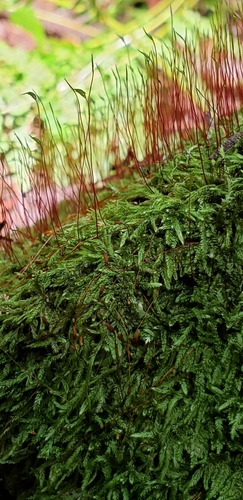
The Phyllodrepaniaceae family, established by Crosby, encompasses the distinctive Neotropical moss genus Phyllodrepanium. The most well-known, and possibly only, species is P. falcifolium. These mosses are pleurocarpous, meaning they typically grow in creeping mats or wefts with extensive branching, and their sporophytes arise from lateral buds, not the tips of the main stems.
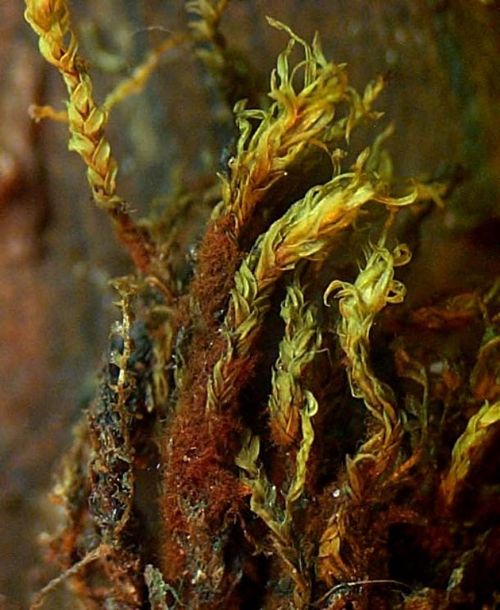
Phyllodrepaniaceae are recognized by their strongly flattened appearance, caused by leaves arranged in two apparent rows (complanate) and strongly curved to one side like sickles (falcate-secund). They typically grow as epiphytes on tree trunks, branches, and logs in humid forest environments in Central and South America.
The family belongs to the large and diverse order Hypnales, which includes many common pleurocarpous mosses. The distinct leaf morphology and arrangement distinguish Phyllodrepaniaceae within this order.
Quick Facts
- Scientific Name: Phyllodrepaniaceae Crosby
- Common Name: Sickle-leaf Moss Family (Informal)
- Number of Genera: 1 (Phyllodrepanium Crosby)
- Number of Species: Likely 1 (Phyllodrepanium falcifolium (Schwägr.) Crosby)
- Distribution: Neotropical (Central and South America)
- Evolutionary Group: Bryophytes - Mosses (Class Bryatae - Order Hypnales)
Key Characteristics (Moss Features)
Gametophyte (Leafy Plant)
The dominant stage. Plants are pleurocarpous, forming creeping, often glossy, green to yellowish-green mats or wefts. Stems branch freely, often pinnately or irregularly, and are covered in leaves. Rhizoids attach the plant to the substrate.
- Shoots: Distinctly flattened (complanate) due to leaf arrangement.
- Leaves (Phyllids): Asymmetrical, strongly curved into a sickle shape and pointing towards one side (falcate-secund). They are typically lanceolate or ovate-lanceolate. Margins may be smooth or slightly toothed.
- Costa (Midrib): Usually very short and double, or completely absent. This is a key feature.
- Leaf Cells: Typically smooth, elongated (linear) or rhomboidal in the main part of the leaf (lamina). Alar cells (at basal corners) are usually not strongly differentiated.
Reproductive Structures (Gametophyte)
Antheridia and archegonia are produced in lateral buds along the stems, often protected by modified perichaetial or perigonial leaves.
Sporophyte (Spore-Producing Structure)
Arises laterally from the gametophyte stem. Consists of:
- Seta: A smooth, often elongated stalk that holds the capsule aloft.
- Capsule (Sporangium): Typically ovoid or cylindrical, often inclined or horizontal. Contains the spores. An operculum (lid) covers the mouth before maturity.
Peristome
Located beneath the operculum. Typical of the Hypnales order, the peristome is generally double, consisting of an outer ring of 16 teeth (exostome) and an inner, more delicate ring (endostome) often comprising segments and cilia. The peristome regulates spore release.
Field Identification
Identifying Phyllodrepaniaceae (Phyllodrepanium) relies on recognizing its distinctive growth form and leaf characteristics within its Neotropical range:
Primary Identification Features
- Flattened Shoots: Look for creeping moss shoots that appear distinctly flattened, like they've been pressed.
- Sickle-Shaped Leaves: Observe the strongly curved (falcate) leaves, typically all pointing in the same direction (secund).
- Habitat and Location: Found primarily as epiphytes (on bark) in humid forests within Central and South America.
- Lack of Strong Costa: Check leaves (may need hand lens) for the absence of a prominent midrib; it's usually short and double or absent entirely.
Secondary Identification Features
- Glossy appearance: Plants often have a somewhat glossy sheen when dry.
- Pleurocarpous Habit: Confirm the creeping growth form with lateral sporophytes (if present).
Common Confusion Points
- Other Hypnales Mosses: Many families in the Hypnales are pleurocarpous and grow as epiphytes (e.g., Hypnaceae, Sematophyllaceae). Some may have curved leaves, but the combination of strongly complanate shoots, distinctly falcate-secund leaves, and the lack of a strong costa is characteristic of Phyllodrepanium.
- Liverworts: Some leafy liverworts can appear flattened, but they lack costas, have different cell structures, and distinct reproductive structures (usually not stalked capsules with peristomes).
Field Guide Quick Reference
Look For:
- Creeping moss mats/wefts
- Strongly flattened shoots
- Sickle-shaped, secund leaves
- Costa short/double or absent
- Epiphytic habit in Neotropics
Key Variations:
- Color (green to yellowish)
- Degree of branching
- Presence/absence of sporophytes
- (Family likely monotypic - variations are within P. falcifolium)
Notable Examples
The family is likely monotypic, containing only one genus and species:

Phyllodrepanium falcifolium
(No widely used common name)
The defining species of the family Phyllodrepaniaceae. It forms distinctive flattened, creeping shoots with strongly sickle-shaped leaves lacking a prominent midrib. It grows as an epiphyte in humid Neotropical forests.
Phylogeny and Classification
Phyllodrepaniaceae is classified within the Class Bryatae (true mosses) and is firmly placed within the large order of pleurocarpous mosses, the Hypnales. This order contains a vast number of moss families and species, representing a major radiation of epiphytic and forest-floor mosses.
The family's exact relationships within the Hypnales may vary depending on the specific phylogenetic study, but its distinct morphology, particularly the unique leaf arrangement and shape, supports its recognition as a separate family lineage within this diverse order. It represents a specialized adaptation likely related to its epiphytic lifestyle in the Neotropics.
Position in Plant Phylogeny
- Kingdom: Plantae
- Division: Bryophyta (Mosses)
- Class: Bryatae (or Bryopsida)
- Order: Hypnales
- Family: Phyllodrepaniaceae
Evolutionary Significance
Phyllodrepaniaceae exemplifies the morphological diversity within the Hypnales. Its specialized features, such as the complanate shoots and falcate-secund leaves without a strong costa, represent a unique evolutionary trajectory likely adapted for specific microhabitats or light conditions in Neotropical forests. Studying this family contributes to understanding the evolution and diversification of epiphytic pleurocarpous mosses.