Phrymaceae
The Phrymaceae family, often called the Lopseed Family (after its type genus Phryma) or informally the Monkeyflower Family (due to the inclusion of the large genus Mimulus sensu lato), belongs to the order Lamiales. This family has undergone significant taxonomic revision based on molecular data, expanding greatly from its original single species (Phryma leptostachya) to include numerous genera formerly placed in Scrophulariaceae. It now comprises mostly herbs and subshrubs with a nearly worldwide distribution, particularly diverse in western North America and Australia.
Overview
Phrymaceae is a prime example of how molecular phylogenetics has reshaped plant classification. Once considered monotypic (containing only Phryma leptostachya), it now encompasses a diverse array of approximately 13-18 genera and around 200 species, depending on the taxonomic treatment (e.g., whether Mimulus is treated broadly or split into segregate genera like Erythranthe and Diplacus). These plants are predominantly herbaceous annuals or perennials, though some form subshrubs or shrubs.
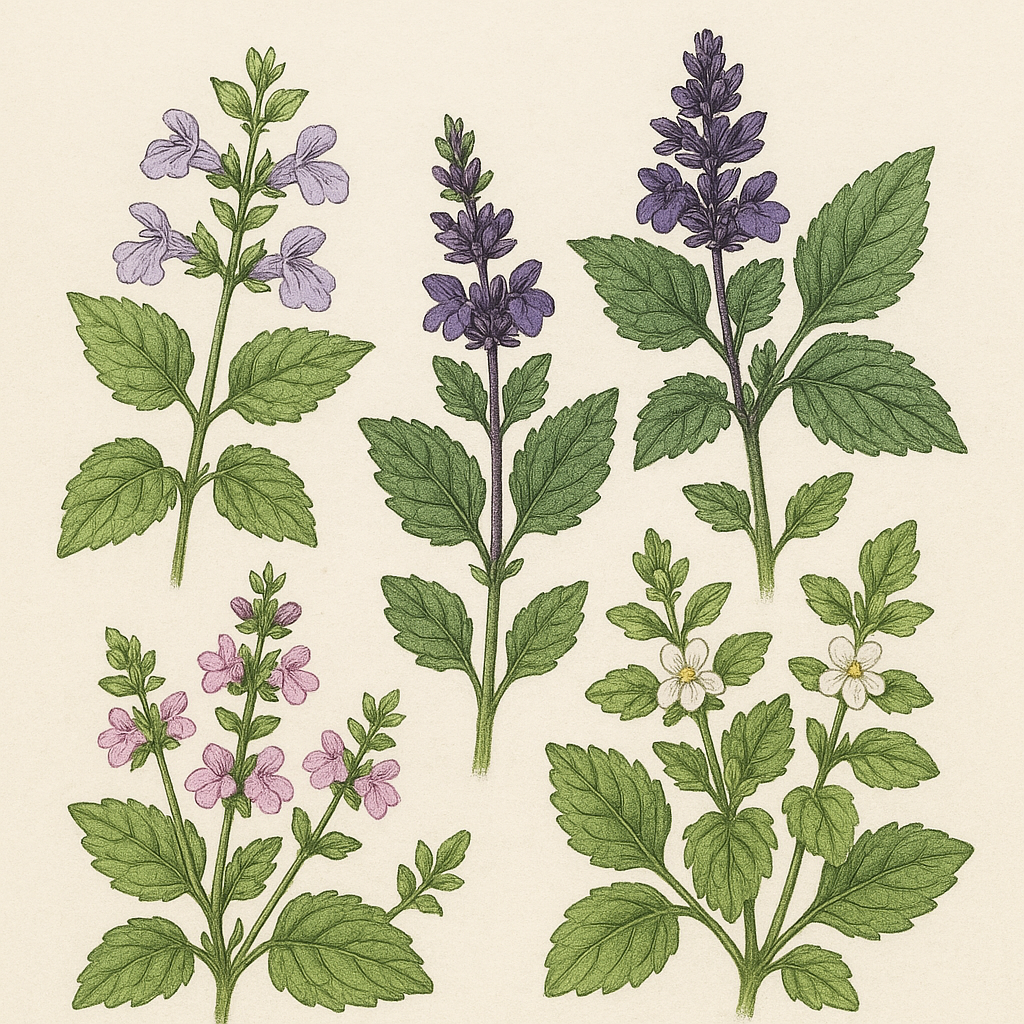
The family is characterized by typically opposite leaves, often square stems, and distinctly zygomorphic (bilaterally symmetrical), two-lipped (bilabiate) flowers. Many species, particularly in the Mimulus group, have sensitive stigma lobes that close upon touch. The family exhibits remarkable ecological diversity, with species adapted to habitats ranging from deserts and alpine regions to wetlands and aquatic environments.
Phrymaceae has a cosmopolitan distribution but shows major centers of diversity in western North America (especially California) and Australia. Its placement is firmly within the Lamiales order, closely related to families like Orobanchaceae and Paulowniaceae.
Quick Facts
- Scientific Name: Phrymaceae
- Common Name: Lopseed Family, Monkeyflower Family
- Number of Genera: Approximately 13-18 (circumscription varies)
- Number of Species: Approximately 190-210
- Distribution: Cosmopolitan, especially temperate regions; centers of diversity in western North America and Australia.
- Evolutionary Group: Eudicots - Asterids - Lamiids - Lamiales
Key Characteristics
Growth Form and Habit
Mostly annual or perennial herbs or subshrubs; some genera include true shrubs (e.g., Diplacus). Stems are often square in cross-section, especially when young. Plants may be terrestrial, semi-aquatic, or aquatic.
Leaves
Leaves are typically opposite and decussate (arranged in perpendicular pairs), though sometimes alternate above or whorled. They are usually simple, with margins ranging from entire to serrate, dentate, or lobed. Stipules are absent. Glandular hairs are common, sometimes making the plant feel sticky.
Inflorescence
Flowers may be solitary in leaf axils or arranged in various types of inflorescences, including terminal or axillary racemes, spikes, cymes, or panicles. Floral bracts are usually present.
Flowers
Flowers are typically bisexual and strongly zygomorphic (bilaterally symmetrical). Key features include:
- Calyx: Tubular or campanulate, composed of 5 fused sepals, usually ending in 5 distinct teeth or lobes; persistent in fruit.
- Corolla: Tubular, distinctly bilabiate (two-lipped). The upper lip is typically 2-lobed, and the lower lip is 3-lobed. The throat of the corolla is often partially closed by a raised palate on the lower lip. Colors are diverse: yellow, red, pink, magenta, purple, blue, or white, often with contrasting nectar guides.
- Androecium: Stamens typically 4, arranged in two pairs of unequal length (didynamous), attached to the corolla tube (epipetalous). Sometimes only 2 stamens are present. Anthers typically have two distinct pollen sacs.
- Gynoecium: Features a superior ovary composed of 2 fused carpels. It is usually 2-locular with numerous ovules on axile placentas, though sometimes it appears 1-locular due to intrusion of placentas or reduction. The style is terminal and simple, usually ending in a 2-lobed stigma which is often sensitive (closing rapidly when touched) in the Mimulus group.
Fruits and Seeds
The fruit is most commonly a capsule that dehisces loculicidally (splitting along the back of each locule) or sometimes septicidally (splitting along the septa). In the type genus Phryma, the fruit is a unique indehiscent, one-seeded achene enclosed in the reflexed calyx. Some genera have schizocarps. Seeds are typically numerous and small.
Chemical Characteristics
Iridoid glycosides are often present, a common feature in Lamiales. Flavonoids and other phenolic compounds are also found.
Field Identification
Identifying members of Phrymaceae requires attention to floral details, especially given potential confusion with other families in the Lamiales order:
Primary Identification Features
- Habit: Mostly herbs or subshrubs.
- Leaves: Usually opposite, simple, without stipules.
- Stems: Often square.
- Flowers: Strongly zygomorphic, distinctly bilabiate (2 upper lobes, 3 lower lobes).
- Calyx: Tubular, 5-toothed, persistent.
- Stamens: Usually 4 (didynamous) or sometimes 2, attached to corolla.
- Ovary: Superior, 2-carpellate.
- Stigma: Often 2-lobed (sometimes sensitive).
- Fruit: Typically a capsule (except Phryma - achene).
Secondary Identification Features
- Glandular hairs common.
- Corolla throat often has a palate.
- Phryma has unique reflexed fruit habit.
Seasonal Identification Tips
- Flowering occurs mainly from spring through fall in temperate regions, varying by species and altitude/latitude.
- Fruit characteristics (capsule type or the unique achene of Phryma) can be important for confirmation.
Common Confusion Points
Distinguishing Phrymaceae from other Lamiales families with similar flowers:
- Lamiaceae (Mint Family): Usually aromatic; ovary deeply 4-lobed forming 4 nutlets; style typically gynobasic (arising from base of ovary lobes). Phrymaceae lacks strong minty aroma, has capsule/achene fruit, and terminal style.
- Scrophulariaceae sensu stricto (Figwort Family): Flowers often less strongly bilabiate or have different stamen configurations (e.g., 5th stamen present as staminode); capsule dehiscence can differ.
- Orobanchaceae (Broomrape Family): Includes many parasitic or hemiparasitic plants (check for haustorial connections); capsule dehiscence and seed morphology often differ.
- Plantaginaceae (Plantain Family): Highly diverse; many have actinomorphic flowers (e.g., Plantago), or if zygomorphic (Veronica, Antirrhinum), details of stamen number and corolla shape differ.
- Careful examination of ovary structure, fruit type, style base, stamen number, and presence/absence of aromatic oils is crucial.
Field Guide Quick Reference (Phrymaceae)
Look For:
- Herbs/subshrubs, often square stems
- Leaves: Opposite, simple
- Flowers: Zygomorphic, bilabiate (2+3 lobes)
- Calyx: 5-toothed, tubular
- Stamens: 4 (didynamous) or 2
- Ovary: Superior, 2-carpellate
- Stigma: 2-lobed (often sensitive)
- Fruit: Capsule (usually) or achene (Phryma)
Key Distinctions:
- Not aromatic, fruit not 4 nutlets (vs. Lamiaceae)
- Ovary superior, 2-carpellate
- Stamen number usually 4 or 2
- Bilabiate corolla shape
- Sensitive stigma common in Mimulus group
Notable Examples
Phrymaceae includes several well-known and diverse genera:

Phryma leptostachya
American Lopseed
The type species for the family, found in eastern North America and eastern Asia. It is unique within the family for its fruit, an achene enclosed within the persistent calyx which reflexes downwards sharply against the stem at maturity.

Mimulus / Erythranthe / Diplacus spp.
Monkeyflowers
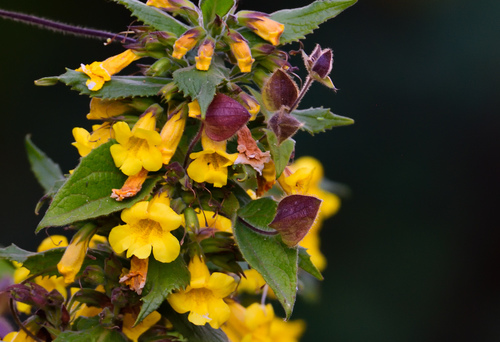
This large complex (treated as one genus or split) is highly diverse, especially in western North America. Includes annuals, perennials, and shrubs with often showy yellow, red, pink, or purple bilabiate flowers. Many have sensitive stigmas. A model system for ecological and evolutionary studies. (Pictured: Erythranthe guttata).

Glossostigma spp.
(Mudmats)
Tiny, creeping, often mat-forming herbs found in aquatic margins and mudflats, primarily in Australia, New Zealand, and Asia. They have very small leaves and inconspicuous flowers, popular in aquariums.

Peplidium spp.
(No common name)
Small, creeping or prostrate herbs, often found in seasonally wet habitats or claypans, primarily in Australia. They have small, opposite leaves and inconspicuous flowers.
Phylogeny and Classification
Phrymaceae belongs to the large and diverse order Lamiales, within the Lamiid clade of Asterids. Its classification represents a major success story for molecular phylogenetics. Originally containing only Phryma, the family was dramatically expanded based on DNA evidence to include most genera previously classified in the subfamily Mimuloideae of Scrophulariaceae.
This revised Phrymaceae forms a well-supported monophyletic group. Within Lamiales, it is closely related to families such as Paulowniaceae (Empress Tree family), Orobanchaceae (Broomrape family), and more distantly to Lamiaceae (Mint family) and Verbenaceae (Vervain family). The traditional Scrophulariaceae was found to be polyphyletic, leading to the transfer of many genera to Phrymaceae, Plantaginaceae, Orobanchaceae, and other smaller families, leaving a much smaller core Scrophulariaceae.
Position in Plant Phylogeny
- Kingdom: Plantae
- Clade: Angiosperms (Flowering plants)
- Clade: Eudicots
- Clade: Asterids
- Clade: Lamiids
- Order: Lamiales
- Family: Phrymaceae
Evolutionary Significance
Phrymaceae is significant for several evolutionary reasons:
- It exemplifies how molecular data revolutionized plant classification, revealing phylogenetic relationships not apparent from morphology alone and leading to the breakup of polyphyletic groups like the traditional Scrophulariaceae.
- The Mimulus complex (including Erythranthe, Diplacus) serves as a model system for studying evolutionary processes like adaptation, speciation, hybridization, and the evolution of floral traits and pollination syndromes.
- The family showcases remarkable ecological diversification, with adaptations to a wide range of habitats from deserts to wetlands.
- Features like the sensitive stigma provide insights into specialized plant-pollinator interactions.