
Phylum Lycopodiophyta
Lycopodiophyta, commonly known as lycophytes, encompasses the clubmosses, spikemosses, and quillworts. This ancient phylum represents the earliest diverging lineage of extant vascular plants (Tracheophytes), distinct from both ferns (Monilophytes) and seed plants (Spermatophytes). Lycophytes are characterized by typically having small leaves with a single, unbranched vein (microphylls), often dichotomous branching of stems, and reproduction via spores produced in sporangia usually located in the axils or on the upper surface of specialized leaves (sporophylls), frequently aggregated into terminal cones (strobili). They exhibit an alternation of generations with a dominant sporophyte.
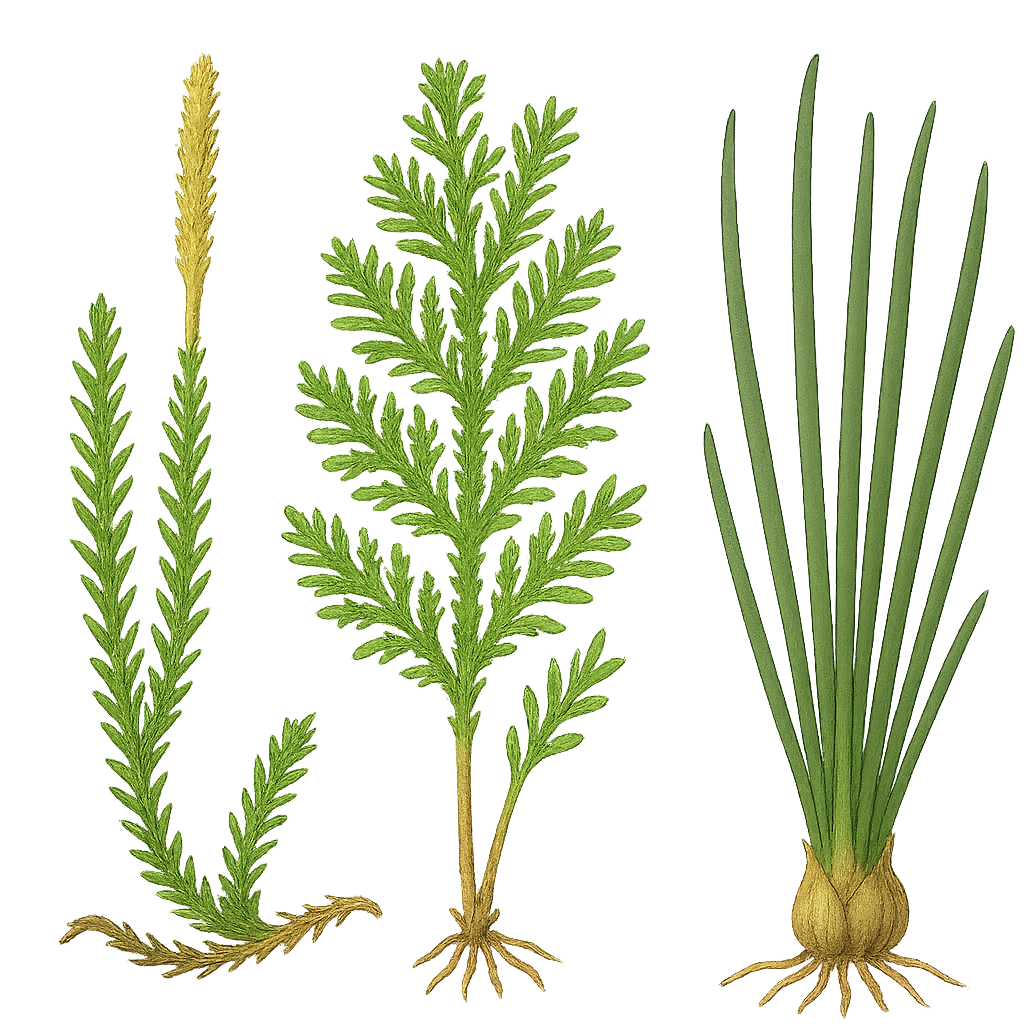
Overview of Lycophytes
Lycophytes represent a lineage tracing back over 400 million years to the Devonian period. During the Carboniferous period, tree-like lycophytes such as Lepidodendron and Sigillaria were dominant components of swamp forests, reaching enormous sizes. Today, only about 1,200-1,350 species in 15-20 genera survive, mostly as small herbaceous plants. They are found worldwide, from arctic tundra to tropical rainforests and deserts, occupying diverse niches including terrestrial forest floors, epiphytic branches, rocky crevices, and aquatic environments.
The phylum comprises three distinct extant orders/families: Lycopodiaceae (clubmosses), which are homosporous (produce one type of spore); and Selaginellaceae (spikemosses) and Isoetaceae (quillworts), which are heterosporous (produce microspores and megaspores). This distinction in spore production has significant implications for their life cycles and gametophyte development. Ecologically, lycophytes can be important ground cover, contribute to soil stabilization, and serve as habitat components, though they generally lack the dominance of their Paleozoic ancestors or modern ferns/angiosperms.
Direct economic importance is limited. Historically, the flammable spores of Lycopodium were used as flash powder ('lycopodium powder') and lubricants. Some species are used in traditional medicine or grown as ornamentals (e.g., certain Selaginella). In Oklahoma (current location as of March 27, 2025), native lycophytes are relatively uncommon but include some Spikemosses (Selaginella species) found on rock outcrops or dry soil, and potentially Quillworts (Isoetes) in seasonal pools or shallow water, particularly in the eastern part of the state.
Quick Facts (Phylum Lycopodiophyta)
- Scientific Name: Phylum Lycopodiophyta D.H. Scott (alt. Lycophyta)
- Common Name: Lycophytes (Clubmosses, Spikemosses, Quillworts)
- Number of Extant Genera: Approximately 15-20
- Number of Extant Species: Approximately 1,200-1,350
- Distribution: Cosmopolitan, diverse habitats from arctic to tropical.
- Evolutionary Group: Vascular Plants (Lycophytes - sister to Euphyllophytes)
- Major Extant Orders/Families: Lycopodiales/Lycopodiaceae, Selaginellales/Selaginellaceae, Isoetales/Isoetaceae
Key Characteristics (Seedless Vascular Plant)
Sporophyte Generation (Dominant Stage)
The main lycophyte plant body is the diploid sporophyte.
- Stems: Typically exhibit dichotomous branching (forking into two equal branches), although pseudo-monopodial growth occurs. Stems can be erect, creeping horizontally (often rhizomatous), or pendent (epiphytic). Possess true vascular tissue (xylem/phloem), usually arranged in a protostele (a simple central vascular cylinder).
- Leaves (Microphylls): Characterized by possessing microphylls – typically small, simple leaves with a single, unbranched vein. Microphylls are numerous and usually cover the stem densely, arranged spirally or sometimes oppositely or in whorls. In Isoetes, the leaves are larger, linear or quill-like, clustered on a basal corm-like stem.
- Ligule: A small, scale-like flap of tissue located on the adaxial (upper) surface of the leaf base. Present in the heterosporous groups (Selaginellaceae, Isoetaceae), absent in the homosporous group (Lycopodiaceae). Visible with magnification.
- Roots: True roots present, typically adventitious (arising from stem/rhizome) and often dichotomously branching.
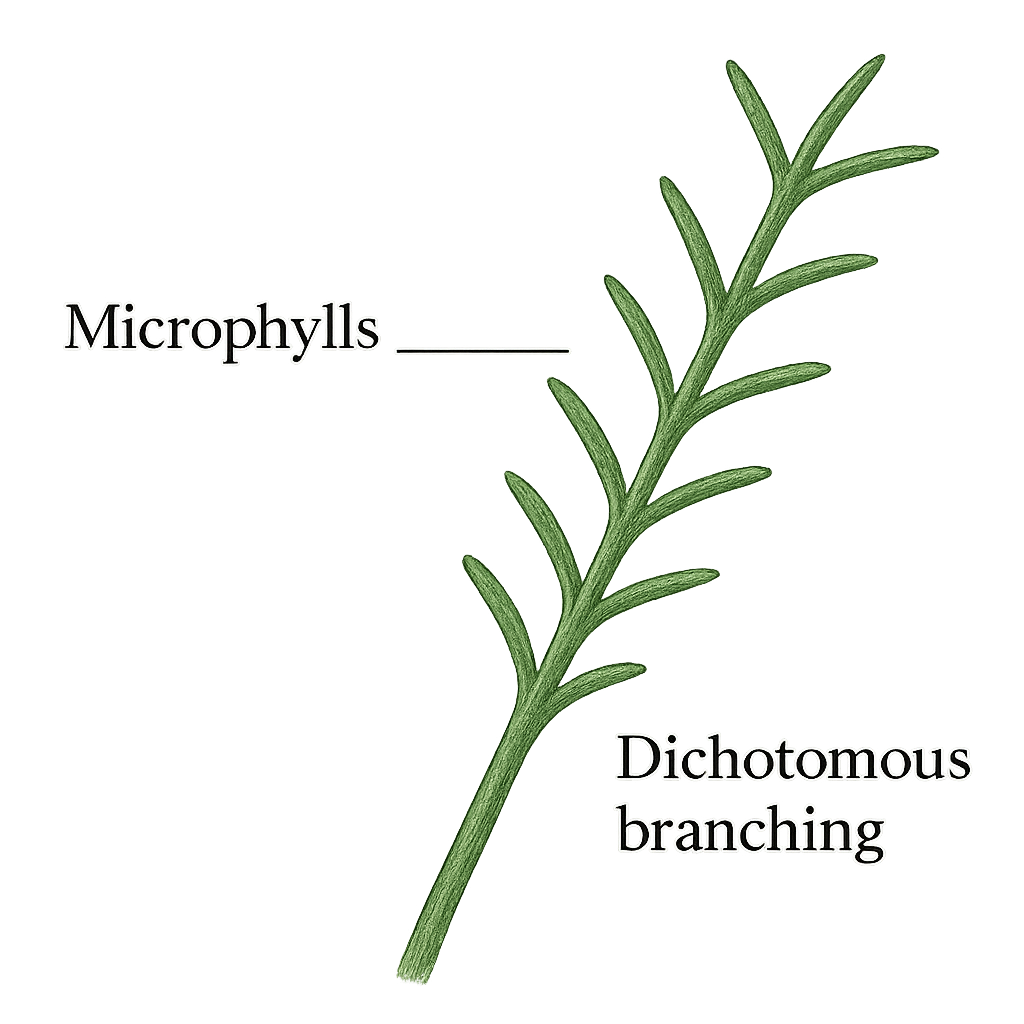
Lycophyte characteristics: Dichotomous branching and small leaves with a single vein (microphylls).
Reproductive Structures (Sporophyte)
- Sporangia: Relatively large (eusporangiate or similar development), typically kidney-shaped (reniform) or globose. Borne singly on the adaxial (upper) surface or in the axil of specialized leaves called sporophylls.
- Strobilus (Cone): Sporophylls are frequently aggregated into compact, terminal structures called strobili (cones). In some groups, sporangia occur in fertile zones along otherwise vegetative stems.
- Spores: Two distinct conditions occur:
- Homospory: Producing only one type of spore morphologically. Spores germinate into potentially bisexual gametophytes (characteristic of Lycopodiaceae).
- Heterospory: Producing two types of spores in different sporangia: numerous small microspores (develop into male gametophytes) and fewer large megaspores (develop into female gametophytes) (characteristic of Selaginellaceae and Isoetaceae).
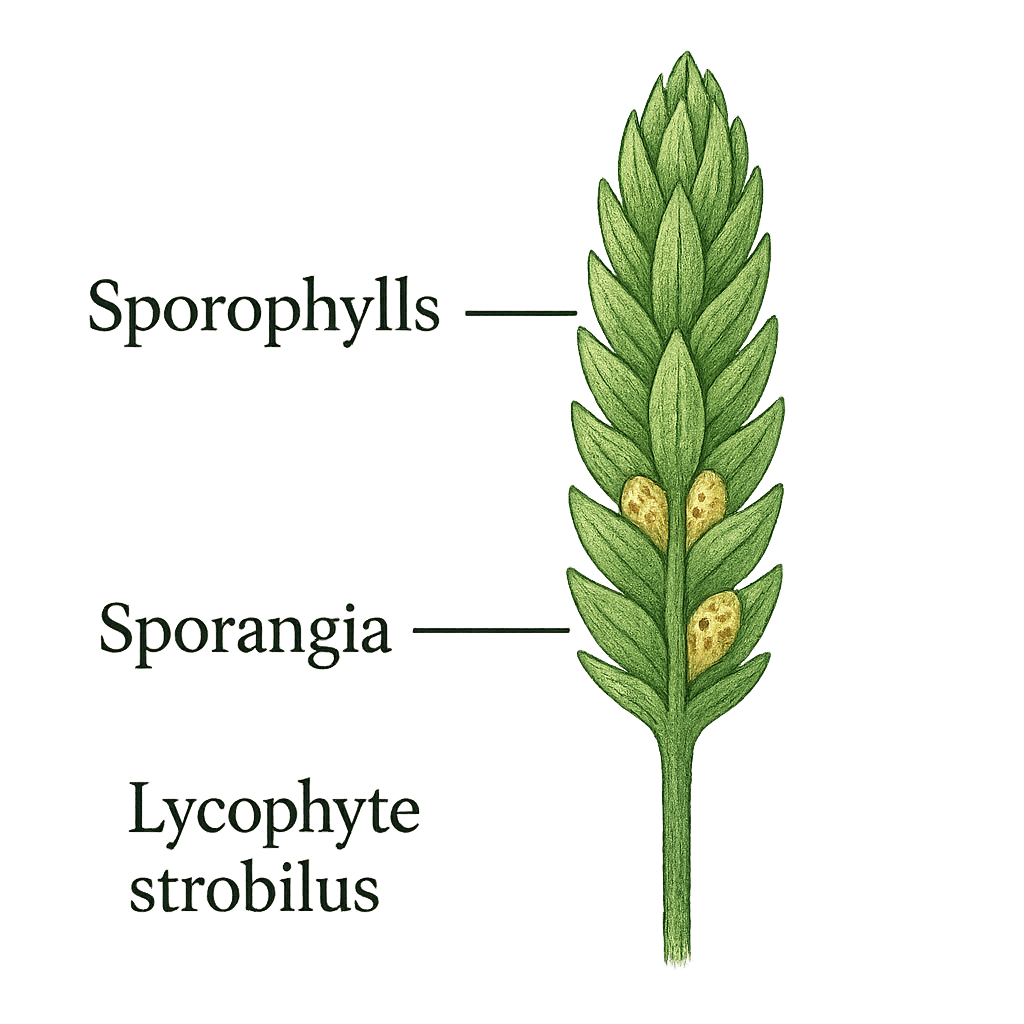
Typical lycophyte strobilus (cone) composed of sporophylls bearing sporangia.
Gametophyte Generation (Reduced Stage)
The haploid gametophyte develops from the spore and is typically small and inconspicuous, though variable.
- Homosporous Lycopods (Lycopodiaceae): Gametophytes are relatively large (mm to cm scale), variable in form (globose, branching, disc-shaped), often long-lived, and can be either surface-living and photosynthetic OR subterranean, non-photosynthetic, and dependent on mycorrhizal fungi for nutrition. Typically bisexual.
- Heterosporous Lycopods (Selaginellaceae, Isoetaceae): Gametophytes are extremely reduced and develop mostly or entirely within the confines of the spore wall (endosporic development). The female gametophyte develops within the megaspore wall, nourished by stored reserves, eventually protruding archegonia. The male gametophyte develops within the microspore wall, releasing swimming sperm.
Life Cycle
Alternation of generations with a dominant sporophyte:
- Diploid sporophyte produces haploid spores (one type in homosporous, two types in heterosporous) by meiosis in sporangia (often in strobili).
- Spores disperse.
- Spores germinate into haploid gametophytes (larger, potentially bisexual, sometimes subterranean in homosporous; highly reduced, endosporic, unisexual in heterosporous).
- Gametophytes produce sperm (multiflagellate) and eggs in antheridia and archegonia.
- Fertilization (requires water) forms a diploid zygote.
- Zygote develops into an embryo, which grows into a new diploid sporophyte, eventually becoming independent.
Chemical Characteristics
Contain various secondary metabolites, notably lycopodine alkaloids (in Lycopodiaceae), flavonoids, and triterpenoids. Lack lignin in certain cell types found in euphyllophytes. Some Selaginella species contain biflavonoids related to desiccation tolerance.
Identification Basics
Identifying lycophytes involves recognizing their unique microphylls, sporangia position, often dichotomous branching, and distinguishing the three main extant groups.
Distinguishing Lycophytes (Lycopodiophyta)
- vs. Ferns (Monilophytes): Lycophytes have microphylls (small leaves, single vein); ferns have megaphylls (larger fronds, complex venation, usually circinate vernation). Lycophyte sporangia are axillary/adaxial on sporophylls (often in strobili); fern sporangia (leptosporangia) are usually on frond underside in sori.
- vs. Mosses (Bryophytes): Lycophytes are vascular plants with dominant sporophytes, true roots, stems, microphylls, and sporangia. Mosses are non-vascular with dominant gametophytes, rhizoids (not true roots), phyllids (lacking vascular tissue), and dependent sporophytes (capsules on setae).
- vs. Seed Plant Seedlings (esp. Conifers): Seedlings may have small leaves, but they develop from seeds, have different growth patterns, and eventually produce cones (gymnosperms) or flowers/fruits (angiosperms).
Field Observation Tip
The key feature distinguishing lycophytes from ferns and seed plants is the presence of microphylls. Look closely at the leaves: are they small with just a single, unbranched vein? Also check where sporangia are borne: on the upper leaf surface or in the axil (lycophyte), or typically on the lower surface in clusters (fern)?
Identifying Major Lycophyte Groups (Field Clues)
- Lycopodiaceae (Clubmosses): Lack ligules; leaves usually uniform in size and spirally arranged (or opposite/whorled); stems often creeping with erect branches bearing distinct strobili; homosporous. Terrestrial or epiphytic.
- Selaginellaceae (Spikemosses): Possess ligules (tiny flap at leaf base - needs lens!); leaves often dimorphic (smaller dorsal, larger lateral) arranged in 4 ranks giving a flattened appearance; stems often creeping or tufted; strobili often 4-angled; heterosporous. Many terrestrial, some adapted to dry ('resurrection plant') or moist habitats.
- Isoetaceae (Quillworts): Possess ligules; leaves unique, quill-like (linear, hollow, septate) arising in a rosette from a basal, swollen, corm-like stem; large sporangia embedded in the broadened leaf bases; heterosporous. Aquatic or amphibious (growing in temporary pools or wet ground).
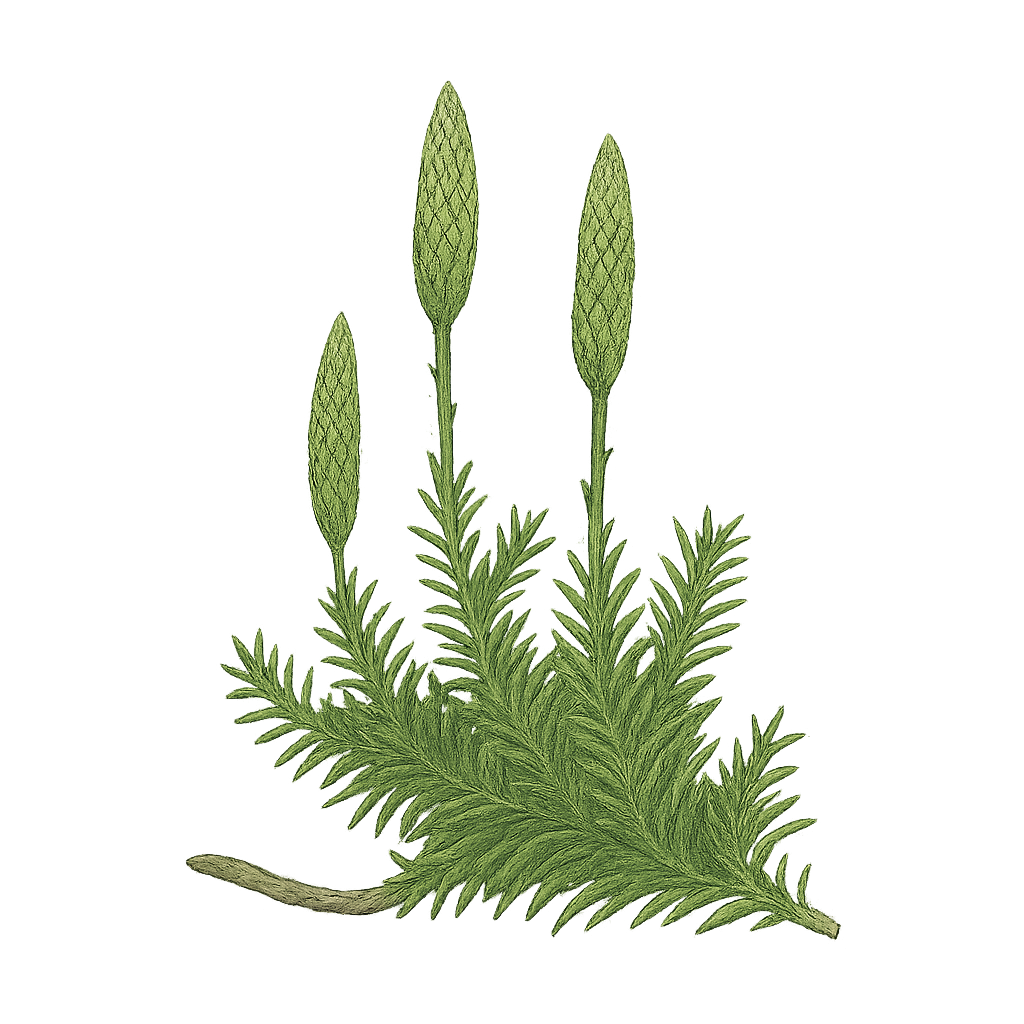
Lycopodium (Clubmoss): Uniform microphylls, often distinct strobilus, no ligule.
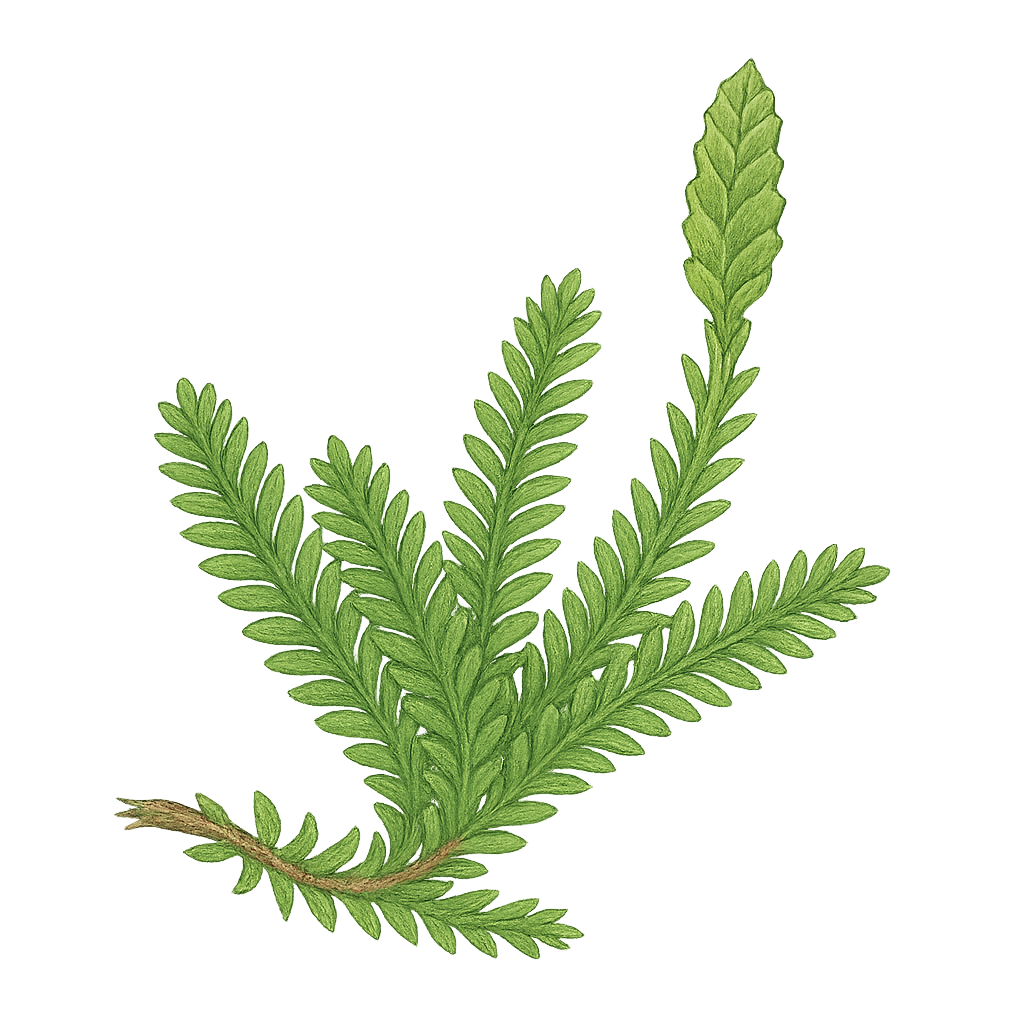
Selaginella (Spikemoss): Often dimorphic leaves in 4 ranks, ligule present.

Isoetes (Quillwort): Quill-like leaves from corm-like base, sporangia in leaf base, ligule present.
Field Guide Quick Reference (Lycophytes)
Look For:
- Vascular plant, reproducing by spores
- Leaves small, simple, with single vein (Microphylls)
- Stems often dichotomously branching
- Sporangia borne on upper surface or axil of sporophylls
- Sporophylls often clustered into strobili (cones)
Key Group Clues:
- Lycopodiaceae: No ligule, homosporous, uniform leaves (usu.)
- Selaginellaceae: Ligule present, heterosporous, often dimorphic leaves in 4 ranks
- Isoetaceae: Ligule present, heterosporous, quill-like leaves from corm, sporangia in leaf base
Major Extant Orders / Families / Genera
The living lycophytes fall into three distinct orders and families.

Lycopodiales / Lycopodiaceae
(Clubmosses - e.g., Lycopodium, Huperzia, Lycopodiella, Diphasiastrum)
The homosporous lineage. Lack ligules. Leaves typically uniform and spirally arranged (or opposite/whorled). Includes creeping forms with erect branched stems often bearing distinct strobili (Lycopodium), epiphytic forms (Huperzia), and bog/wetland forms (Lycopodiella). Spores uniform in size.

Selaginellales / Selaginellaceae
(Spikemosses - Genus Selaginella)
A large, diverse genus (~700 spp.). Characterized by being heterosporous and possessing ligules. Leaves often dimorphic (small dorsal, larger lateral) arranged in 4 ranks, giving branches a flattened appearance. Many species are tropical, but others are adapted to temperate or arid conditions, including 'resurrection plants' that curl up when dry. Strobili often quadrangular.

Isoetales / Isoetaceae
(Quillworts - Genus Isoetes)
Aquatic or amphibious plants growing from a short, fleshy, corm-like stem. Leaves are linear or quill-like, arranged in a basal rosette, hollow with internal air chambers (septate), and possess a ligule. Large megasporangia and microsporangia are embedded in cavities within the broadened base of the leaves. Heterosporous.
Phylogeny and Classification
Lycopodiophyta represents the oldest extant lineage of vascular plants (Tracheophytes), having diverged before the evolution of megaphylls (large complex leaves) that characterize the Euphyllophytes (ferns + seed plants). Their small leaves with a single vein are termed microphylls, potentially having evolved independently from megaphylls. Molecular and morphological evidence consistently places Lycophytes as the sister group to all other living vascular plants (Euphyllophytes).
Originating in the Silurian/Devonian periods, lycophytes reached their peak diversity and ecological dominance during the Carboniferous, when giant tree forms like Lepidodendron and Sigillaria (related to modern Isoetales) formed vast forests. The three extant orders (Lycopodiales, Selaginellales, Isoetales) represent distinct lineages that survived subsequent extinction events. The evolution of heterospory (producing two types of spores) occurred independently within lycophytes (Selaginella, Isoetes) and also in the lineage leading to seed plants, representing a crucial step towards the seed habit.
Position in Plant Phylogeny
- Kingdom: Plantae
- Clade: Embryophytes (Land Plants)
- Clade: Tracheophytes (Vascular Plants)
- Phylum: Lycopodiophyta (Lycophytes)
- (Sister group to Euphyllophytes [Monilophytes + Spermatophytes])
Evolutionary Significance
Lycophytes are critically important for understanding the early evolution of vascular plants. They demonstrate the earliest development of key vascular plant traits like true roots, stems, vascular tissue (protostele), and specialized leaves (microphylls). Their extensive fossil record, including dominant Carboniferous tree forms, provides vital information about past ecosystems and climates. The independent evolution of heterospory in two lycophyte lineages highlights the selective pressures favoring differentiation of spore sizes and resource allocation, a crucial precursor to the evolution of seeds. Studying modern lycophytes offers insights into the biology and genetics of this ancient and unique plant lineage.


