Icacinaceae
(No widely accepted common name)
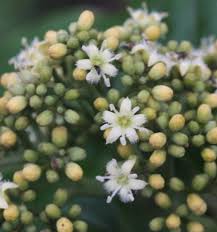
Icacinaceae is a family of dicotyledonous flowering plants comprising trees, shrubs, and lianas, primarily found in tropical and subtropical regions worldwide. Its classification has been historically complex, but it is now placed in its own order, Icacinales, representing an early-diverging lineage within the Lamiid clade of Asterids. Members often have simple, alternate leaves and small, inconspicuous flowers, typically followed by drupaceous fruits.
Overview
The Icacinaceae family includes approximately 23 genera and around 160 species of woody plants. They are predominantly distributed in the tropics and subtropics of both the Old and New Worlds. The family exhibits considerable morphological diversity, ranging from large rainforest trees to shrubs and woody climbers (lianas).
Historically, the circumscription of Icacinaceae was much broader and served as a "dumping ground" for genera with unclear affinities. Modern molecular phylogenetic studies have led to a significant reorganization, with many former members being transferred to other families and orders (e.g., Cardiopteridaceae, Stemonuraceae, Pennantiaceae). The remaining core Icacinaceae is now recognized as a distinct lineage, placed in the monotypic order Icacinales within the Lamiids.
Economically, the family is of minor importance, although some species have local uses. For example, the tuberous roots of Icacina senegalensis are consumed as a famine food in parts of West Africa, and some species yield timber or have traditional medicinal applications. The family's primary significance lies in its unique phylogenetic position, offering insights into the early evolution of the large Lamiid clade.
Quick Facts
- Scientific Name: Icacinaceae Miers
- Common Name: (None widely accepted)
- Number of Genera: Approximately 23
- Number of Species: Approximately 160
- Distribution: Pantropical and subtropical
- Evolutionary Group: Eudicots - Asterids - Lamiids - Icacinales
Key Characteristics
Growth Form and Habit
Plants are typically woody, including trees, shrubs, and lianas (woody vines). They are not herbaceous geophytes like Hypoxidaceae.
Leaves
Leaves are usually simple, alternate (sometimes opposite), petiolate, and typically entire, though sometimes toothed or lobed. They lack stipules and have pinnate venation (not parallel). Glandular dots are absent.
Inflorescence
Flowers are borne in axillary or terminal cymose inflorescences, which can be panicle-like, umbel-like, or condensed into clusters.
Flowers
Flowers are generally small, inconspicuous, actinomorphic (radially symmetrical), and can be bisexual or unisexual (plants then dioecious or monoecious). Key features include:
- Calyx: Consists of 4 or 5 small sepals, usually fused at the base (connate).
- Corolla: Consists of 4 or 5 petals, typically free (distinct), sometimes hairy on the inner surface (villous).
- Androecium: 4 or 5 stamens, alternating with the petals, usually free. Anthers typically dehisce via longitudinal slits.
- Gynoecium: Ovary is usually superior, composed of 2-5 fused carpels but typically appearing unilocular (1-celled) due to abortion of other locules. Contains 1 or 2 pendulous ovules per functional locule. A single style is usually present, sometimes short, with a small stigma.
Fruits and Seeds
The fruit is characteristically a drupe (a fleshy fruit with a single hard stone containing the seed), similar to a plum or cherry. The seed typically has abundant endosperm.
Chemical Characteristics
The family is known to produce various secondary metabolites, including alkaloids (e.g., camptothecin and related compounds have been found in some genera previously included here, though their presence in the core Icacinaceae needs confirmation), triterpenes, and saponins.
Field Identification
Identifying Icacinaceae can be challenging due to its morphological diversity and often inconspicuous flowers. Key features relate to habit, leaves, and fruit:
Primary Identification Features
- Habit: Woody plants – trees, shrubs, or lianas.
- Leaves: Usually alternate, simple, petiolate, entire or toothed, lacking stipules and glands.
- Flowers: Small, 4-5 merous, actinomorphic, often in cymes.
- Ovary Position: Ovary is superior.
- Fruit Type: Fruit is a drupe (fleshy with one stone).
Secondary Identification Features
- Flower Sex: Check if flowers are bisexual or unisexual.
- Petals: Note if petals are hairy inside.
- Ovary Locules: Ovary usually functionally 1-locular with 1-2 pendulous ovules.
- Habitat: Primarily tropical/subtropical forests.
Seasonal Identification Tips
- Flowering Season: Flowers are often small and may be missed; timing varies geographically.
- Fruiting Season: The presence of characteristic drupes is a key identification feature.
- Vegetative State: Alternate, simple, exstipulate leaves on woody plants can suggest the family, but confirmation often requires flowers or fruit.
Common Confusion Points
Icacinaceae can be confused with various other tropical woody families:
- Other Lamiid families (e.g., Boraginaceae sensu lato, Rubiaceae, Loganiaceae): Many families in the Lamiids are woody with simple leaves. Rubiaceae typically has opposite leaves and interpetiolar stipules. Boraginaceae often has different fruit types and inflorescences. Loganiaceae often has opposite leaves. Careful examination of flower structure (ovary locules, ovule number/position, stamen arrangement) and fruit type is needed.
- Anacardiaceae (Cashew family): Often have alternate compound leaves and resin ducts.
- Lauraceae (Laurel family): Often aromatic, with simple alternate leaves, but flowers are typically 3-merous with valvate anthers and a single carpel.
- Families formerly included in Icacinaceae sensu lato (e.g., Stemonuraceae, Cardiopteridaceae): These now-separate families may share some superficial similarities but differ in specific floral or anatomical details.
Field Guide Quick Reference
Look For:
- Woody trees, shrubs, lianas
- Leaves usually alternate, simple, petiolate
- Flowers small, 4-5 merous
- Superior ovary, often 1-locular
- Fruit a drupe
Key Variations:
- Habit (tree vs. shrub vs. liana)
- Leaf margin (entire vs. toothed)
- Flower sex (bisexual vs. unisexual)
- Inflorescence structure
Notable Examples
The family includes several genera distributed across the tropics.

Icacina senegalensis
(False Yam)
A shrub or subshrub native to the Sahel region of West Africa. Notable for its large underground tuber, which is used as a famine food after processing to remove toxins. Produces small whitish flowers and red drupes.

Apodytes dimidiata
White Pear / Bird's Eye
A tree found in Africa, Asia, and Australia. Known for its hard, pale timber. Features clusters of small, white, fragrant flowers followed by distinctive black drupes with a red or orange fleshy appendage (aril).

Pyrenacantha volubilis
(Monkey Chair - genus name)
A species representative of a genus of lianas or shrubs, often with tuberous bases (caudex), found in Africa and Asia. Flowers are small and unisexual; fruits are drupes.

Phytocrene bracteata
(Water Vine - genus name)
Represents a genus of lianas found in Southeast Asia. Known for stems that yield potable water when cut. Flowers are small, unisexual, borne in dense heads; fruit is a drupe.
Phylogeny and Classification
Icacinaceae holds a unique and somewhat isolated position within the angiosperm phylogeny. Based on molecular data (APG IV system), it is placed in its own order, Icacinales, within the large Lamiid clade (also known as Euasterids I). Lamiids include major orders like Lamiales, Solanales, Gentianales, and Boraginales.
Icacinales is considered one of the earliest diverging lineages within the Lamiids, meaning it branched off before the diversification of the other major Lamiid orders. This basal position makes it crucial for understanding the evolutionary history and character evolution of the entire Lamiid clade. It does not have any other families currently placed within the Icacinales order, making it phylogenetically distinct.
Position in Plant Phylogeny
- Kingdom: Plantae
- Clade: Angiosperms (Flowering plants)
- Clade: Eudicots
- Clade: Asterids
- Clade: Lamiids
- Order: Icacinales
- Family: Icacinaceae
Evolutionary Significance
Icacinaceae is evolutionarily important primarily due to its phylogenetic position:
- Basal Lamiid Lineage: Represents an early branch within the Lamiids, providing insights into the ancestral characteristics and early diversification of this major Asterid clade.
- Morphological Diversity: Despite its relatively small size, the family shows considerable variation in habit (trees, shrubs, lianas), suggesting adaptive radiation within tropical environments.
- Biogeography: Its pantropical distribution suggests an ancient origin and raises questions about historical dispersal patterns across continents.
- Taxonomic History: The complex taxonomic history of Icacinaceae highlights the challenges in classifying morphologically generalized groups and the impact of molecular data in refining our understanding of plant relationships.