
Equisetaceae
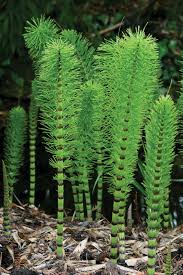
Equisetaceae, the horsetail or scouring rush family, is the sole surviving family of the ancient order Equisetales (Class Equisetopsida). It comprises only one extant genus, Equisetum, with about 15-25 species of seedless vascular plants. These distinctive perennials are characterized by their jointed, ribbed, hollow, silica-rich stems, whorls of highly reduced scale-like leaves fused into nodal sheaths, and reproduction via spores produced in terminal strobili (cones).
Overview
The Equisetaceae represents a lineage of "living fossils," the only remaining members of a group that included giant tree forms (Calamites) abundant in Carboniferous swamps over 300 million years ago. Modern Equisetum species, while herbaceous, retain the characteristic jointed and ribbed stem structure. The family is nearly cosmopolitan, absent only from Australia, New Zealand, and Antarctica, typically favoring moist habitats like stream banks, lake margins, wetlands, moist forests, and damp disturbed areas.
Their stems contain significant amounts of silica, giving them an abrasive quality historically used for 'scouring' pots and polishing wood. This silica provides structural support and likely deters herbivores. While not major economic plants, some species have had minor uses in traditional medicine or as indicators of certain soil conditions. However, they also contain thiaminase, an enzyme toxic to livestock (especially horses) if consumed in quantity, as it destroys Vitamin B1.
As seedless vascular plants, they have a life cycle involving alternation between the dominant sporophyte (the familiar plant) and a small, independent gametophyte. In Oklahoma (current location as of March 27, 2025), the evergreen Equisetum hyemale (Scouring Rush) is common along waterways, while the deciduous Equisetum arvense (Field Horsetail) is frequent in moist disturbed areas, known for its separate fertile and sterile stems.
Quick Facts
- Scientific Name: Equisetaceae Michx. ex DC.
- Common Name: Horsetail family, Scouring Rush family
- Number of Genera: 1 extant (Equisetum)
- Number of Species: Approximately 15-25
- Distribution: Cosmopolitan, except Australia, New Zealand, Antarctica. Typically moist habitats.
- Evolutionary Group: Vascular Plants (Pteridophytes / Monilophytes - Fern Allies)
- Order: Equisetales
- Class: Equisetopsida
Key Characteristics (Seedless Vascular Plant)
Sporophyte Generation (Dominant Stage)
The visible horsetail plant is the diploid sporophyte.
- Rhizomes: Possess extensive, creeping, often deep underground rhizomes with nodes and internodes, enabling perennial growth and colony formation. Roots arise from rhizome nodes. Tubers present in some species.
- Aerial Stems: Distinctly jointed (articulated) at nodes. Internodes are typically hollow (large central canal, smaller peripheral canals) and longitudinally ribbed and grooved. Stems are photosynthetic and contain silica deposits, feeling rough. Stems can be unbranched or bear whorls of branches at nodes. Some species show stem dimorphism (distinct fertile vs. sterile stems), while others bear strobili on vegetative stems.
- Leaves (Microphylls): Highly reduced to non-photosynthetic, scale-like structures. Arranged in a whorl at each node and fused basally to form a sheath around the stem base of the internode above. The free tips form small teeth, the number usually matching the number of stem ridges.
- Roots: True adventitious roots arise from rhizome and stem nodes.

Jointed Equisetum stem showing ribs, hollow center, and whorled scale leaves fused into a sheath with teeth at the node.
Reproductive Structures (Sporophyte)
- Strobilus (Cone): A distinct, terminal, cone-like structure composed of tightly packed whorls of specialized, peltate (umbrella-shaped) sporangiophores.
- Sporangia: Usually 5-10 elongated sporangia hang from the underside of each sporangiophore head. Contain spores produced by meiosis.
- Spores & Elaters: Homosporous (one type of spore produced, though gametophytes may become functionally unisexual). Spores are green, spherical, and unique in possessing four hygroscopic elaters (bands derived from the outer spore wall) that coil and uncoil with humidity changes, aiding in dispersal.

Left: Strobilus composed of sporangiophores. Right: Spore with hygroscopic elaters coiled (moist) and uncoiled (dry).
Gametophyte Generation (Reduced Stage)
The haploid gametophyte is small, free-living, and inconspicuous.
- Structure: Small (mm scale), green, thalloid (flattened, irregularly lobed, cushion-like), surface-living on moist soil. Photosynthetic.
- Anchorage: Anchored by unicellular rhizoids.
- Sex Organs: Typically bisexual initially but often becoming functionally unisexual, bearing archegonia (producing eggs) and/or antheridia (producing multiflagellate sperm).
- Fertilization: Requires external water for sperm to reach the egg.
Life Cycle
Standard alternation of generations for homosporous seedless vascular plants:
- Dominant diploid sporophyte produces haploid spores by meiosis in the strobilus.
- Spores disperse (aided by elaters).
- Spores germinate into small, independent haploid gametophytes.
- Gametophytes produce sperm and eggs.
- Fertilization (requires water) forms a diploid zygote.
- Zygote develops into a new diploid sporophyte, becoming independent.
Chemical and Structural Features
- Silica: Abundant silica deposits in epidermal cells cause roughness.
- Thiaminase: Enzyme present in many species, toxic to livestock in large amounts.
- Vascular Tissue: True xylem and phloem present in stems and rhizomes, arranged in vascular bundles.
Identification Basics
Identifying the family Equisetaceae means identifying the genus Equisetum, which is highly distinctive.
Primary Identification Features
- Jointed, Ribbed, Hollow Stems: The most unmistakable feature.
- Whorled Scale-Leaf Sheaths: Small fused leaves forming a collar at each node.
- Rough Texture: Stems feel abrasive due to silica.
- Terminal Strobilus: Presence of a cone-like structure at the stem tip (on fertile stems).
- Habitat: Typically found in moist places.
- Rhizomatous Growth: Often forming colonies or patches.
- (Genus = Equisetum)
Secondary Identification Features (for species ID)
- Stem Branching: Unbranched vs. whorled branches.
- Stem Dimorphism: Separate fertile/sterile stems vs. strobilus on green stem.
- Evergreen vs. Deciduous: Aerial stems persist over winter or die back.
- Sheath Details: Color, tightness, number/shape/persistence of teeth.
- Stem Ridges/Grooves: Number and characteristics.
- Central Canal Size: Relative diameter.
Seasonal Identification Tips
- Year-round: Distinctive jointed stems (especially evergreen species like E. hyemale) and rhizomatous habit.
- Early Spring: Look for unique non-green fertile stems of dimorphic species (E. arvense).
- Spring/Summer: Strobili mature and release spores. Green sterile stems (or vegetative stems) are fully developed.
- (Oklahoma Context: Evergreen E. hyemale identifiable year-round along streams. E. arvense fertile stems visible early spring in damp spots, followed by green sterile stems).
Common Confusion Points
- Rushes (Juncus): Stems usually round, smooth, not distinctly jointed with sheaths. Have small petaloid flowers.
- Sedges (Carex, etc.): Stems often triangular, leaves grass-like with closed sheaths. Have reduced flowers in spikelets.
- Grasses (Poaceae): Stems round with nodes/internodes but different structure, leaves grass-like with open sheaths. Have reduced flowers in spikelets.
- Casuarina (Casuarinaceae): Woody trees/shrubs with superficially similar jointed photosynthetic stems and scale leaves. Key differences: Dicot trees, different reproductive structures (woody 'cones'), not native to NA.
The jointed, ribbed stems with whorled scale-leaf sheaths are unique to Equisetaceae (Equisetum).
Field Guide Quick Reference (Equisetaceae)
Look For:
- Jointed, ribbed, hollow stems
- Whorled scale-leaves fused into sheath at nodes
- Rough texture (silica)
- Terminal strobilus (cone) present/absent
- Extensive rhizomes
- Moist habitat typical
- (Genus = Equisetum)
Key Variations (Species):
- Stem branched vs. unbranched
- Stem dimorphism (fertile vs. sterile)
- Evergreen vs. deciduous
- Sheath/teeth characteristics
- Number of stem ridges
Representative Species of Equisetum
The single genus Equisetum shows variation mainly in stem branching and dimorphism.

Equisetum arvense
Field Horsetail
Cosmopolitan weed of moist, often disturbed ground. Exhibits stem dimorphism: fleshy, non-green, unbranched fertile stems with strobili appear first in spring, followed by green, sterile stems with numerous whorls of fine branches resembling a small fir tree or a horse's tail.

Equisetum hyemale
Rough Horsetail / Scouring Rush
Widespread in the Northern Hemisphere, including Oklahoma, along streams and wetlands. Stems are evergreen, stout, typically unbranched or sparsely branched at base, very rough. Sheaths usually have dark bands and persistent or deciduous teeth. Bears a small, dark, pointed strobilus terminally on the vegetative stem.

Equisetum telmateia
Giant Horsetail
Large species found in moist areas, native to western North America and Eurasia. Dimorphic: thick, pale fertile stems appear first, followed by very tall (up to 2m+), whitish or pale green sterile stems bearing dense whorls of numerous, drooping green branches.

Equisetum palustre
Marsh Horsetail
Found in marshes and wet meadows across cooler parts of the Northern Hemisphere. Stems are green, bear terminal strobili, and have relatively few, irregular whorls of simple branches (can be unbranched). Noted for being more toxic to livestock due to higher thiaminase levels.

Equisetum fluviatile
Water Horsetail
Aquatic or semi-aquatic species of the Northern Hemisphere, growing in shallow water or swamps. Stems often relatively smooth, with a very large central canal, typically bearing sparse whorls of simple branches, but can be unbranched. Strobili terminal on vegetative stems.
Phylogeny and Classification
Equisetaceae is the sole extant family within the order Equisetales and the class Equisetopsida. This class represents one of the major lineages within the Monilophytes (ferns and fern allies), a group of vascular plants that reproduce via spores. Phylogenetic studies place Equisetopsida as the sister group to the vastly more species-rich Polypodiopsida (leptosporangiate ferns). Monilophytes, in turn, are the sister group to seed plants (Spermatophytes).
The Equisetaceae lineage is ancient, with fossils clearly recognizable from the Devonian period and tree-like relatives (Calamites and others, placed in extinct families within Equisetales) forming a major component of Carboniferous coal swamp forests. The dramatic decline in diversity leaving only the genus Equisetum makes the family a prime example of a "living fossil" group – a surviving remnant of a once much larger and more diverse evolutionary radiation. Its unique morphology represents a distinct body plan among vascular plants.
Position in Plant Phylogeny
- Kingdom: Plantae
- Clade: Embryophytes (Land Plants)
- Clade: Tracheophytes (Vascular Plants)
- Clade: Monilophytes (Ferns and Allies)
- Class: Equisetopsida
- Order: Equisetales
- Family: Equisetaceae
Evolutionary Significance
Equisetaceae (Equisetum) is exceptionally significant for understanding vascular plant evolution. It represents the sole survivor of a major lineage that experimented with a unique body plan involving jointed, photosynthetic stems, highly reduced whorled leaves (microphylls), complex stem anatomy with canals, and terminal strobili bearing sporangiophores. Its extensive fossil record, including dominant tree forms in the Paleozoic, illuminates past ecosystems and evolutionary trajectories. Studying Equisetum helps reconstruct ancestral features of vascular plants and highlights the diversity of forms present before the rise of seed plants.


