Alismataceae
Water Plantain Family
The Alismataceae, commonly known as the water plantain family, is a family of aquatic and wetland flowering plants in the order Alismatales. Primarily herbaceous perennials, they are found worldwide, especially in temperate and subtropical regions of the Northern Hemisphere. The family includes well-known genera like Alisma (water plantains) and Sagittaria (arrowheads).
Overview
Alismataceae are almost exclusively aquatic or marsh-dwelling herbs, often rooted in mud. They exhibit significant variation in leaf form (heterophylly), with submerged, floating, and emergent leaves sometimes present on the same plant, adapting them well to fluctuating water levels. The family is recognized by its characteristic trimerous flowers (parts in threes) and typically apocarpous gynoecium (separate carpels).
These plants play roles in wetland ecosystems, providing habitat and food for various organisms. Some species, particularly Sagittaria, have edible tubers that have been used as food sources by indigenous peoples. Several genera, like Echinodorus and Sagittaria, are popular choices for freshwater aquariums and water gardens due to their attractive foliage and adaptability.
While generally not considered major agricultural weeds, some species can proliferate in irrigation ditches or rice paddies. The family's distribution is cosmopolitan, but diversity is highest in the Northern Hemisphere.
Quick Facts
- Scientific Name: Alismataceae
- Common Name: Water Plantain family
- Number of Genera: Approximately 17
- Number of Species: Approximately 110
- Distribution: Cosmopolitan, predominantly temperate and subtropical Northern Hemisphere; freshwater aquatic and wetland habitats.
- Evolutionary Group: Monocots - Alismatales
Key Characteristics
Growth Form and Habit
Members are typically perennial (less commonly annual) herbs growing in aquatic or marshy environments. They are often rhizomatous or stoloniferous, anchoring in substrate. Many species possess laticifers, producing milky latex when cut.
Leaves
Leaves are usually basal, arising from the rhizome or base of the stem. They exhibit considerable plasticity (heterophylly) with submerged linear or ribbon-like forms, floating ovate to elliptic forms, and emergent linear, ovate, lanceolate, or distinctively sagittate (arrowhead-shaped) forms, often on the same individual. Leaves are petiolate with sheathing bases, and venation is typically parallel or palmate-parallel with cross-veins.
Inflorescence
Flowers are borne in scapose inflorescences (on a leafless stalk arising from the base). The inflorescence structure is typically a panicle, raceme, or umbel-like arrangement, often with flowers or branches arranged in whorls at nodes along the scape.
Flowers
Flowers are typically actinomorphic (radially symmetrical), bisexual or sometimes unisexual (plants then monoecious or dioecious). Key floral characteristics include:
- Perianth: Differentiated into calyx and corolla, typically trimerous (parts in threes).
- Sepals: 3, usually green and persistent.
- Petals: 3, usually white or pink, delicate and deciduous.
- Androecium: Stamens usually 6 or numerous (multiples of 3), distinct.
- Gynoecium: Superior ovary composed of (3-) 6 to numerous distinct (apocarpous) carpels, arranged in a ring or spiral. Each carpel contains a single ovule (rarely more).
Fruits and Seeds
The fruit is an aggregate of achenes (or sometimes follicles), with each achene developing from a single carpel. The achenes are typically flattened or ribbed and may possess a persistent style forming a beak. Each achene contains a single seed. Dispersal is often facilitated by water (achenes float) or by attachment to waterfowl.
Chemical Characteristics
Many species, particularly in Sagittaria and Echinodorus, contain milky latex in laticifers. Starch storage is common, especially in the rhizomes or tubers of some genera like Sagittaria. Compared to families like Asteraceae, complex secondary metabolites like sesquiterpene lactones are less characteristic.
Field Identification
Identifying Alismataceae members involves recognizing their aquatic habitat and specific morphological features:
Primary Identification Features
- Habitat: Look in freshwater marshes, ponds, ditches, slow streams, and lake margins.
- Habit: Herbaceous plants, often with leaves arising basally.
- Flowers: Distinctly trimerous (3 sepals, 3 petals), usually white or pinkish. Look for the superior ovary composed of multiple separate carpels (visible as a cluster of small green structures in the flower center).
- Inflorescence: Flowers typically borne on a scape (leafless stalk) in whorled arrangements.
- Fruit: Aggregate of achenes, often forming a distinctive head.
Secondary Identification Features
- Leaf Shape: Highly variable; look for characteristic arrowhead-shaped (sagittate) leaves in Sagittaria, ovate to lanceolate in Alisma, or linear submerged leaves. Heterophylly is common.
- Latex: Check for milky sap when leaves or stems are broken (present in some genera).
- Whorled Structure: Note if flowers or branches of the inflorescence are arranged in distinct whorls.
Seasonal Identification Tips
- Spring: Look for emerging basal leaves, potentially tubers from the previous year.
- Summer: Peak flowering season. Flowers are key for identification. Fruit development begins.
- Fall: Mature fruits (aggregate achenes) are present. Leaves may begin to senesce. Tubers form in some species.
- Winter: Often die back to rhizomes or tubers, though basal rosettes may persist in milder climates or underwater.
Common Confusion Points
- Araceae (Arum family): Some aquatic aroids (e.g., Peltandra) have similar habitats and sometimes leaf shapes, but possess a characteristic spathe and spadix inflorescence.
- Potamogetonaceae (Pondweed family): Fully aquatic plants, but flowers are typically small, greenish/brownish, lack distinct petals, and are arranged in spikes.
- Hydrocharitaceae (Frogbit family): Some genera have similar habitats, but often have an inferior ovary and different floral structures (e.g., Hydrocharis, Vallisneria).
- Ranunculaceae (Buttercup family): Some aquatic buttercups (Ranunculus spp.) have emergent leaves and yellow flowers, but flowers have numerous petals and stamens, and different leaf dissection.
Field Guide Quick Reference
Look For:
- Aquatic/wetland habitat
- Basal leaves (often variable shapes)
- Flowers with 3 sepals + 3 petals (usu. white/pink)
- Multiple separate carpels (superior ovary)
- Flowers/branches often whorled on scape
- Fruit an aggregate of achenes
Key Variations:
- Leaf shape (linear, ovate, sagittate)
- Presence of milky latex
- Bisexual vs. unisexual flowers
- Number of stamens (6 to many)
- Number of carpels (few to many)
Notable Examples
The Alismataceae includes several well-known aquatic plants:

Alisma plantago-aquatica
Common Water Plantain
A widespread perennial found in ditches and pond margins. Features a basal rosette of ovate to lanceolate leaves with long petioles and a large, branched panicle of numerous small, pale lilac or white flowers. Carpels are arranged in a single ring.

Sagittaria latifolia
Broadleaf Arrowhead / Wapato
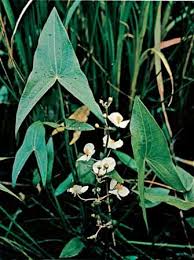
Native to the Americas, recognized by its distinctive sagittate (arrowhead-shaped) emergent leaves. Flowers are white, often unisexual (monoecious), borne in whorls. Produces edible tubers (wapato) used historically as a food source by Native Americans.

Echinodorus cordifolius
Creeping Burhead / Radican Sword
A popular aquarium plant native to Mexico, Central, and South America. Known for its broad, heart-shaped (cordate) leaves on long petioles. Can grow both submerged and emergent. Produces plantlets along the inflorescence.

Baldellia ranunculoides
Lesser Water Plantain
Found in Europe and North Africa, this smaller species prefers shallow water or damp mud. Leaves are linear to lanceolate. Flowers are pale pink, borne in simple umbels or whorls on the scape. Carpels are numerous in a globose head.
Phylogeny and Classification
Alismataceae belongs to the order Alismatales, an early-diverging lineage within the monocots. This order comprises mainly aquatic and wetland plants. Molecular phylogenetic studies place Alismataceae as closely related to families like Limnocharitaceae (sometimes merged into Alismataceae) and Hydrocharitaceae.
The family represents an important group for understanding the evolution of monocots, particularly adaptations to aquatic life and variations in floral morphology. Features like apocarpy (separate carpels) are considered relatively primitive within angiosperms.
Position in Plant Phylogeny
- Kingdom: Plantae
- Clade: Angiosperms (Flowering plants)
- Clade: Monocots
- Order: Alismatales
- Family: Alismataceae
Evolutionary Significance
The Alismataceae and the broader Alismatales order showcase key adaptations for aquatic and wetland life:
- Heterophylly: Ability to produce different leaf forms suited to submerged, floating, or emergent conditions.
- Aerenchyma Tissue: Spongy tissues allowing gas exchange in waterlogged environments.
- Hydrophily (Water Pollination): Occurs in some related families (e.g., Hydrocharitaceae), though Alismataceae are typically insect-pollinated.
- Hydrochory (Water Dispersal): Fruits/seeds adapted for dispersal by water currents.
- Basal Monocot Features: Retains some potentially ancestral traits like separate carpels.


